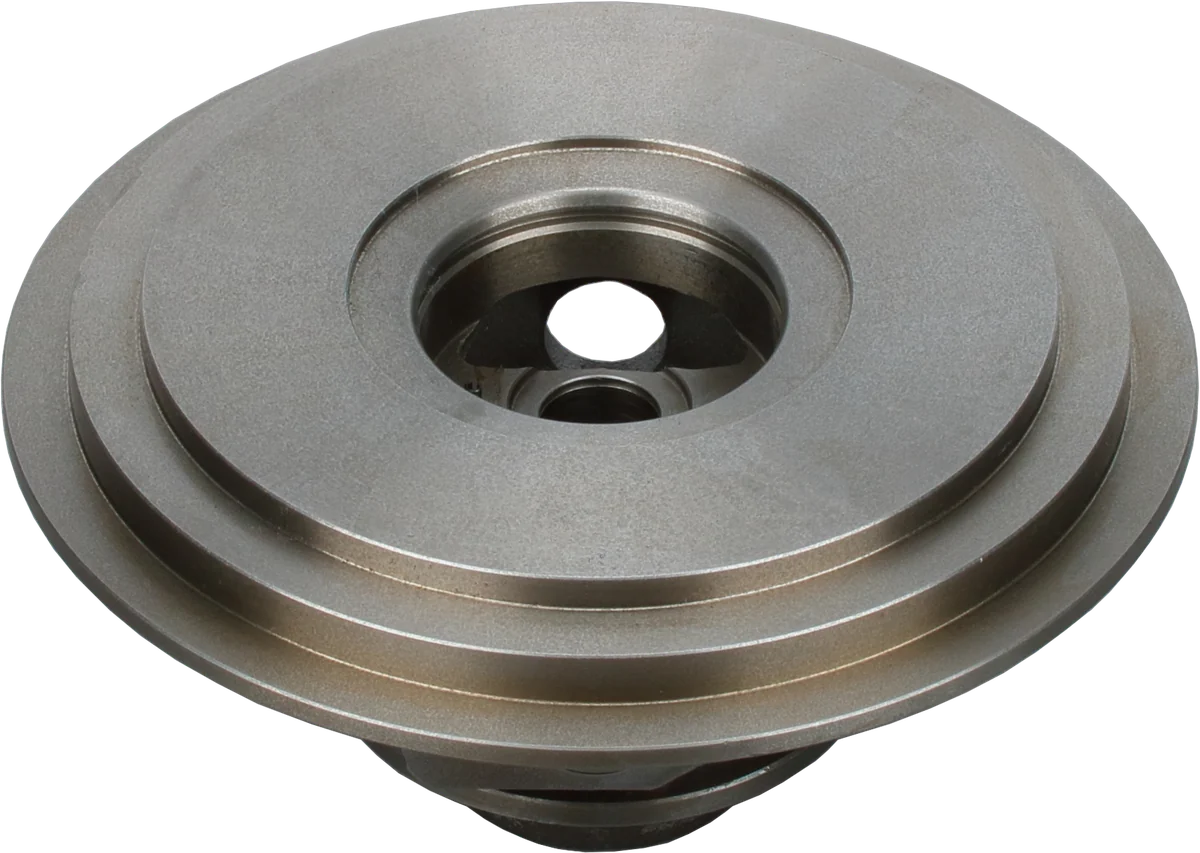
Turbo bearings — also called turbocharger bearings — keep the shared turbine and compressor shaft in position while it turns. Radial support limits sideways movement; thrust control limits end-to-end movement. Understanding both helps a mechanic distinguish a serviceable bearing repair from a job that needs a replacement center housing rotating assembly, or CHRA.
What the bearing system actually does
The bearing housing sits between the compressor and turbine housings. It locates the bearing components and contains passages that feed oil to the working surfaces and let it drain back to the engine. Its bore condition matters as much as the replaceable bearing.
In a journal-bearing turbo, shaft rotation draws oil into a narrowing gap. Pressure generated within that oil wedge supports the shaft without continuous metal contact during normal running. The engine supply replenishes the film and removes heat; a normal dashboard pressure reading does not prove oil is reaching the turbo correctly.
A turbo bearing must control a small rotor turning much faster than the engine crankshaft, next to a hot turbine. Oil condition, heat removal and vibration damping therefore matter alongside static clearance. Ball bearings carry loads through rolling contacts rather than the journal's supporting oil wedge, but they still need lubrication.
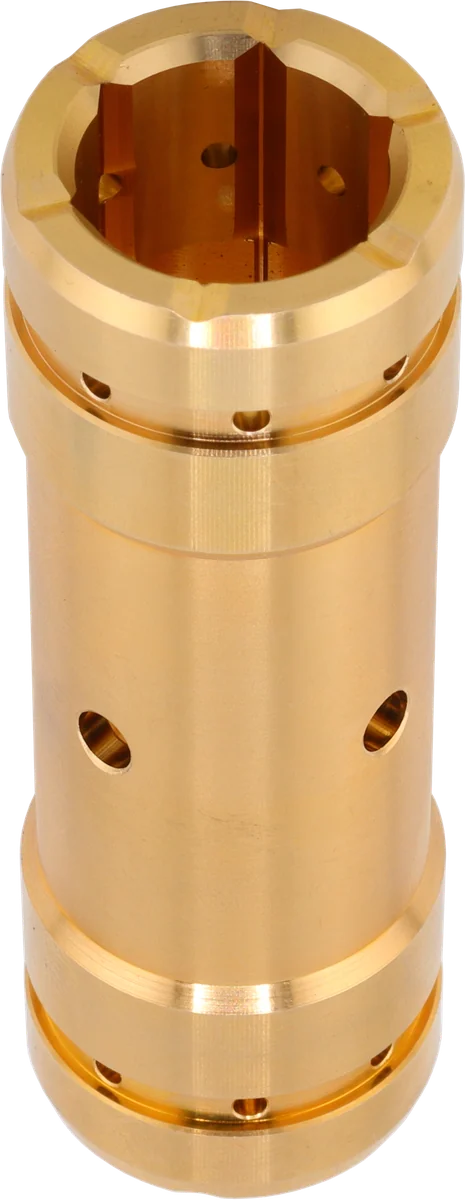
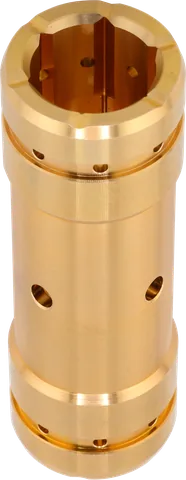
Bearing bore: the inner oil film supports the shaft.
Oil passages: keep the lubrication path clear.
Outer bearing surface: inspect the fit and condition.
Product photograph from 2026. Numbers identify the features explained below.
Turbocharger bearing types: full-floating, semi-floating and ball bearing
These names describe different support arrangements, not interchangeable grades of repair kit. A ball bearing turbo and a journal-bearing turbo need different parts, oil delivery and rebuild procedures.
| Bearing type | How it works | Typical use | Oil needs | Rebuild implications |
|---|---|---|---|---|
| Full-floating journal bearing | A ring rotates more slowly than the shaft, with oil films inside and outside it. | Widely used in diesel turbochargers. | Clean specified supply replenishes both films and removes heat. | New rings require serviceable journals and housing bores. |
| Semi-floating journal bearing | A sleeve is restrained from rotating; its inner film supports the shaft and its outer film mainly damps motion. | Compact, high-speed turbo designs. | Correct delivery to the shaft film and outer damping space. | Sleeve geometry, locating feature and housing must match. |
| Ball-bearing cartridge | Rolling contacts in a cartridge carry radial and axial loads. | Selected production and performance turbochargers. | Specified oil supply and metering; rolling contacts are not oil-free. | Cartridge or CHRA replacement may be required; confirm service support. |
The floating-ring bearing guide explains the inner and outer films. For response, compatibility and repair trade-offs, use the ball-bearing versus journal-bearing comparison.
Oil viscosity, temperature, clearance and supply together affect floating-bearing behaviour. The operating-conditions guide explains why acceptable behaviour at one operating point does not establish adequate film separation everywhere.
Why the turbo thrust bearing needs separate attention
Pressure and gas flow through the wheels create axial forces that change with operating conditions, making the thrust assembly a potential limiting component when axial demand rises. Many journal-bearing turbos use a rotating collar against oil-supported stationary thrust faces; some sleeves integrate those faces.
Turbo thrust bearing failure usually follows extra axial load, inadequate oil or damaged faces, any of which can defeat the separating film even while radial support appears serviceable; the thrust-bearing failure guide covers the causes and inspection sequence. Do not use acceptable sideways movement as proof that end play is acceptable.
Design details that affect bearing durability
A durable bearing system depends on how its surfaces, oil paths and supports work together. External appearance or a larger-looking bearing cannot establish that relationship.
Oil must reach the loaded surfaces and leave the housing
Feed holes and galleries in the bearing housing carry lubricant to the journal and thrust faces, and the drain path must let used oil leave freely, carrying heat away. A restricted drain or excessive crankcase pressure can cause oil leakage even when the bearings remain serviceable, so oil in an end housing is not proof of bearing failure.
Bearings for the same turbo family can differ in small details of their outside shape and oil holes. Those details are part of how oil reaches the shaft and drains away, which is why bearings that look similar are not automatically interchangeable. Match the part to the exact turbo rather than by diameter alone.
Bore shape and shaft finish affect the oil film
The bearing's bore and outside diameter set the working gaps that the oil films fill, and the shape of those surfaces affects how the film builds pressure and how stable the rotor runs. A semi-floating bearing's anti-rotation feature must also leave it the small radial movement it was designed to have. Any machined features on a new bearing are deliberate; do not dress or polish them during assembly.
Journal surface finish must suit the bearing alloy as well as the dimensions. Matching a new bearing to a scored or incorrectly finished shaft can still produce poor durability. Checking diameter alone misses that part of the repair assessment.
Thrust faces need usable area and an effective feed
Axial capacity depends on the area actually supporting an oil wedge, face geometry, the matching collar and oil delivery. Grooves distribute lubricant but also interrupt the working surface, so more grooves or greater circumferential coverage do not by themselves establish greater capacity.
The thrust-bearing materials and design guide explains those trade-offs. Use a validated matched assembly rather than modifying grooves or choosing parts by colour.
Ball-bearing cartridges need correct support and retention
Rolling contacts transmit forces into the cartridge and its housing supports; axial locating parts belong to that load path. Some cartridge supports use an outer oil film to absorb vibration while a locating feature prevents unwanted rotation.
Oil passages must supply the rolling contacts as designed, not merely wet the surrounding cavity. Correct balls and races cannot compensate for a damaged seat or incorrect cartridge retention. A cartridge that physically fits a bore is not necessarily a compatible replacement.
Can you replace turbo bearings?
Yes, when the design is serviceable and the reusable parts pass inspection. Turbocharger bearing replacement is a measured rebuild, not simply fitting new bushes to a shaft that turns by hand.
- Qualify the parts. Inspect journals, bearing bores, thrust collars, sealing areas and wheels against the exact turbo's service specification. Check dimensions and surface condition; new bearings cannot restore worn mating parts.
- Choose a kit rebuild when the core is sound. Confirm bearing type, oil-feed features, thrust parts and retaining hardware with the repair-kit selection guide. The turbo rebuilding guide covers the workshop sequence.
- Choose a CHRA when internal damage makes rebuilding impractical. A correctly matched assembled core replaces the bearing housing and rotating assembly. Retained compressor and turbine housings still need inspection.
- Assess the complete turbo when damage extends beyond the core. Housing damage or unserviceable control hardware can change the decision. Compare the options in CHRA versus complete turbocharger.
A rebuild that disturbs the rotating assembly needs appropriate balance verification, including assembled-core high-speed checks where specified. Alignment marks and freely turning wheels do not establish balance; the turbocharger balancing guide explains what each process verifies.
Before ordering, record the turbo identification, bearing arrangement, measured damage and the supplier's assembly and balancing scope. The words repair kit or cartridge do not establish what parts or verification are included.
Count cleaning, measurement, balancing, damaged mating parts and downtime before treating a bearing-only repair as the cheapest option. Correct the initiating fault before returning any rebuilt or replacement unit to service.
Why turbo bearings fail: common causes
Turbo bearing failure is rarely the original fault. When turbo bearings fail, the damage usually follows a lubrication, contamination, heat or balance problem elsewhere. Failure patterns overlap. Preserve the parts and photograph deposits and wear before cleaning; the most damaged component may show the consequence rather than the original cause.
| Cause | What it can do | What to check |
|---|---|---|
| Oil starvation | Loss of film replenishment and cooling can lead to scuffing or seizure. | Inspect the whole feed path and verify delivery; see oil-starvation symptoms. |
| Contamination | Particles score journal and thrust surfaces or damage rolling contacts. | Examine oil, filter and debris sources; compare the bearing-wear causes. |
| Coking and hot shutdown | Heat-degraded oil leaves deposits that can obstruct feed or drainage. | Check passages, heat history and shutdown practice using the oil-coking guide. |
| Imbalance | Repeated radial loading and excessive rotor motion stress the bearing system. | Inspect wheels and shaft, review assembly work and confirm balance verification. |
| Excessive exhaust back pressure | Changed wheel pressures can alter axial demand. | Test suspected exhaust restrictions and control faults; the thrust effect depends on geometry and operating point. |
Does turbo bearing noise prove failure?
Whining, rumbling or scraping can accompany bearing trouble, but leaks, wheel damage and other faults produce overlapping sounds. Use the ball-bearing failure-signs guide for cartridge symptoms and the shaft-play guide for measurement principles.
Some radial movement can exist in a stopped journal-bearing turbo without its operating oil films. That does not make wheel contact acceptable. Measure against the exact model's limits rather than judging by finger feel. Radial and axial checks need their own specified setup and acceptance criteria; movement measured at a wheel tip is not a direct measurement of the bearing's working oil-film clearance.
Oil-film forces can also excite rotor motion distinct from mass imbalance; oil whirl and oil whip explained covers that distinction. Stop operation for scraping, wheel contact, metal debris or loss of lubrication, and inspect with the engine stopped and turbo cool.
Oil and additives: what actually protects turbo bearings?
Correct-specification oil and a clean, reliable supply matter far more than an aftermarket additive. An additive is not a fix for a restricted feed, contaminated oil, worn surfaces or inadequate drainage.
- Match the whole engine specification. Confirm viscosity grade, performance standard and required manufacturer approval. The oil guide for turbocharged engines explains selection; thicker oil cannot restore bearing geometry.
- Maintain filtration and cleanliness. Use the specified filter, follow the applicable service schedule and investigate fuel or coolant contamination. Keep open oil connections and replacement parts clean during service.
- Pre-lubricate after bearing or turbo service. Follow the model's priming and first-start procedure. Verify feed and drain condition before installation; do not add a generic restrictor because a turbo has ball bearings.
- Manage heat through the prescribed shutdown procedure. After heavy operation, follow the vehicle manufacturer's cooldown guidance and maintain any required water-cooling circuit. There is no universal idle time for every turbo and duty cycle.
Sourcing turbo bearing parts
Once the inspection shows what failed, match the replacement to the exact turbo part number. LeadTurbo supplies repair kits, individual journal bearings and thrust bearings for rebuilds, and replacement CHRAs/cores when the bearing housing or shaft cannot be reused. Send us the turbo part number or engine model if you need help confirming the right part.
Common Questions
Can you replace turbo bearings?
Yes. Turbocharger bearing replacement is possible in a serviceable design with the correct parts and rebuilding specifications. The shaft, housing and thrust components must pass inspection, and the rebuilt assembly needs the specified balancing checks. Damaged mating parts can make a replacement CHRA more practical.
What does turbo bearing noise sound like?
Bearing trouble may produce whining, rumbling or scraping, but those sounds also have other causes. Check leaks, wheel condition, oil delivery and measured shaft movement. Stop operation if there is scraping, wheel contact, metal debris or loss of lubrication.
What is a semi-floating bearing turbo?
It uses a journal-bearing sleeve restrained from rotating while retaining its intended small radial movement. An inner oil film supports the shaft, and the outer oil film mainly damps vibration. It is a designed arrangement, not a description of bearing wear.
What does the turbo thrust bearing do?
It controls movement along the shaft's axis. In many journal-bearing turbos, oil separates a rotating collar from stationary thrust faces. Ball-bearing cartridges can carry axial loads through their rolling contacts instead, so their service procedures differ.
Do ball bearing turbos still need engine oil?
Yes. Rolling contacts need lubrication, and some cartridge supports also use oil for vibration damping. Follow the exact turbo's oil delivery and metering requirements; fitting a generic restrictor can cause inadequate supply.
What additives protect turbo bearings?
Start with oil meeting the engine manufacturer's viscosity and performance requirements, clean filtration and correct delivery. These matter far more than an aftermarket additive. An additive cannot fix a restricted feed, contaminated oil, worn bearing surfaces or inadequate drainage.