A new whistle under boost deserves attention, especially when it arrives with oil consumption or reduced performance. However, ordering a cartridge based on the whistle alone can miss a leaking charge pipe, damaged wheel, or oil-drain problem.
Diagnosing diesel ball bearing turbocharger failure combines physical inspection, lubrication checks, and—when needed—vibration analysis. Bearing frequencies help explain what technicians measure, but they are not a universal list of sounds that owners can match by ear.
How Turbocharger Ball Bearing Cartridges Work
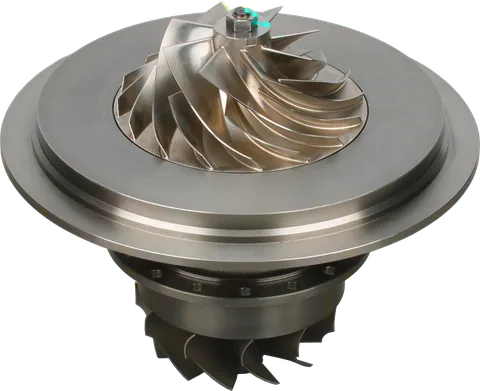
A typical ball-bearing turbocharger cartridge uses two angular-contact bearing rows to support the rotating shaft and handle radial and axial loads. The inner races turn with the shaft. Balls roll between the inner and outer races, while a cage keeps the balls spaced. Exact arrangements vary by turbo design.
Rolling contacts provide little damping by themselves. Many turbo cartridges therefore sit inside an oil-fed support with a small clearance between the cartridge sleeve and bearing housing. The sleeve is restrained against rotation but can move slightly sideways.
As the rotor moves, it squeezes the oil surrounding that support. Oil displacement dissipates vibration energy: this is the squeeze-film damper. It helps control shaft motion without requiring the bearing sleeve to spin.
The damper oil film and the lubricating films at the ball-to-race contacts serve different purposes. Both depend on appropriate oil delivery. A turbo can develop problems from damaged rolling contacts, inadequate damping, or both.
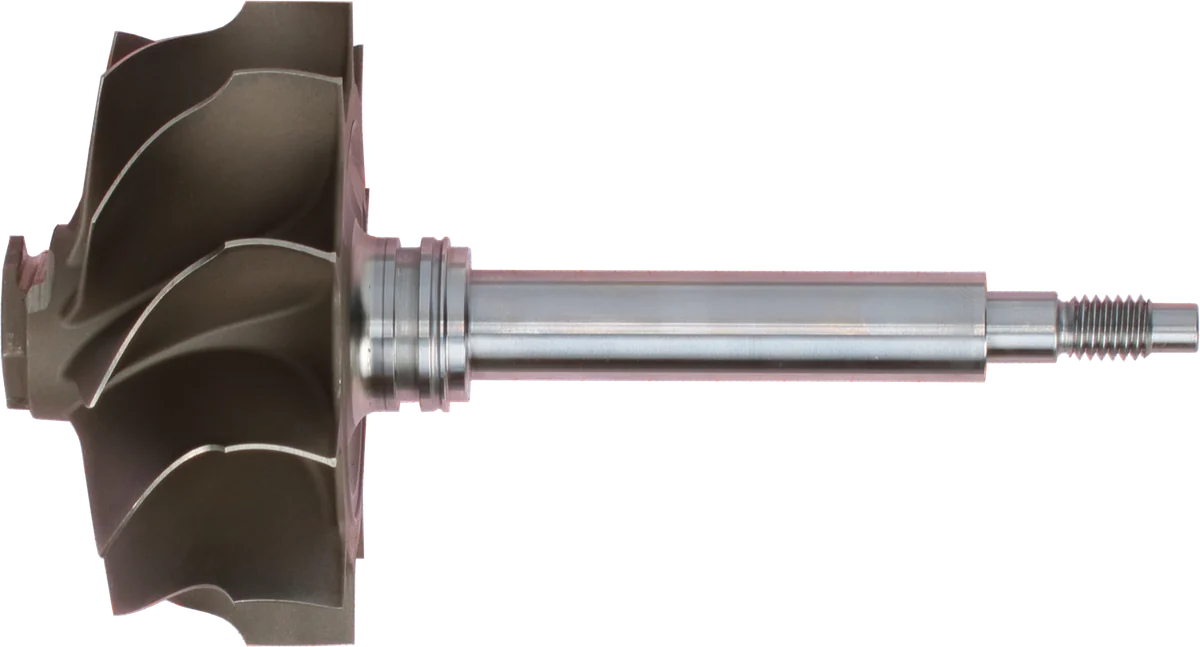
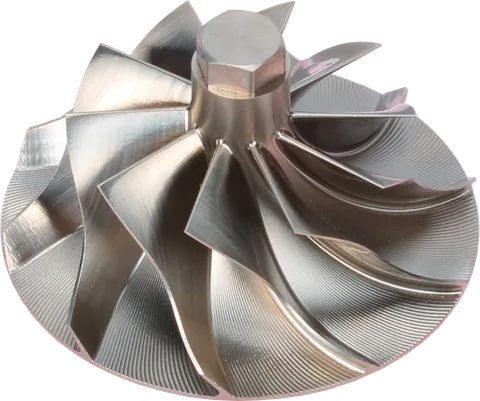
Turbine wheel: exhaust energy drives the shaft.
Shaft surface: inspect wear and scoring before reuse.
Shaft end: connects to the compressor-side rotating parts.
Product photograph from 2026. Numbers identify the features explained below.
What Bearing Defect Frequencies Actually Mean
Imagine a small pit in a bearing race. Each ball crossing that pit produces a disturbance. Repeated crossings create a pattern whose repetition rate depends on shaft speed and bearing geometry.
Relevant geometry includes the number of balls, their diameter, their circular path through the bearing, and the contact angle. Consequently, there is no single bearing defect frequency that identifies every ball bearing turbo failure.
Analysts often describe frequency relative to shaft rotation. “1×” means once per turbo shaft revolution. Turbo shaft speed is not engine RPM, and it changes with exhaust energy and operating conditions.
For the usual arrangement with a rotating inner race and stationary outer race:
| Damaged component | What creates the repeating pattern | Typical frequency relationship | Diagnostic limitation |
|---|---|---|---|
| Outer race | Successive balls cross a damaged area on the stationary race | Ball-pass outer-race frequency, or BPFO; commonly several events per shaft revolution | Signal strength depends on the defect's position relative to the loaded region |
| Inner race | The rotating race defect repeatedly meets the balls | Ball-pass inner-race frequency, or BPFI; higher than BPFO for the same bearing | Signal strength can vary as the defect moves through the loaded region |
| Ball | A damaged spot repeatedly encounters the races as the ball spins | Related to ball-spin frequency, or BSF; twice that frequency may be prominent | Ball slip and changing contact conditions can blur the pattern |
| Cage | Cage damage or disturbed ball spacing repeats as the cage orbits | Fundamental train frequency, or FTF; generally below half shaft rotational frequency | A low-frequency peak alone does not prove cage damage |
These are repetition rates, not necessarily the pitch someone hears. Small impacts can excite a much higher-frequency resonance in the bearing or housing. The resulting noise may sound like a hiss or whine even though the impacts repeat more slowly.
Vibration specialists may use envelope analysis to reveal those repetitions within a high-frequency signal. Harmonics and nearby peaks called sidebands can provide supporting evidence. Actual patterns shift with slip, load, and speed, so diagnosis requires more than matching one peak to a theoretical value.
How Damage Develops Inside the Cartridge
Failure may begin with contamination, inadequate lubrication, fatigue, or abnormal loading. It does not always follow one predictable sequence.
A hard particle can indent a raceway. Repeated ball contact then concentrates stress around the damaged area. Surface fatigue may eventually release small flakes, known as spalling. Those fragments circulate through the bearing and create additional damage.
Cage pockets can wear as balls rub against them. Increasing pocket clearance allows less controlled ball movement, while severe cage damage can interfere with rotation.
Lubrication loss reduces separation between contacting surfaces and increases frictional heating. Overheating can degrade the lubricant, encourage deposits, and affect bearing materials or internal fit. A worsening bearing may allow enough rotor movement for a wheel to contact its housing.
Ceramic ball bearing wear needs careful interpretation. In a hybrid bearing, the balls are ceramic but the races are steel. Race damage or cage wear can therefore cause turbo cartridge failure even when the balls look intact. Ceramic balls can also chip or suffer surface damage under unfavorable conditions.
Ball Bearing Turbocharger Failure Symptoms
Changes from the turbocharger's established behavior matter more than a particular sound description. Possible warning signs include:
- A new whine, chirp, gritty hiss, or rumble that varies with load.
- Scraping or catching during gentle hand rotation with the engine stopped.
- Radial or axial movement outside the manufacturer's specified limits.
- Compressor or turbine wheel contact marks.
- Slower boost response accompanied by other evidence of mechanical trouble.
- New oil leakage or smoke that requires investigation of the complete oil and ventilation system.
Early bearing damage may produce measurable vibration before noticeable shaft play develops. Conversely, a little movement felt by hand does not automatically prove bearing damage, particularly where the cartridge has a damped mounting.
An unbalanced rotor commonly produces vibration at shaft rotational frequency. Blade-passing noise follows the number of blades passing a fixed location. Air leaks and housing resonances introduce still more possibilities.
A tone that changes pitch—or remains nearly constant—cannot establish which mechanism is responsible. Resonances can emphasize certain frequencies while the underlying excitation changes.
How to Diagnose Ball Bearing Turbocharger Failure
Start with conditions that can be checked without further loading a potentially damaged turbocharger. If there is scraping, confirmed wheel contact, or sudden heavy smoke with oil loss, stop running the engine and investigate.
-
Record when the noise occurs. Note cold versus hot operation, boost versus overrun, and whether it followed an oil change, turbo installation, or intake modification. Avoid repeated acceleration runs simply to reproduce it.
-
Inspect surrounding systems. With the engine off and cool, check intake connections, charge pipes, clamps, and accessible exhaust joints. Look for loose hardware, leaks, and foreign-object damage.
-
Check the oil path. Verify oil condition and level, the correct feed arrangement, and an unobstructed return. A restricted drain or excessive crankcase pressure can cause leakage without proving the bearings have failed.
-
Inspect the accessible wheel. Follow the service procedure when removing an inlet connection. Look for damaged blades and housing witness marks. Turn the shaft gently; do not spin it with compressed air.
-
Measure movement correctly. Use the specified measuring location, equipment, and loading method. Internet clearance figures from another turbo are not a substitute for the cartridge's limits.
-
Escalate uncertain cases. A turbo specialist can assess internal condition and, where appropriate, obtain vibration measurements with a suitable sensor and shaft-speed reference.
Keep fingers, tools, clothing, and recording devices away from exposed rotating components. A phone recording may document a change, but automatic audio processing and limited frequency response make it unsuitable for confirming a particular race defect.
Common Causes: Oil Problems and Excessive Loading
Contamination can arrive through dirty oil, debris left in a replacement feed line, or careless assembly. A replacement cartridge remains vulnerable if the source of contamination is still present.
Oil starvation can result from a blocked feed, an unsuitable restrictor, inadequate supply pressure, or failure to prime the assembly according to installation instructions. Hot oil that has degraded beyond its service requirements also provides less reliable protection.
Overspeed, foreign-object damage, and rotor imbalance increase bearing demands. Operating outside the turbo's intended range can overload an otherwise serviceable cartridge.
Oil-feed oversupply is a separate concern. Excess flow can overwhelm the available drainage capacity and contribute to oil leakage. Installing a smaller restrictor to hide smoke may then create starvation. Check the specified supply conditions, return routing, and crankcase ventilation before changing the feed arrangement.
Why Cartridges Are Usually Replaced
When considering ball bearing turbocharger repair vs replacement, remember that cartridges are precision assemblies. Replacing a visibly damaged bearing does not establish that the races, cage, shaft interfaces, or remaining components are serviceable.
A successful rebuild must restore correct bearing fit and preload, maintain cleanliness, and meet the applicable rotor balancing requirements. Depending on the design, internal parts or approved rebuild procedures may not be available separately.
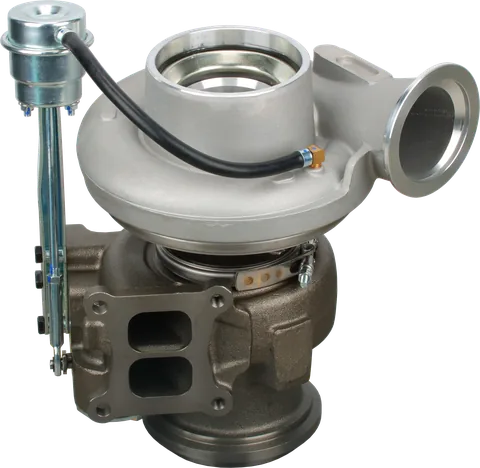
For these reasons, replacement of the bearing cartridge or complete CHRA is often the practical repair. The terms are not interchangeable: a CHRA generally includes the center housing and rotating assembly, while a bearing cartridge can be a smaller internal unit.
Confirm exactly what the replacement includes. Damaged wheels or housings may require a more complete assembly, and every repair should address the original failure cause.
Preventing Repeat Ball Bearing Turbo Failure
Use the oil grade and service interval specified for the vehicle and application. Maintain the filtration system, keep installation openings clean, and investigate contamination rather than assuming fresh oil will remove the problem.
Follow the turbo supplier's instructions for priming, feed-line condition, drainage, and coolant connections where fitted. Use an oil restrictor only when specified, including the specified size or approved arrangement. Account for any restriction already built into the turbo.
Verify the oil supply under the stated test conditions. More flow is not automatically better. Correct supply, unrestricted drainage, and sound crankcase ventilation work together to protect the replacement cartridge.
Common Questions
What does a failing ball bearing turbo sound like?
Possible sounds include a new whine, gritty hiss, chirp, or scraping noise that changes with operating conditions. None uniquely identifies bearing damage. Air leaks, wheel contact, and other rotating components can sound similar.
Can a noise frequency identify which bearing part failed?
It can support a diagnosis when the turbo shaft speed and bearing geometry are known. Analysts compare repeating vibration patterns with predicted race, ball, and cage frequencies. A phone recording without those inputs cannot reliably identify the damaged part.
Should a ball bearing turbo have any shaft play?
Allowable movement depends on the cartridge and its mounting. Some measured radial movement can involve the damped support rather than internal bearing looseness. Follow the manufacturer's measurement method and limits; wheel contact, catching, or scraping requires investigation.
Can ceramic ball bearings wear out?
Yes. Ceramic balls can suffer surface damage or fracture, and hybrid bearings still contain steel races and a cage that can deteriorate. Ceramic construction does not eliminate the need for clean oil, correct lubrication, and controlled operating temperatures.
Does every ball bearing turbo need an oil restrictor?
No. Requirements depend on the turbo design, any built-in restriction, and the engine's oil supply. Use the specified arrangement and verify pressure where instructed. An arbitrary restrictor can starve the bearing; removing a required one can allow excessive flow.
Can I replace only the bearings inside the cartridge?
Usually this is not a practical DIY repair. Bearing fit, preload, cleanliness, and rotor balance require controlled procedures and equipment. Depending on the design and available service parts, a specialist may rebuild it, but cartridge or CHRA replacement is often the appropriate route.
Should I replace my turbocharger cartridge?
Replacement is often practical for a damaged cartridge, but inspect the turbo and oil system first. Check the wheels, housings, oil feed, and oil return, and confirm what the replacement includes. Damaged wheels or housings may require a more complete assembly. Address the original failure cause to help protect the replacement.
For help with ball bearing turbo failure, contact LeadTurbo with your turbo part number, vehicle details, and symptoms to identify an appropriate replacement option.