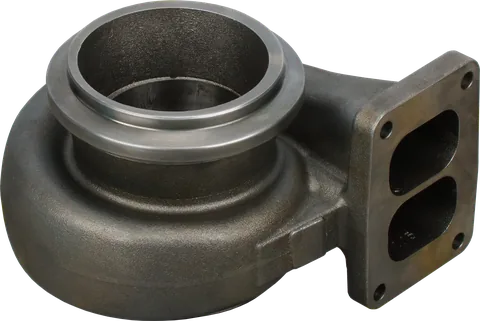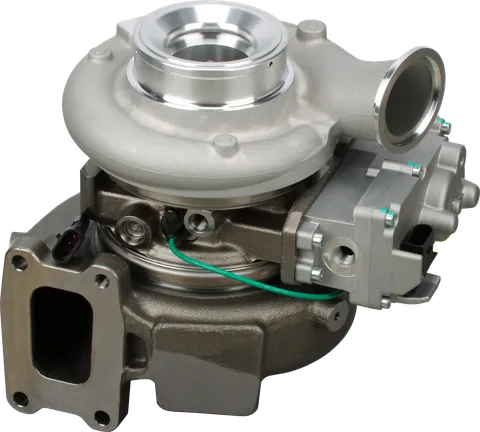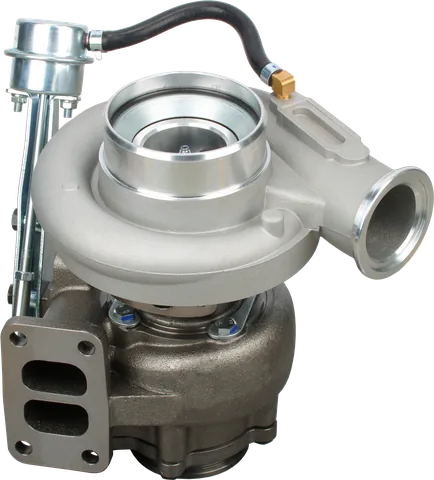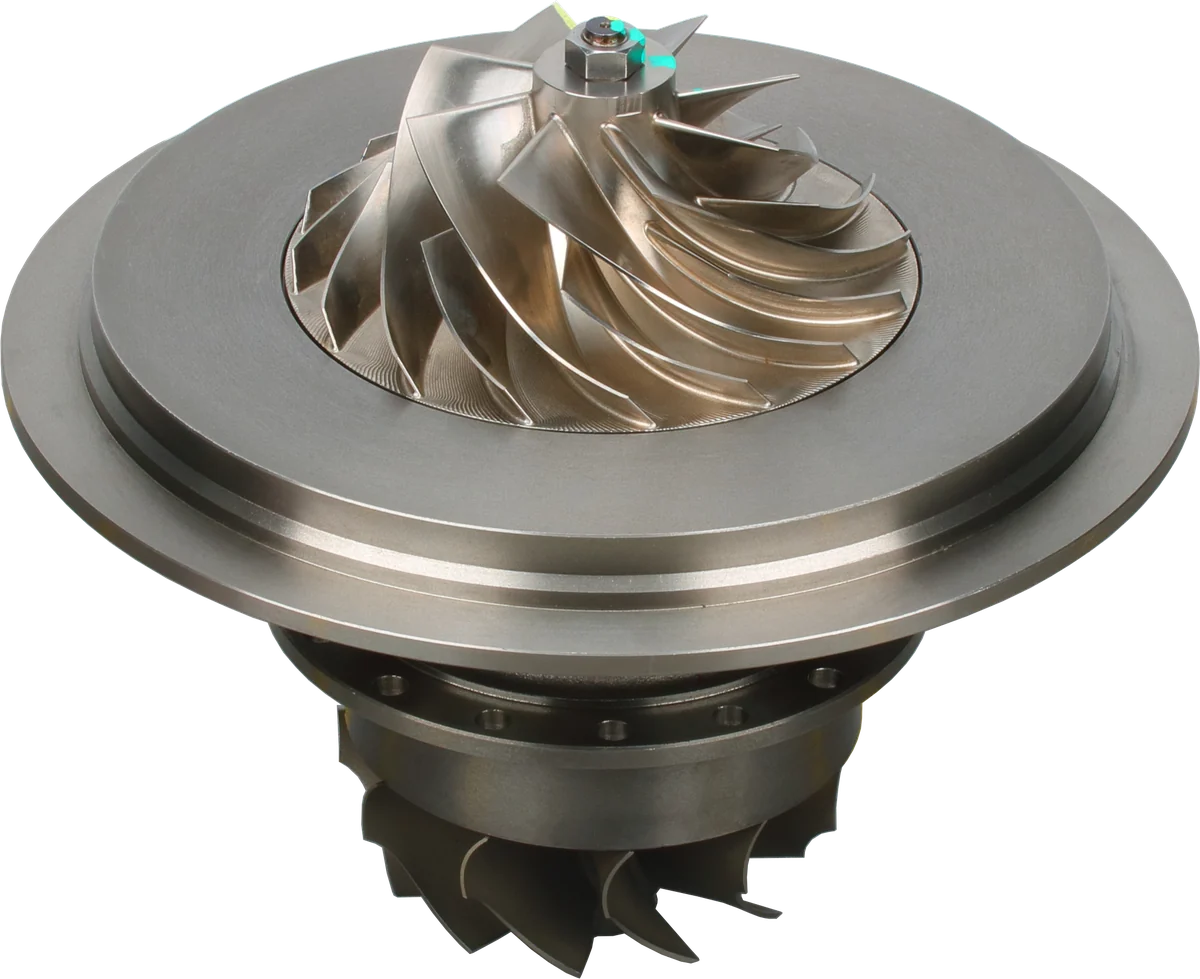
A cheap rebuild and a properly prepared replacement core can look nearly identical on a workbench. Both may have clean housings, fresh bearings, and a wheel that turns freely. The important difference can be something you cannot see: how the rotating parts behave together at speed.
For a buyer, “balanced” needs an explanation. For a mechanic, replacing worn parts is only part of rebuilding the assembly. Understanding component balancing, low-speed balancing, and high-speed core testing helps you judge what work has actually been done.
Why a tiny imbalance creates a large problem
A turbocharger rotor needs its mass distributed closely around its intended rotation axis. Small manufacturing differences, wear, deposits, or wheel damage can leave more mass acting on one side than another.
As the rotor turns, that uneven distribution produces a rotating force. For the same amount of imbalance, the force grows with the square of shaft speed. Doubling speed produces four times the imbalance force; tripling it produces nine times the force.
That does not mean measured vibration always increases by exactly those ratios. Bearings, oil films, shaft flexibility, and resonance all affect the response. It explains why a rotor that seems harmless when turned by hand can load its bearings heavily during operation.
Excessive movement can disturb the supporting oil films, accelerate bearing wear, and eventually allow wheel contact with a housing. Balancing reduces the excitation that starts this chain. It cannot restore a bent shaft, repair damaged blades, or compensate for unsuitable bearing clearances.
What does turbo balancing actually mean?
Component balancing checks individual rotating parts, such as the compressor wheel and turbine wheel-and-shaft assembly. Assembly balancing evaluates parts after they have been fitted together.
When comparing component vs assembly turbocharger balancing, remember that separately balanced parts still have some residual imbalance. Their relative positions can make those remaining effects reinforce or partially offset each other. Small differences in how mating surfaces seat can also change the completed rotor.
| Process | What it evaluates | Why it matters | What it does not establish |
|---|---|---|---|
| Component balancing | Individual wheels or the turbine shaft assembly | Reduces initial imbalance before assembly | How the finished core behaves |
| Low-speed two-plane balancing | A component or rotor behaving approximately as a rigid body | Corrects both sideways forcing and rocking effects | The complete high-speed vibration response |
| High-speed core or VSR balancing | The assembled CHRA running in its bearing system | Checks high-speed response and guides further correction | Overall turbo condition or correct installation |
These categories overlap: component balancing is commonly performed at low speed. A statement such as “all wheels balanced” therefore does not necessarily mean the assembled core received a high-speed check.
A CHRA is the center housing rotating assembly: the bearing housing and associated rotating and bearing components. For buying decisions, CHRA vs. complete turbocharger explains the scope of each replacement.
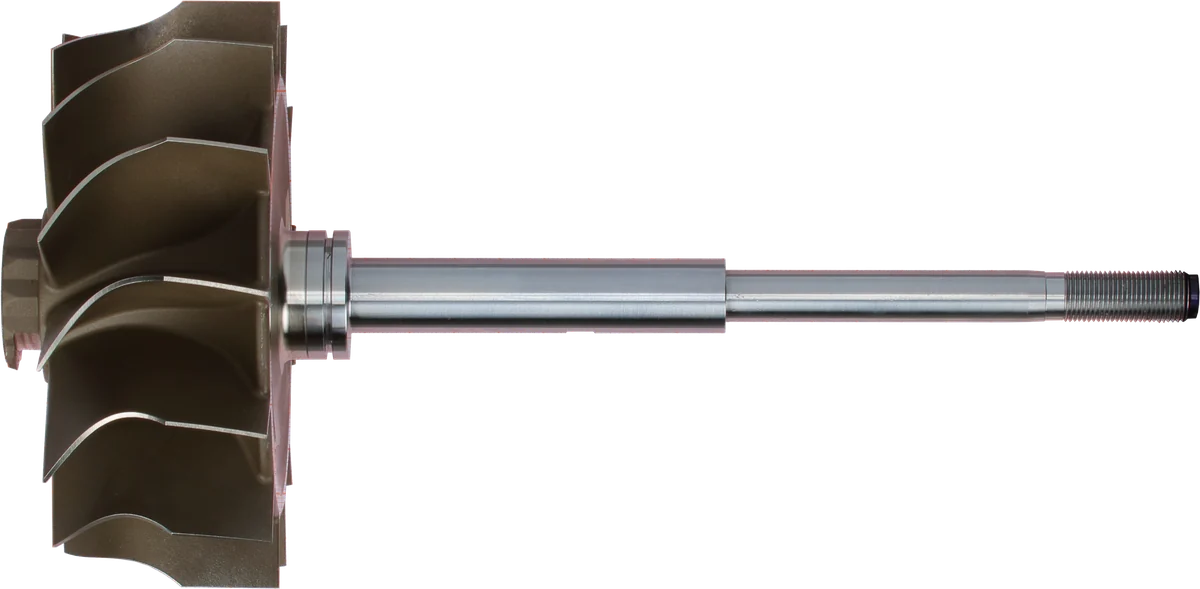
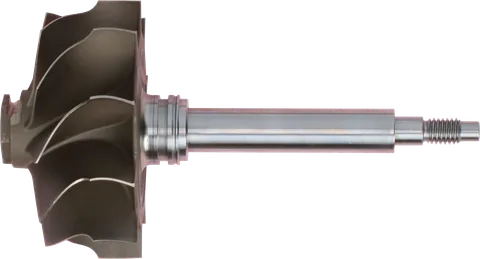
Turbine wheel: exhaust energy drives the shaft.
Shaft surface: inspect wear and scoring before reuse.
Shaft end: connects to the compressor-side rotating parts.
Product photograph from 2026. Numbers identify the features explained below.
How is a turbocharger balanced at low speed?
During low-speed turbocharger balancing, the part or rotor is tested where shaft bending has little influence on the measurement. It can be treated approximately as a rigid body.
Two-plane balancing addresses two different effects. One is an overall heavy-side effect that tends to move the rotor sideways. The other is a rocking effect caused by uneven mass distribution along its length. A rotor can have little obvious heavy-side tendency and still develop a significant rocking effect while spinning.
The balancing machine measures the response and identifies corrections at two separated locations along the rotating part. A technician makes controlled corrections in permitted areas, then repeats the measurement.
This is why attempts at turbo balancing without a machine, such as letting a wheel settle on a shaft, spinning it by hand, or checking whether it “feels smooth,” cannot establish dynamic balance.
Low-speed balancing provides the foundation for a sound rotating assembly. However, it does not fully reproduce how a flexible shaft and its bearing supports respond at high operating speeds. Finishing this stage does not automatically verify the completed CHRA.
Why high-speed core balancing matters
At high speed, a turbocharger shaft can behave as a flexible rotor. Its bending response becomes important, and vibration may rise around particular speed ranges. The bearing system and its oil films also influence how the rotor moves.
High-speed turbo core balancing evaluates the assembled unit under conditions that reveal behavior a low-speed component check may miss.
VSR commonly means vibration sorting rig. In a typical VSR balancing process, the CHRA receives a controlled oil supply while compressed air drives the turbine through a specified speed range. The equipment measures vibration, and the technician makes permitted balance corrections where needed before testing again.
The purpose is to check the actual assembly, including the effects of:
- Residual imbalance remaining in individual components.
- The relative angular positions of the assembled parts.
- Small seating and alignment differences within the rotating stack.
- The rotor’s high-speed response in its bearing system.
VSR balancing complements component balancing. It should not be used to disguise damaged parts or incorrect assembly.
Test procedures and acceptance limits depend on the turbo design and equipment. There is no single advertised test speed or vibration number that proves every core is acceptable. A useful high-speed balance result should be linked to the supplied unit and interpreted against an appropriate test procedure.
Possible signs of an unbalanced turbocharger
Poor balance can produce a whistle or whine that changes as turbo speed changes. Its basic forcing repeats once per shaft revolution, although what you hear also depends on how the turbo and surrounding structures transmit sound.
Other possible consequences include premature bearing wear, wheel-to-housing contact, and oil leakage associated with excessive rotor movement or damaged sealing areas.
None of these symptoms proves imbalance on its own. A practical inspection should consider:
- New noise after rebuilding: Check intake and exhaust connections as well as the turbo.
- Scraping or wheel contact: Inspect for damage and investigate bearing condition before further operation.
- Early bearing deterioration: Review oil supply, contamination, clearances, and balance history.
- Oil leakage or smoke: Check drainage and crankcase pressure alongside the turbo’s internal condition.
- Repeated failures: Identify the original cause before installing another core.
A turbo’s sealing system depends on operating conditions and clearances; an oil leak is not automatically a defective “oil seal.” See turbocharger oil leak causes for a broader diagnostic approach.
Oil-film instability is also different from mass imbalance. Oil whirl can create vibration below shaft rotational frequency, and oil whip can become tied to a rotor vibration mode. Better balancing alone may not resolve these mechanisms. A noise diagnosis should distinguish them rather than treating every tone as evidence of a heavy wheel.
Why you should leave a balanced CHRA assembled
Once a CHRA has been balanced as an assembly, its rotating parts form a verified combination.
Removing the compressor wheel, loosening the shaft nut, or rotating the wheel relative to the shaft can change that combination. Re-indexing means changing the angular relationship between parts. Even reinstalling the same pieces can introduce small seating differences.
Paint marks are useful assembly references, but matching them does not prove that the previous balance condition has been restored. Changing a wheel, shaft, or rotating spacer gives even more reason to repeat the appropriate checks.
Keep these boundaries clear during installation:
- Leave the balanced rotating stack intact.
- Follow the supplier’s instructions for any permitted housing adjustment.
- Keep debris out of oil passages and wheel areas.
- Return a disturbed rotating assembly for professional assessment.
Changing the orientation of an external housing, where the design permits it, is different from re-indexing the rotating parts. Either operation still requires the correct procedure.
What to ask a rebuild or CHRA supplier
Price alone cannot establish quality. A lower-priced core may have a documented process, while an expensive listing may provide little evidence. Ask concrete questions before ordering:
- What was balanced? Individual components, the assembled rotor, or the completed CHRA?
- Was this assembled core tested at high speed? Ask whether VSR testing is part of the process for this model.
- Can the result be traced to this unit? Look for a matching serial number or another clear identifier.
- What acceptance procedure applies? Ask how the supplier determines a pass for this turbo design.
- What was inspected before balancing? Shaft condition, wheel damage, bearing fits, and clearances still matter.
- What happens if the assembly is disturbed or arrives damaged? Obtain installation and return instructions.
A graph without identification, units, or acceptance criteria provides limited reassurance. Equally, not every supplier includes a printed report in the box; ask what records or process documentation are available.
“Pre-balanced wheels” and “VSR-balanced CHRA” describe different levels of work. If the answer remains vague, include professional inspection and turbo balancing in your cost comparison.
Choosing a repair kit or assembled core
A repair kit replaces specified service parts. It does not include proof that your reused wheels and shaft remain suitable, or that the rebuilt assembly is balanced.
A kit can make sense when the hard parts pass inspection and the rebuilder has access to the required equipment. Read how to choose a turbocharger repair kit before assuming fresh bearings will solve the problem.
An assembled, appropriately balanced core can simplify the job when the surrounding housings and control hardware remain serviceable. Confirm the exact part number and application before choosing a replacement CHRA/core.
Either route still requires correcting the original failure cause. Follow the checks in what to inspect before installing a replacement turbocharger, especially lubrication, contamination, and oil drainage.
Common Questions
Does a rebuilt diesel turbocharger need balancing?
A rebuild that disturbs the rotating assembly needs balance verification using the appropriate process for that turbo. Reusing the original wheels or installing new bearings does not establish that the assembled rotor remains within acceptable limits.
Is component balancing enough for a replacement CHRA?
Component balancing is an important starting point, but it does not verify the completed CHRA. Ask how the supplier checks assembly balance and whether high-speed testing is included for that turbo design.
Can I rebuild a turbo at home without balancing equipment?
You can perform suitable inspection and installation work, but you cannot verify rotor balance by hand. If you rebuild the rotating assembly, arrange professional balancing. An assembled, appropriately balanced CHRA may be a more practical option.
Does turbo whistle always mean poor balance?
No. Normal airflow, intake leaks, exhaust leaks, wheel damage, and bearing problems can also produce noise. A new whistle after a rebuild deserves investigation, but sound alone cannot confirm imbalance.
Can turbo balancing fix a turbo oil leak?
Only if imbalance and its resulting movement or wear contribute to the leak, and any damaged parts are also repaired. Restricted drainage, crankcase pressure, lubrication problems, and other causes require their own diagnosis.
Can I remove the compressor wheel from a balanced CHRA?
Removing or re-indexing the wheel can change the balance of the assembly. Matching old marks does not verify the result. Have the CHRA checked and rebalanced as required before returning it to service.
Is a replacement turbocharger already balanced?
Do not assume it is balanced as a complete assembly. Ask whether the supplier balanced individual components, the assembled rotor, or the completed CHRA. Pre-balanced wheels alone do not verify assembly balance. Check whether high-speed testing is included for that turbo design and whether the result can be traced to your unit.
For help choosing a replacement, contact LeadTurbo with your turbo part number, vehicle details, and symptoms.