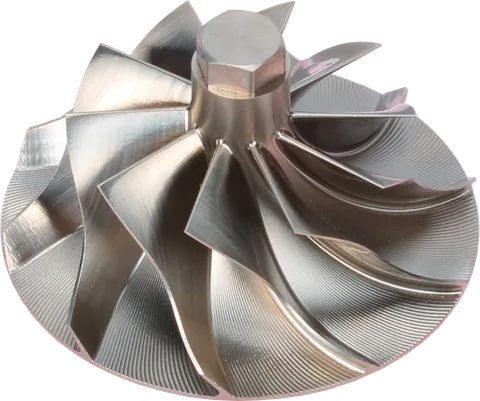
The best oil for turbo engine protection is the oil that meets your exact engine's requirements. There is no universal “turbo grade,” and a replacement turbo does not automatically require thicker oil.
Start with the owner's manual or engine service information for guidance on how to choose turbocharger oil. Confirm the engine variant, required viscosity, performance specification, and any manufacturer approval. Then match those requirements to the oil container and product documentation.
Understanding what those requirements accomplish helps you avoid expensive mistakes—especially when protecting a newly installed turbo.
Choose the best oil for turbo engine protection by specification
An engine oil serves bearings, pistons, timing components, and other lubricated systems. Its formulation also needs to suit the vehicle's emissions equipment. Selecting oil only for the turbo overlooks those other requirements.
Use this checklist when comparing products:
| Item to check | What it tells you | Practical decision |
|---|---|---|
| SAE viscosity grade | Cold-temperature behavior and hot-viscosity classification | Use a grade permitted for your engine and climate |
| Required performance specification | A defined set of oil performance requirements | Match the full designation in the service information |
| Manufacturer approval | Suitability under a manufacturer's approval system, where applicable | Verify the exact approval required |
| Synthetic requirement | Whether the manufacturer requires a particular oil type | Follow it; “synthetic” alone is insufficient |
| Service schedule | How operating conditions affect maintenance | Check mileage, time, and severe-service instructions |
Where formal approval is required, distinguish a documented approval from a general “recommended for” statement. Similar-looking labels do not necessarily mean interchangeable oils.
When choosing the best oil for a diesel turbocharger, remember that gasoline and diesel engines can have different requirements even when they use the same viscosity grade. A pickup's oil specification should not be copied to another engine simply because both are turbocharged.
Why Turbo Bearings Demand So Much From Oil
Many turbochargers use journal bearings that support the rotating shaft on a thin oil film. The thrust bearing also relies on lubrication while controlling axial movement. Ball-bearing designs have different lubrication needs, but still require the specified oil supply.
Three conditions make this demanding:
- High temperature: Heat reaches the bearing housing from the turbine side, while friction adds heat within the oil.
- High shear: Adjacent layers of oil move at different speeds across a very small distance.
- Thin films: Small changes in oil condition, supply, or bearing geometry can reduce the separation between surfaces.
Oil also carries heat away. A restricted feed therefore compromises both lubrication and cooling.
In journal-bearing turbos, shaft motion develops the pressure within the supporting oil film. Engine oil pressure supplies and replenishes that film; it does not tell the whole story about conditions inside the bearing.
Our guide to how floating-ring bearings work explains this arrangement in more detail.
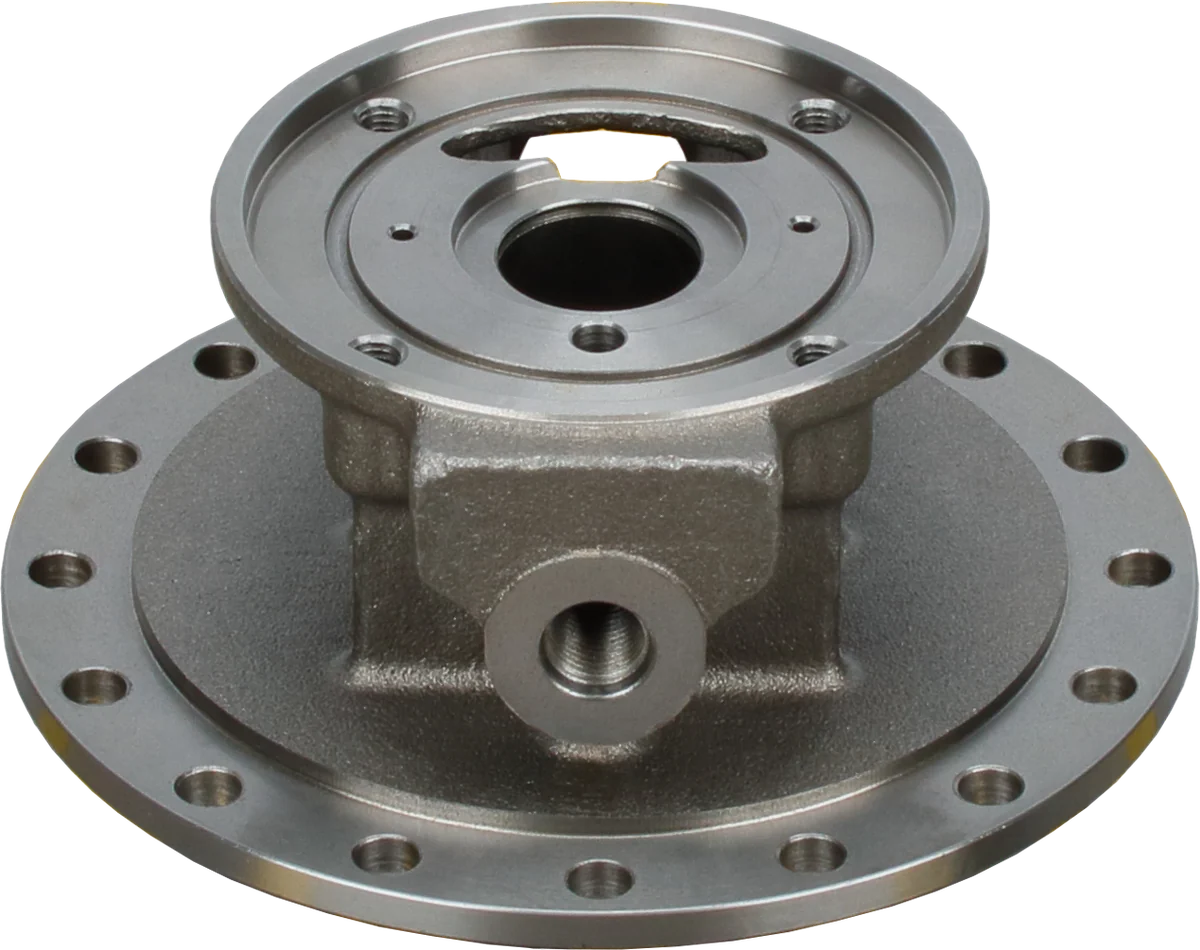
Central bore: houses the shaft and bearing system.
Mating surface: check cleanliness and damage.
Product photograph from 2026. Numbers identify the features explained below.
Turbocharger oil viscosity in cold weather and heat
Viscosity describes resistance to flow and deformation. Engine oil becomes less viscous as it heats up and more viscous as it cools.
A multigrade oil does not become thicker as the engine warms. Its formulation limits how much viscosity changes while meeting both cold and hot classification requirements.
The number before W, meaning winter, identifies a cold-temperature grade. A lower winter grade must satisfy cold-cranking and pumping requirements at lower test temperatures. It is not a direct reading of oil thickness at every outdoor temperature.
The second number identifies the hot-viscosity grade. It relates to defined viscosity limits, including measurements at standardized temperatures; it is not the maximum temperature the oil can withstand.
For Canadian winter starts, cold-flow performance matters because oil must reach the turbo promptly. However, choose a winter grade that the engine manufacturer permits.
What Viscosity Index Adds
Viscosity index, or VI, describes how strongly an oil's viscosity changes with temperature. A higher VI generally indicates less temperature-related change.
VI is different from the SAE grade. Two oils carrying the same grade can have different viscosity indices and formulations.
Base oils and viscosity-modifying additives influence this behavior. Some additives can temporarily change their response under high shear, and mechanical stress can permanently degrade certain viscosity modifiers over time.
A high VI is useful information, but it is not a complete measure of oil quality or turbo protection.
What HTHS Viscosity Means for a Turbo
HTHS stands for high-temperature, high-shear viscosity. It describes an oil's resistance to shearing under standardized hot, heavily sheared test conditions, commonly at 150°C.
Picture oil between a moving shaft and its bearing. Oil near the moving surface travels faster than oil farther away. When that speed difference occurs across a very thin film, the shear rate becomes high.
HTHS testing helps characterize behavior that an ordinary viscosity measurement alone cannot fully describe. However, an HTHS value is not a direct measurement of your turbo's operating film thickness or remaining bearing life.
With other conditions equal, higher viscosity can support greater film thickness, but also creates more viscous drag. Actual protection depends on load, temperature, clearances, speed, supply, and formulation.
That is why “thicker is safer” is unreliable advice. Manufacturers select oil requirements around the complete engine design. Choosing a higher hot grade or HTHS value without authorization can upset that balance.
Do not use thicker oil to conceal low pressure, turbo noise, or leakage. Investigate the cause with a turbocharger failure diagnosis.
Synthetic vs Conventional Oil for a Turbocharger
Suitable synthetic formulations can offer useful cold-temperature performance and resistance to oxidation and thermal degradation. These properties make them well suited to demanding turbocharged applications.
However, turbocharger protection from synthetic oil depends on the complete formulation, not the word “synthetic” on the bottle. An oil with the wrong approval or viscosity remains the wrong choice.
Where synthetic oil is required, use it. Where several compliant products are allowed, prioritize the correct specification, a trustworthy supply source, and consistent maintenance.
Avoid aftermarket oil additives unless specifically authorized. Adding a treatment changes the formulated oil and does not repair worn bearings, restricted lines, or fuel dilution.
The Stribeck Curve: Why Starts and Stops Matter
The Stribeck curve explains how friction changes as lubrication moves from surface contact toward separation by an oil film. For a journal bearing, the practical picture has three regions:
- Boundary lubrication: The oil film does not fully separate surface irregularities. Surface chemistry and protective additive films become especially important.
- Mixed lubrication: Oil supports part of the load, while some surface irregularities still contact each other.
- Hydrodynamic lubrication: Motion draws oil into a supporting wedge that separates the surfaces. Friction mainly comes from shearing the oil.
Increasing speed can help establish a separating film. Higher load or lower viscosity can work against separation. Once a full film exists, additional viscosity can increase fluid friction rather than deliver a free improvement in protection.
Start-Up and Hot Shutdown Are Vulnerable Transitions
At start-up, shaft speed and oil supply are changing. Cold oil can be slow to reach a restricted feed, and an unprimed replacement turbo may begin operating without adequate lubrication. Avoid immediate hard acceleration or high boost.
During shutdown, the normal engine-driven oil supply stops while the rotor slows. After heavy operation, stored turbine heat can continue heating oil left in the housing. This heat soak increases the risk of deposits.
These transitions deserve care, but they are not the only dangerous conditions: oil starvation under load can be destructive as well.
Follow the vehicle's warm-up and cooldown instructions. Gentle driving as the engine warms and reduced load near the end of a demanding trip help manage temperature. There is no universal idle timer for every turbocharged vehicle.
Oil Change Intervals, Filters, and Contamination
A sensible turbo oil change interval starts with the manufacturer's schedule or oil-life monitoring instructions. Apply any calendar limit and the severe-service guidance relevant to your use.
Repeated short trips, extensive idling, towing, and dusty operation may change maintenance needs. Check how your manufacturer defines those conditions. Switching to synthetic oil does not independently authorize an extended interval.
Inspect regularly for:
- Falling oil level: Find the consumption or leakage source and maintain the specified level.
- An unexplained rising level or strong fuel odor: Investigate possible fuel dilution; appearance or smell alone cannot quantify it.
- Coolant contamination: Repair the source rather than relying on repeated oil changes.
- Sludge, grit, or metal debris: Diagnose contamination before it reaches replacement components.
- Overfilling: Keep the level within the specified range; excess oil can contribute to aeration and other problems.
Oil color alone does not establish whether oil is serviceable. Where contamination or interval suitability is uncertain, laboratory analysis can provide useful evidence.
Use the correct filter for the engine. Fit, filtration, flow capacity, and applicable valve characteristics matter. A physically compatible filter is not necessarily an appropriate substitute, and no filter can remove dissolved fuel from oil.
How Coking Develops
Coking leaves hard deposits when oil undergoes severe thermal degradation. It is not defined by crossing one universal temperature, and an oil's flash point is not a coking threshold.
Deposits can restrict passages, interfere with drainage, and reduce bearing clearance. The resulting heat and flow problems can accelerate damage.
Fresh oil cannot reliably cure a coked feed line. Address restrictions and drainage faults directly. If oil is escaping from the turbo, review turbocharger oil leak causes before blaming viscosity.
Protecting a Replacement Turbo From Its First Start
Oil choice is only one part of installation. The old turbo's failure must be understood so the replacement does not encounter the same conditions.
Before starting:
- Correct the original fault. Check oil pressure, supply restrictions, contamination, drainage, and crankcase ventilation as appropriate.
- Install fresh specified oil and the correct new filter.
- Inspect the feed and return paths. Replace lines when required by the service procedure or when cleanliness and flow cannot be assured.
- Keep openings clean. Prevent dirt, gasket fragments, and excess sealant from entering oil passages.
- Prime the turbo as directed. Use the specified clean lubricant and follow the turbo supplier's procedure.
- Establish oil supply using the approved procedure. If cranking without starting is required, use the vehicle-specific method and starter-duty limits.
- Check the initial run. Verify pressure as instructed, inspect for leaks, and avoid immediate hard loading.
Do not spin the turbo with compressed air as an installation check.
For the first subsequent oil change, follow the engine and turbo supplier's instructions. There is no universal replacement-turbo break-in interval. An earlier change may be appropriate after contamination, but circulating debris through a new turbo is not an acceptable cleaning method.
Use the full replacement turbo installation checklist to coordinate these checks.
Common Questions
What is the best oil for turbo engine protection?
Choose oil with the viscosity grade and performance specifications required for your exact engine, including any manufacturer approval. Use synthetic oil when specified. The correct oil must suit the whole engine and its emissions system, not just the turbocharger.
Is thicker oil better for turbo bearings?
Not automatically. Excessive viscosity can impair cold flow and increase friction. An engine designed for a lower-viscosity oil should use its specified grade unless the manufacturer authorizes an alternative for the operating conditions.
Does every turbocharged engine need full synthetic oil?
Follow the engine manufacturer's requirements. Many turbocharged engines specify synthetic oil, and suitable synthetic formulations can offer useful temperature and oxidation resistance. However, the word synthetic alone does not establish the correct viscosity, performance level, or approval.
What does HTHS viscosity tell me?
HTHS describes oil viscosity under standardized high-temperature, high-shear conditions. It helps indicate how oil behaves in heavily stressed lubricating films. Use the HTHS requirements built into the specified oil standard rather than choosing the highest available value.
How often should I change oil in a turbocharged engine?
Follow the manufacturer's interval or oil-life monitor instructions, including applicable time limits and severe-service requirements. Short trips, towing, extensive idling, and contamination can affect oil service needs. Synthetic oil alone does not authorize a longer interval.
When should I change oil after installing a replacement turbo?
Install the turbo with fresh specified oil and a new correct filter. Follow the engine and turbo supplier's instructions for the first subsequent change. An earlier change may be appropriate after a contamination-related failure, but it cannot replace proper cleaning and repair.
What oil does a replacement turbocharger need?
Use fresh oil that meets your exact engine's viscosity grade, performance specifications, and any required manufacturer approval. A replacement turbo does not automatically need thicker oil. Check the owner's manual or service information, match those requirements to the oil label and product documentation, and install the correct new filter.
Can thicker oil stop turbocharger leaks?
Do not use thicker oil to conceal a turbocharger leak. Find the leakage source and check drainage, oil supply restrictions, and crankcase ventilation as appropriate. Excessive viscosity can impair cold flow and increase friction, so use the specified grade and address the underlying fault.
Need help identifying replacement turbo parts? Contact LeadTurbo with your turbo part number, vehicle details, and symptoms.