Two turbochargers can share mounting flanges and look nearly identical while using different exhaust housings. That difference can change how an engine responds under load and how hard it works to push exhaust out. For replacement work, the goal is to restore the housing specification intended for that engine rating.
What does turbine housing A/R measure?
The turbo A/R ratio describes the relationship between a passage's cross-sectional area and its position around the shaft:
- A is the internal scroll area at the manufacturer's specified measuring section.
- R is the distance from the shaft centerline to the centroid, or geometric center, of that same area.
- A/R is that area divided by that radius.
This is not the exhaust flange opening, wheel diameter, or boost setting. Measurement conventions matter, so compare markings using the manufacturer's housing family and specifications.
For housings designed around the same turbine wheel, a smaller A/R generally means less inlet flow capacity. A larger value generally allows more flow. The housing changes the restriction and the gas velocity and direction approaching the rotor.
However, A/R is not identical to turbine nozzle area or the effective flow area of the complete stage. The nozzle passage and wheel outlet both affect capacity, along with passage shape and flow losses. Two unrelated housings with the same marking need not flow alike.
The wheel works best when incoming gas speed and direction suit its blade geometry. A housing change can move that operating relationship, so a larger opening is not an efficiency upgrade at every speed. Flow capacity and efficiency must suit the engine together.
How does a turbocharger turbine housing work?
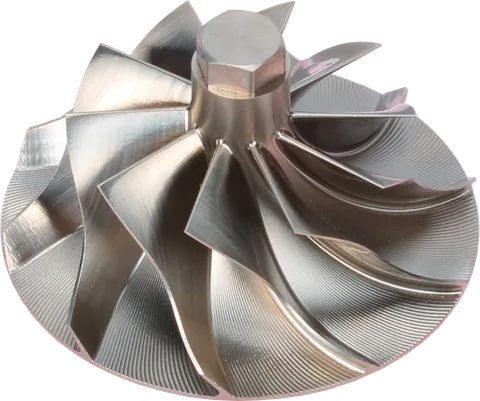
In a radial-inflow turbine, exhaust enters around the wheel's outside, moves inward through the blades, and turns to leave roughly parallel to the shaft.
| Location | What happens there | Why it matters |
|---|---|---|
| Volute | Spiral passage distributes exhaust around the wheel. | Sets the approach to the nozzle region. |
| Nozzle or throat | Narrowing passage accelerates and directs gas toward the rotor. | Strongly influences inlet flow capacity. |
| Turbine wheel | Rotating blades turn the gas and extract energy. | Produces torque to drive the compressor. |
| Exducer and outlet | Gas leaves the wheel's exit section and enters the exhaust outlet. | Wheel exit geometry also limits flow. |
Exhaust arrives with thermal energy and pressure above the outlet. Expansion through the stationary passages converts some of that energy into velocity. Further expansion and flow turning inside the rotating blades produce shaft work. The pressure drop is shared between the inlet passages and the rotor; it does not all occur before the wheel.
The compressor receives that power through the shared shaft; useful turbine output depends on exhaust flow, pressure, temperature, and efficiency.
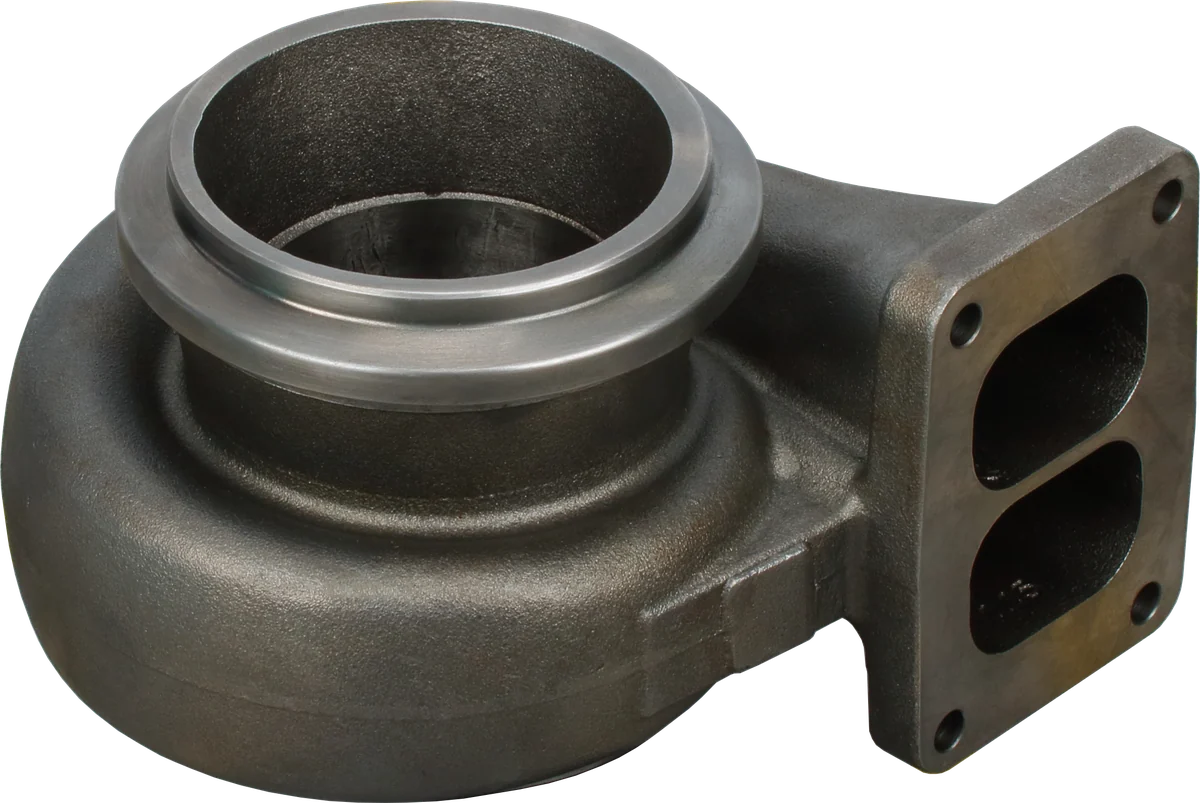
Exhaust inlet: verify the flange and passage geometry.
Turbine cavity: check clearance and contact damage.
Mounting face: the replacement must match the interfaces.
Product photograph from 2026. Numbers identify the features explained below.
Small vs large turbocharger A/R: operating compromises
The following tendencies apply within a comparable housing family, using the same wheel and broadly comparable engine conditions. They are not guarantees across different turbochargers.
| Operating condition | Smaller A/R | Larger A/R |
|---|---|---|
| Low-speed load pickup | Usually quicker spool and boost rise | Usually slower spool and boost rise |
| High exhaust flow | Greater restriction and exhaust manifold pressure | More flow capacity and usually lower manifold pressure |
| Pumping work at high load | Usually higher if the housing becomes restrictive | Often lower when restriction is relieved |
| Sustained-load EGT | Can rise as exhaust restriction, pumping work and trapped residual gas increase | Can fall when excessive restriction is reduced |
A smaller passage helps build turbine-driving pressure at low exhaust flow, allowing boost to rise sooner. At high load, however, pushing more exhaust through that passage requires greater upstream pressure. A housing chosen only for quick response can become a liability during sustained hard work.
A larger passage shifts that compromise toward higher flow. It can reduce exhaust pressure and associated thermal stress at high load, but may deliver less useful turbine power during low-speed load pickup. Installing a larger housing does not automatically make an engine run cooler at every operating point.
A smaller housing speeds spool-up by raising gas velocity and pressure at the wheel, not by lightening the rotor; rotor inertia is unchanged.
Flow can eventually be limited by sonic conditions at a controlling passage. At fixed inlet pressure and temperature, lowering outlet pressure further then adds little flow. Higher inlet pressure can still increase mass flow, but building that pressure increases the engine's exhaust pumping burden.
Why boost alone does not prove a good match
A/R influences boost through turbine power and shaft speed. The actual boost level also depends on the compressor, engine airflow, fueling, and boost controls. A small housing may reach a boost target quickly while imposing excessive exhaust pressure; a larger housing may struggle to reach it at low speed.
When exhaust pressure is high relative to intake pressure, the engine generally spends more work exchanging gases. Pushing exhaust out against that pressure increases pumping loss. Greater retained exhaust and reduced fresh-air availability can also make combustion conditions less favorable.
At the same demanded output, those effects can increase fuel use and thermal load. Higher EGT may accompany the mismatch, especially when fueling exceeds the available air. A boost gauge alone cannot show whether the turbine side is restrictive. Compare exhaust pressure and EGT with application limits under consistent load and speed, using the same measurement locations.
Vaneless, fixed-nozzle, and variable-geometry housings
A housing's cast shape is only part of the flow specification when a separate nozzle system controls the wheel inlet.
| Design | What sets the passage area | Replacement implication |
|---|---|---|
| Vaneless housing | The volute and built-in approach passage perform the nozzle function. | Match the housing geometry to the correct wheel. |
| Fixed nozzle ring | Stationary vanes establish passage area and gas direction. | Match the nozzle specification as well as the casting. |
| Variable geometry | Movable vanes or another variable nozzle mechanism change the working opening. | Match the turbine assembly, control hardware, and calibration requirements. |
Vaneless does not mean there is no nozzle action. It means there is no row of nozzle vanes.
Closely related castings can use different nozzle rings, so identical exterior appearance does not establish identical flow. On assemblies with a separate ring, verify its part specification when rebuilding or selecting replacement housing parts.
On a VGT turbocharger, the effective opening changes during operation. A housing marking alone cannot describe that range or establish interchangeability. Fixed housings and variable nozzle systems therefore require different matching information.
Why diesel housings are selected by engine rating
Engine displacement does not establish exhaust flow by itself. Rated speed, fuel delivery, torque demand, and the duration of heavy loading all affect what the turbine must handle.
Manufacturers select diesel turbine arrangements around requirements such as:
- Low-speed torque and response when load is applied.
- Exhaust flow at the specified power and governed speed.
- Sustained thermal loading in continuous-duty equipment.
- Acceptable exhaust pressure, turbo speed, and engine control behavior.
Related engine hardware can serve a road vehicle, generator, or marine installation with different ratings. Their housings may fit the same general turbo family yet serve different operating requirements. Even within one vehicle range, a different power rating can require a different turbine specification.
A generator has to accept a sudden electrical load and then carry it without excessive exhaust pressure or temperature. Equipment working repeatedly at low engine speed also needs adequate response as fueling rises. These demands cannot be captured by a flange size.
Choose a replacement diesel turbocharger housing for the documented application. A housing advertised for the same displacement is not enough evidence.
Which turbocharger housing fits my engine?
Treat turbine housing A/R as one part of the replacement specification. Match the housing code or A/R stamped or cast into the OE housing, then verify it against the complete turbo part number and engine application.
Use these check points:
- Record the full turbocharger part number and all readable housing markings.
- Confirm the engine identification, power rating, rated speed, and equipment application.
- Verify turbine wheel profile and housing machining, including specified clearances.
- Match inlet and outlet connections, scroll division, and the wastegate or variable nozzle arrangement.
- Check any replacement code against an approved application listing or documented supersession.
The same A/R marking does not establish turbocharger turbine housing compatibility. A casting number may identify a basic casting rather than the finished, machined specification. Conversely, an approved replacement may carry a revised code.
A matching flange and A/R marking can still accompany the wrong machined contour. An unsuitable housing can cause wheel contact or excessive clearance, so confirm the finished housing specification.
Some diesel housings use an area designation in square centimeters instead of a decimal A/R. Preserve that designation exactly in parts inquiries; without the manufacturer's geometry and identification system, converting it into an A/R number can mislead the match.
If the installed turbo has an uncertain history, do not copy its housing blindly. Verify the engine's required specification first. If markings are unreadable, provide clear photos and the turbo identification so the housing can be checked before ordering.
Common Questions
What is the correct turbine housing A/R for my diesel engine?
Use the specification tied to the engine rating and complete turbocharger part number. Confirm the housing marking against the OE application or an approved supersession. Engine displacement alone cannot establish the correct housing.
Does a larger A/R always make more boost?
No. A larger housing can reduce exhaust restriction at high flow, but it may deliver less turbine power at low flow. Boost depends on the full turbo match, fueling, engine speed, load, and control settings.
Can two housings with the same A/R flow differently?
Yes. Wheel size, passage shape, scroll arrangement, nozzle design, and machining can differ. Compare A/R values within a defined housing family; the number alone does not establish equivalent flow capacity or interchangeability.
Is a housing marked in square centimeters the same as A/R?
No. An area marking and an A/R designation describe different geometry. There is no universal conversion that makes them interchangeable. Use the manufacturer's housing code and application data.
Will a new CHRA correct a mismatched housing?
No. A CHRA replaces the rotating assembly and bearing housing, not the exhaust volute. It cannot correct the wrong housing flow capacity, and its turbine wheel must still match the housing's machined profile.
Can a turbocharger housing cause slow spool?
Yes. With the same wheel and comparable engine conditions, a larger A/R within the same housing family usually produces slower spool and boost rise during low-speed load pickup.
Contact LeadTurbo with your turbo part number, housing marking, and engine rating for help matching a replacement.