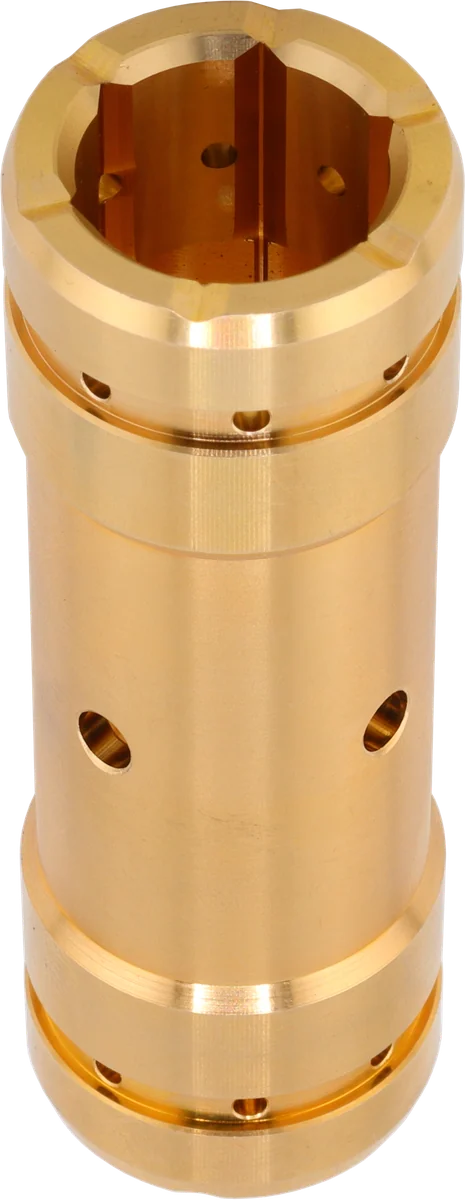
What the journal bearing actually supports
To understand how turbocharger floating bearings work, start with the rotating shaft shared by the turbine and compressor wheels. Inside the center housing, radial bearings control the shaft’s sideways movement while allowing it to spin with low friction. The smooth shaft surfaces running inside those bearings are called journals.
A turbo journal bearing uses oil rather than rolling balls to separate the moving surfaces. Under normal operating conditions, with an established hydrodynamic film, the journal and bearing do not make metal-to-metal contact.
Rotation drags oil into a narrowing gap between the slightly offset journal and bearing. Pressure develops within this oil wedge and supports the load. This is hydrodynamic lift: the moving surfaces help generate their own supporting pressure.
The engine’s oil supply replenishes the bearing and carries away heat, but supply pressure alone does not explain how the journal stays separated from the bearing. Rotation, viscosity, load, and geometry all matter.
During starting, stopping, or interrupted lubrication, full separation may not exist. That distinction explains why a bearing designed for very low operating wear can still suffer serious damage from an oil supply problem.
Radial bearings also perform a different job from the thrust bearing, which controls movement along the shaft. Excessive end play needs a separate thrust bearing inspection.
How a turbo floating bearing uses two oil films
In a full-floating bearing turbo, a sleeve-shaped ring sits between the shaft journal and the center housing bore. Oil occupies two working clearances:
- Inner clearance: between the shaft journal and the ring’s inside surface.
- Outer clearance: between the ring’s outside surface and the housing bore.
Oil reaches these spaces through the housing passages and the bearing’s oil holes or grooves, according to the design.
The ring is free to rotate. Oil dragged by the shaft applies a driving torque to its inner surface, while the outer oil film resists its rotation. The ring settles at a speed determined by these competing effects.
It normally turns in the same direction as the shaft, at a fraction of shaft speed. That fraction changes with operating conditions; the ring is not geared to the shaft.
Because the ring rotates, the speed difference across the inner film is smaller than it would be against a stationary sleeve. This can reduce inner-film friction. The outer film still produces friction, so overall bearing losses depend on the complete design.
Both films transmit forces. The inner film supports the journal relative to the ring, while the outer film supports the ring relative to the housing and provides valuable damping. As the assembly moves sideways, oil resists that motion and dissipates vibration energy.

Shaft cross-section.
Inner oil film: between shaft and ring.
Floating ring: separates the two oil films.
Outer oil film: between ring and housing.
Simplified schematic, not to scale.
Why floating bearings are so common in automotive turbochargers
Floating-ring journal bearings offer a practical combination of manufacturing cost, compact packaging, friction control, and vibration damping. These advantages help explain the widespread use of automotive turbocharger floating bearings.
Their relatively simple parts suit volume production. The oil films can accommodate small operating movements, and the outer film helps manage vibration as the rotor passes through different speeds and loads.
Manufacturing tolerance also matters. Designers choose dimensions and allowable variation so the bearing works across expected production differences and temperature changes. This is tolerance management, not permission to assemble loosely matched parts.
A workable design must balance several competing needs:
- Enough oil-film support to control shaft movement.
- Enough damping to limit vibration.
- Suitable oil flow to supply and cool the bearing.
- Acceptable friction and heat generation.
- Dimensions that can be manufactured consistently.
Ball-bearing systems make different compromises. For a broader comparison, see Ball Bearing vs. Journal Bearing Turbochargers.
Full-floating vs semi-floating turbocharger bearings
A semi floating bearing also has an inner oil film and an outer oil film, but its sleeve is restrained from rotating. Depending on the design, a pin or another locating feature provides that restraint while allowing the intended small radial movement.
The shaft rotates inside the stationary sleeve. Outside it, the oil film primarily acts as a squeeze-film damper: small sideways movements squeeze oil through the available gap, resisting vibration.
| Feature | Full-floating ring | Semi-floating bearing |
|---|---|---|
| Ring rotation | Permitted; normally slower than the shaft | Restrained by a locating feature |
| Inner oil film | Between shaft and rotating ring | Between shaft and stationary sleeve |
| Outer oil film | Supports and damps the rotating ring | Primarily provides squeeze-film damping |
| Friction behavior | Ring rotation reduces inner relative speed | Inner film sees the shaft’s full relative speed |
| Replacement requirement | Correct ring geometry and clearances | Correct sleeve geometry, clearances, and restraint |
“Semi-floating” does not mean that the bearing is partly worn or has only one oil film. It describes the intended bearing arrangement.
The two designs are not interchangeable merely because their parts look similar. Oil passages, locating features, and rotor behavior must match the original engineering.
What inner and outer clearance do
Turbocharger floating bearing clearance is a designed working space. Too little can be as harmful as too much, and there is no universal clearance suitable for every turbo.
Inner clearance affects the oil wedge supporting the journal, along with oil flow, friction, heat generation, and shaft motion. An excessively tight fit can restrict oil flow and leave insufficient margin as temperatures change. Excessive clearance changes the film’s supporting behavior and can allow damaging movement.
Outer clearance affects how the ring moves within the housing, how oil passes around it, and how the outer film supports and damps the assembly. Excessive outer clearance can compromise rotor control even if the ring fits the shaft correctly.
The outer clearance is often larger than the inner clearance, but the intended relationship is design-specific. Increasing either gap does not automatically improve lubrication or damping.
Also distinguish radial clearance from diametral clearance. Diametral clearance is the difference between the relevant bore and outside diameters; radial clearance is half that difference. Confusing the two can cause a serious inspection error.
A measurement at the compressor-wheel end is not the same as either bearing clearance. It includes the effects of the bearing arrangement and the distance from the bearings to the measurement point. Follow the specified inspection method and limits.
How bearing wear shows up
Start with evidence from all mating surfaces. A damaged ring may be the most obvious part, but the journal and housing bore determine whether new bearings can work correctly.
Useful inspection points include:
- Scoring: Grooves or scratches on the ring bore, ring exterior, or journal can indicate debris or contact after oil-film separation was lost.
- Oval wear: An out-of-round ring bore or housing bore can create uneven clearance that a single diameter reading misses.
- Ring wear: Loss of material from the inner or outer surface changes the working gaps. Uneven wear deserves investigation beyond replacing the ring.
- Shaft journal marks: Grooves, smeared metal, discoloration, or localized rubbing require assessment against surface and dimensional limits.
- Housing damage: Scoring or enlargement of the housing bore can leave excessive outer clearance with a new standard ring.
- Oil passage deposits: Debris or carbon deposits can interfere with oil delivery and allow the replacement parts to fail again.
Measure accessible journals and bores at multiple positions and directions to check diameter, taper, and roundness. Use suitable precision equipment and the correct component specifications.
Marks alone do not prove the original failure cause. Contamination, inadequate oil delivery, imbalance, and other faults can produce overlapping damage patterns. Our guide to diagnosing a failed turbocharger before replacement explains the wider checks.
Shaft surface condition matters as well as size. Aggressive polishing can change journal geometry or affect a treated surface; see the guide to shaft hardening and floating-bearing journals.
Does bearing noise prove the rings are worn?
No. Whining, rubbing, or a changing tone is a reason to investigate, not a reliable bearing diagnosis by itself.
Rotor imbalance can produce vibration that follows shaft rotation. Oil-film forces can also produce subsynchronous motion, meaning the shaft moves around its bearing at a frequency below its rotational speed. Under some conditions, that motion can become unstable.
Bearing-ring rotation and oil whirl are different motions. A ring spinning slower than the shaft is expected in a full-floating design; it does not by itself indicate instability.
Sound can also come from airflow, leaks, or wheel damage. Turbo Oil Whirl and Oil Whip Explained covers the distinction in more detail.
What this means when choosing a repair kit or CHRA
A repair kit makes sense when inspection confirms that reusable parts remain serviceable and the rebuilder can measure, assemble, and balance the turbo correctly.
Match the kit to the turbo’s identification and bearing design. Ring dimensions, oil-feed features, thrust components, and retaining hardware can differ between visually similar units. Check exactly what the kit includes.
New rings cannot restore a worn shaft or housing bore. Installing them without measuring both interfaces can leave the rebuilt turbo with incorrect clearance from the start.
Use How to Choose a Turbocharger Repair Kit to review compatibility before comparing repair kits.
A replacement CHRA becomes a practical option when the shaft, wheels, or center housing are damaged, or when the necessary rebuilding equipment is unavailable. Confirm fitment and what assembly and balancing work the supplier has performed. The CHRA versus complete turbocharger guide helps determine whether the surrounding housings and controls can be reused.
A rebuild also requires the appropriate turbocharger balancing process. Reusing assembly marks does not demonstrate that the finished rotor is adequately balanced.
Whichever route you choose, correct the original failure cause before installation.
Common Questions
Is a turbo floating bearing the same as a journal bearing?
A floating bearing is a type of journal bearing. Journal bearing describes how an oil film supports the shaft; floating describes the bearing ring’s ability to move within the housing, with rotation permitted in a full-floating design.
How fast does a full-floating bearing ring spin?
It normally rotates in the shaft’s direction at a fraction of shaft speed. The ratio depends on bearing geometry, clearances, oil viscosity, temperature, and operating conditions. There is no universal percentage for every turbo.
Should a journal-bearing turbo have shaft play when dry?
Some radial movement can be normal without operating oil films. Acceptable movement depends on the turbo and measurement method. A finger check cannot verify bearing clearance, and wheel contact, roughness, or excessive measured movement requires investigation.
Can I replace worn turbocharger bearing rings without replacing the shaft?
Only if the shaft journals and housing bores remain within the applicable dimensional and surface-condition limits. New rings cannot correct a scored, undersized, tapered, or out-of-round journal, or a worn housing bore.
Is a semi-floating bearing an upgrade over a full-floating bearing?
Neither design is automatically better. Each uses a different balance of friction, damping, oil flow, and rotor behavior. Use the bearing system specified for the turbo; converting between them requires engineering changes beyond swapping rings.
Will thicker oil fix a worn turbo floating bearing?
No. Thicker oil does not restore worn surfaces or correct excessive clearance. Use the engine manufacturer’s specified oil and investigate lubrication faults and mechanical wear instead of trying to hide symptoms with a viscosity change.
Is turbocharger bearing ring rotation normal?
Yes, in a full-floating design. Rotation at a fraction of shaft speed does not by itself indicate instability. A semi-floating sleeve is restrained from rotating.
For help comparing a repair kit, CHRA, or replacement turbo, contact LeadTurbo with your turbo part number and symptoms.