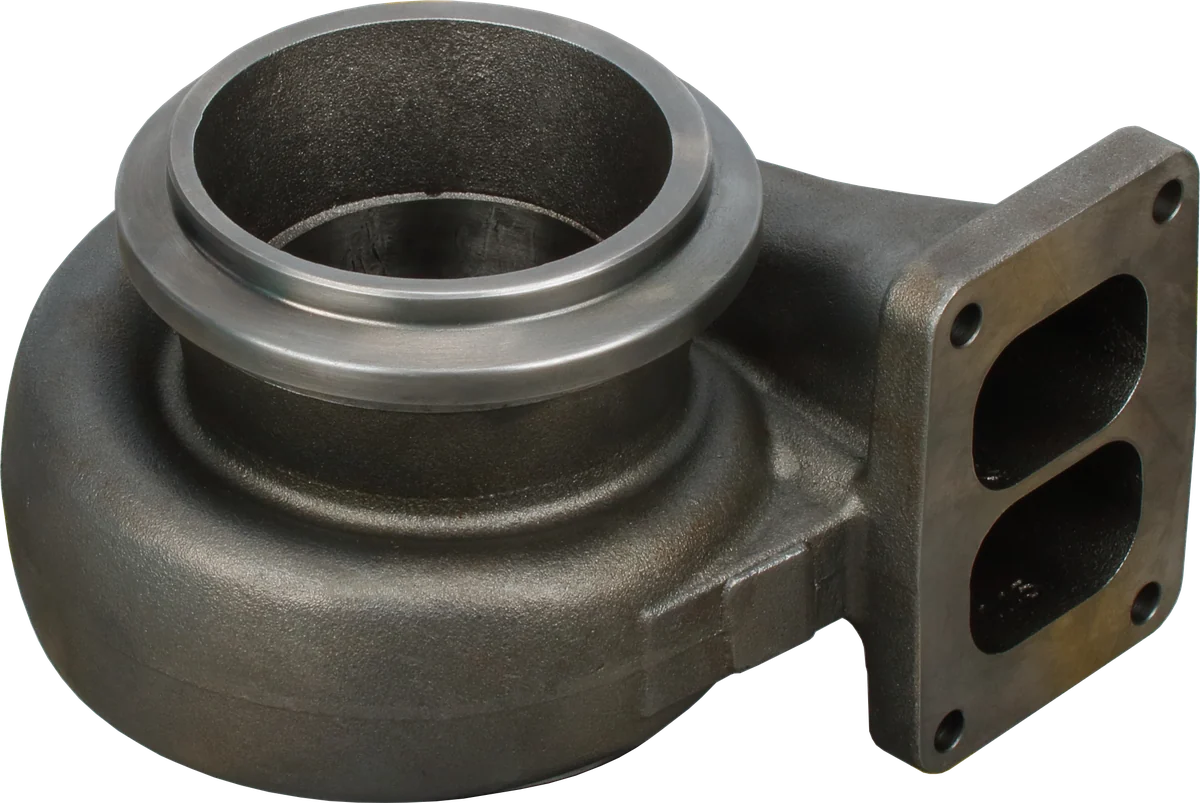
Finding a cracked diesel turbocharger housing does not tell you whether the casting has reached the end of its service life. The immediate questions are where the crack goes, what it affects and what the manufacturer permits. A superficial internal indication and a leaking outer wall require different decisions. On a truck, excavator or generator, guessing can turn a housing problem into wheel damage or an exhaust leak.
Can a cracked turbine housing be reused?
To learn how to inspect turbocharger housing cracks, start with the turbo part number and the OEM inspection procedure for that exact model. Some manufacturers permit limited heat checking in specified internal areas, such as a tongue or divider. Those allowances are conditional; they do not mean every small crack is harmless.
Crack length alone is insufficient. Location, depth, number, connection to adjacent cracks, loose material and effects on sealing or clearance can all matter. There is no universal acceptable crack size for all diesel turbochargers.
| Location | Why cracks develop there | What makes the finding serious |
|---|---|---|
| Tongue or twin-scroll divider | Thin, restrained edges respond quickly to changing exhaust temperatures. | Cracks joining together, loose tips, or damage approaching the wheel path. |
| Volute wall | Wall transitions and uneven heating create local strain. | A crack through the outer wall, soot leakage, or distortion. |
| Wastegate port | The port edge sees concentrated heat and stress. | A damaged seat, bypass leakage, or metal that could detach. |
| Inlet and outlet flanges | Clamping, pipe loads and temperature changes act together. | Cracked bolt bosses, loss of sealing, or failure to meet flatness limits. |
Inspect the housing cold, using the approved cleaning and inspection method:
- Expose the metal without grinding away evidence or rounding crack edges.
- Map both ends of each indication and check accessible inner and outer surfaces.
- Look for missing metal, connected cracks, wheel rub marks and flange distortion.
- If depth or extent remains uncertain, use qualified inspection appropriate to the alloy; do not judge from a phone photo alone.
A cold crack may close tightly, while heating changes its opening. Soot tracks support a leak diagnosis, but their absence does not establish that a crack is shallow. If accessible surfaces cannot reveal its extent, document the uncertainty and obtain the required inspection before reuse.
Connected cracks deserve special attention because they can outline a fragment that may eventually detach. A divider crack can also allow exhaust pulses to communicate between scrolls, while a wastegate-seat crack can create an unwanted bypass. Assess function and material security as well as whether gas escapes outside.
Replace castings with leaking outer-wall cracks, loose sections or damage that compromises wheel clearance, mounting integrity or sealing. Replace anything outside the applicable OEM limits. If no criteria are available, obtain model-specific guidance from the turbo manufacturer or its authorized remanufacturer before reuse.
Why do turbocharger housings crack during heat cycles?
A cracked turbine housing often reflects accumulated strain over many operating cycles. During a load increase, the exhaust-facing surfaces heat and expand before the rest of the casting catches up. Nearby cooler metal restrains that movement. Cooling changes the stress again. Repetition can initiate a crack and gradually extend it.
Think of a loader moving between heavy digging and light repositioning. A thin tongue changes temperature faster than a heavy flange. Abrupt section changes, uneven wall thickness or casting variations can create hot spots and steep temperature differences. These conditions concentrate thermal fatigue at specific locations.
Excessive EGT increases the burden by reducing hot strength and promoting oxidation. Check excessive load, fueling, air supply and exhaust restriction against engine data. Use the correct limit for the probe location; exhaust gas temperature is not the same as housing metal temperature.
Quick shutdowns after hard work skip the gradual temperature reduction available during an approved cool-down routine. Heat continues to redistribute after shutdown, adding temperature differences between sections. Sudden external cooling is more severe: wash water or a fluid leak striking a hot casting can produce thermal shock.
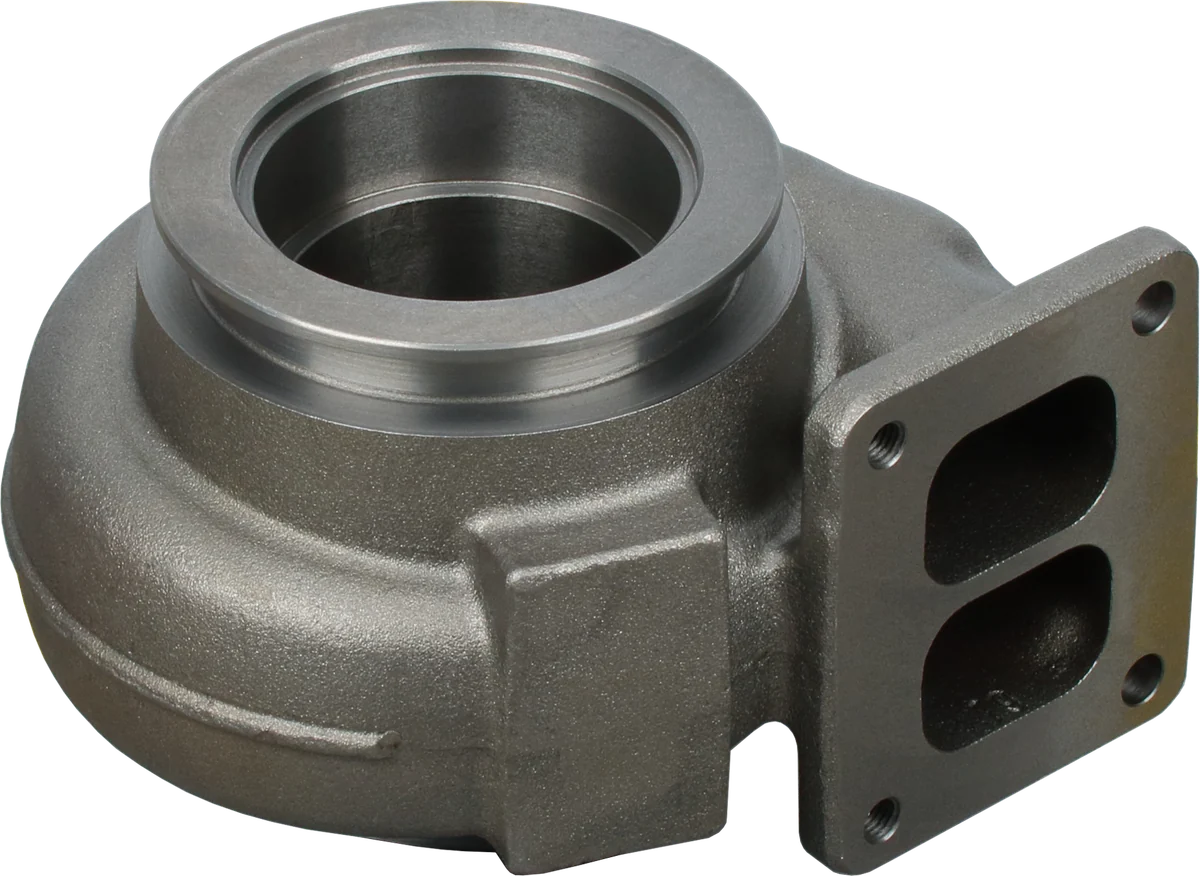
Exhaust inlet: verify the flange and passage geometry.
Turbine cavity: check clearance and contact damage.
Mounting face: the replacement must match the interfaces.
Product photograph from 2026. Numbers identify the features explained below.
Mounting stress adds another load
An exhaust connection should meet the turbo naturally, with the pipe supported as designed. Pulling a misaligned downpipe into place with flange bolts stores bending load in the housing. That load changes as the engine moves and the exhaust expands.
A missing support bracket, failed hanger, or missing or seized specified flex section can make the turbo carry pipe weight and vibration. Marine installations and gensets also need their designed allowance for exhaust-system movement.
Wrong bolts can bottom in blind holes, damage bosses or clamp a flange unevenly. Use the specified length, grade, washers, torque and tightening sequence. When diagnosing a flange crack, check alignment with the cold pipe safely supported and disconnected. Correct the mounting problem before fitting the replacement.
How turbine housing material affects durability
Comparing cast iron vs stainless turbocharger housings means balancing retained strength, oxidation resistance, thermal expansion and resistance to repeated strain. Higher-EGT engines may need more capable alloys, but the entire casting design must suit the material.
SiMo is a heat-resistant type of ductile iron; Ni-resist identifies a family of austenitic cast irons.
| Material family | Useful characteristics | Service implication |
|---|---|---|
| Conventional alloyed ductile cast iron | Practical strength, castability and cost for many diesel applications. | Grade and approved temperature duty matter; generic iron is not an equivalent substitute. |
| SiMo ductile cast iron | Silicon improves oxidation resistance; molybdenum supports elevated-temperature strength. | Thermal-cycle capability still depends on composition, processing and geometry. |
| Austenitic Ni-resist cast iron | Nickel-rich grades provide useful hot strength and oxidation resistance. | Generally greater expansion and lower heat conduction than ferritic irons; verify design compatibility. |
| Heat-resistant cast stainless steel | Appropriate grades retain useful properties at high exhaust temperatures. | Stainless grades vary; thermal expansion, wall design and application approval remain critical. |
A Ni-resist turbine housing is not automatically a drop-in upgrade. Similar outside dimensions do not establish compatible expansion or wheel clearance. A replacement turbocharger turbine housing must match the approved application, wheel contour, A/R, flange arrangement and control system. Do not choose a casting solely because its alloy sounds more heat resistant.
In service, alloy identification by color or appearance is unreliable. Confirm the part specification or supplier's documented material and application approval.
Match the evidence to the likely cause
Use these clues to investigate turbocharger housing crack symptoms; several mechanisms can act together, and appearance alone does not prove the cause.
| Possible cause | Evidence to look for | Corrective action |
|---|---|---|
| Repeated thermal cycling | Branching internal cracks near thin edges or section changes. | Review load transitions and shutdown practices; apply OEM acceptance criteria. |
| Excessive EGT | Overtemperature records, heavy oxidation or distortion. | Diagnose the operating fault and replace damaged castings. |
| Uneven section heating | Localized cracking at wall transitions; similar damage recurring in the same area. | Verify the correct casting and investigate the duty cycle. |
| Thermal shock | Damage associated with washdown or a known external fluid leak. | Eliminate the fluid source and allow cooling before cleaning. |
| Exhaust loading | Flange or boss cracks with pipe misalignment or failed supports. | Restore alignment, specified brackets and expansion joints. |
| Incorrect fasteners | Bottomed bolts, damaged threads or uneven flange contact. | Restore the mounting to OEM specifications and fit the correct hardware. |
Turbocharger housing repair vs replacement: why welds rarely last
A weld can close a visible line without restoring the housing's original condition. Cast iron is sensitive to the heating and cooling of welding; unsuitable filler or procedure can leave a hard, brittle region or new residual stress beside the repair. Oxidized crack surfaces complicate sound bonding.
Specialist repair may require verified alloy identification, controlled preheating, compatible filler, controlled cooling and dimensional checks. Stainless castings also need an alloy-specific procedure. Even a sound weld leaves the original thermal or mounting problem unresolved, and the surrounding casting has already accumulated service damage.
For working diesel equipment, replacement is usually the more defensible choice. Consider welding only under an explicitly approved repair procedure with defined inspection and acceptance requirements.
Prevent repeat housing damage
Build these checks into the equipment's operating and installation routine:
- Cool down after heavy load. Use the engine manufacturer's specified light-load or idle procedure. Respect approved automatic shutdown strategies.
- Control EGT. Investigate sustained abnormal readings and correct the operating fault before returning to full load.
- Support the exhaust correctly. Restore specified brackets, hangers and flex sections; align joints without using bolts to pull piping into place.
- Use the correct hardware. Follow the specified fasteners, torque and tightening sequence.
- Refit specified heat shields. Maintain their mounting and clearances; use only approved insulation arrangements, since additional wrapping changes the thermal environment.
- Keep water off hot housings. Let the assembly cool before washing and correct external coolant or water leaks.
- Check recurrence. Document the crack location and inspect the repaired installation at the OEM interval or an agreed shop follow-up.
Parts for this guide
 4037627 TH HX55W Turbine Housing Replacement
FOR 4037627 TH
Turbine Housing
In Stock
 7C6615 TV7804 Turbocharger Replacement for CAT 3406 360HP
7C6615
Turbocharger
On backorder — orders accepted
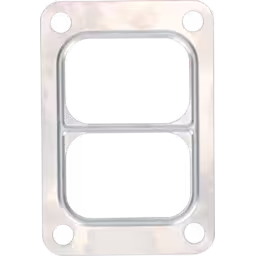 171702 GA-TI Turbocharger Gasket for Detroit Diesel S60 6L 470HP
FOR 171702 GA-TI
Gasket
On backorder — orders accepted
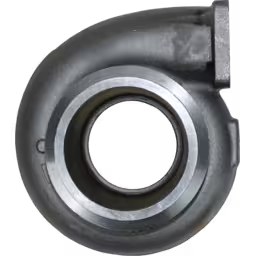 3591301 HX83 Turbine Housing for Cummins QSK60 G7 | Replacement
3591301
Turbine Housing
In Stock
Common Questions
Can I keep running a cracked turbine housing?
Only if the exact turbocharger's OEM criteria permit the crack and the completed inspection meets every condition. Stop using a housing with an external exhaust leak, loose metal, impaired wheel clearance, or damage outside those limits.
Is a hairline crack automatically acceptable?
No. A hairline appearance does not establish crack depth or remaining strength. A tiny crack at a sealing surface or bolt boss can still require replacement.
Will replacing the CHRA fix a housing crack?
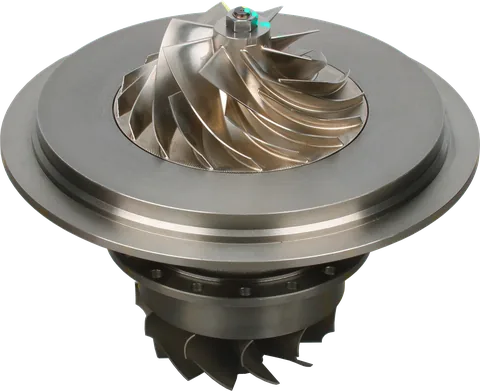
No. A CHRA contains the rotating assembly and bearing housing. The separate turbine casting still needs inspection, and the cause of the crack still needs correction.
How long should the engine idle before shutdown?
Follow the engine or equipment manufacturer's procedure. Recent load and any approved automatic shutdown system affect the requirement; use the specified cool-down routine.
Can you replace a turbocharger housing?
An approved replacement housing may be an option if other components pass inspection. Installation must restore specified clearances and control settings, including any required VGT calibration.
For help matching a replacement housing or turbocharger, contact LeadTurbo with the part number, engine details and clear photos of the damage.