Two engines with the same displacement can need different turbochargers because they spend their working lives at different speeds and loads. A boat pulling hard through the water, a generator supplying steady electrical power, and a truck climbing a grade put different demands on the compressor and turbine.
For marine diesel turbocharger replacement or genset work, the practical question is whether the turbo matches the engine's rating and installed systems throughout that duty cycle. A familiar housing shape or matching flange does not answer it.
What changes when matching a marine diesel turbocharger?
Start marine turbo matching with the way the load changes. On a conventional fixed-frequency generator set, the governor holds engine speed close to its target while electrical demand changes engine torque. A set carrying substantial continuous load needs good efficiency and manageable temperatures at that operating point.
Constant-pressure exhaust systems are common on larger diesels built for sustained high-load duty, including many generator sets. That does not mean every genset uses one: exhaust arrangement also depends on engine size, design, and required response.
With a fixed-pitch propeller, absorbed power generally rises steeply as shaft speed increases. This propeller curve gives the matching engineer a relatively predictable operating path under defined conditions. Hull fouling, added displacement, towing, or altered propeller pitch can change that path.
| Application | Normal load pattern | Matching priority |
|---|---|---|
| Working genset | Nearly constant speed; load can remain high | Full-load efficiency plus specified load-step response |
| Fixed-pitch propulsion | Speed and absorbed power rise together | Stable airflow along the expected propeller curve |
| Tug or trawler (heavy propeller load) | High torque at low to mid rpm | Air supply and surge margin at low speed |
| Controllable-pitch propeller | Often near-constant rpm while load varies with pitch | Behaves more like a genset; check low-load surge margin |
| Truck or mobile equipment | Frequent speed and torque changes | Broad response and stable operation across the working range |
Trucks mix steady cruising with acceleration and low-speed pulling. They need a broader operating range than either a single steady generator point or an idealized propeller curve suggests.
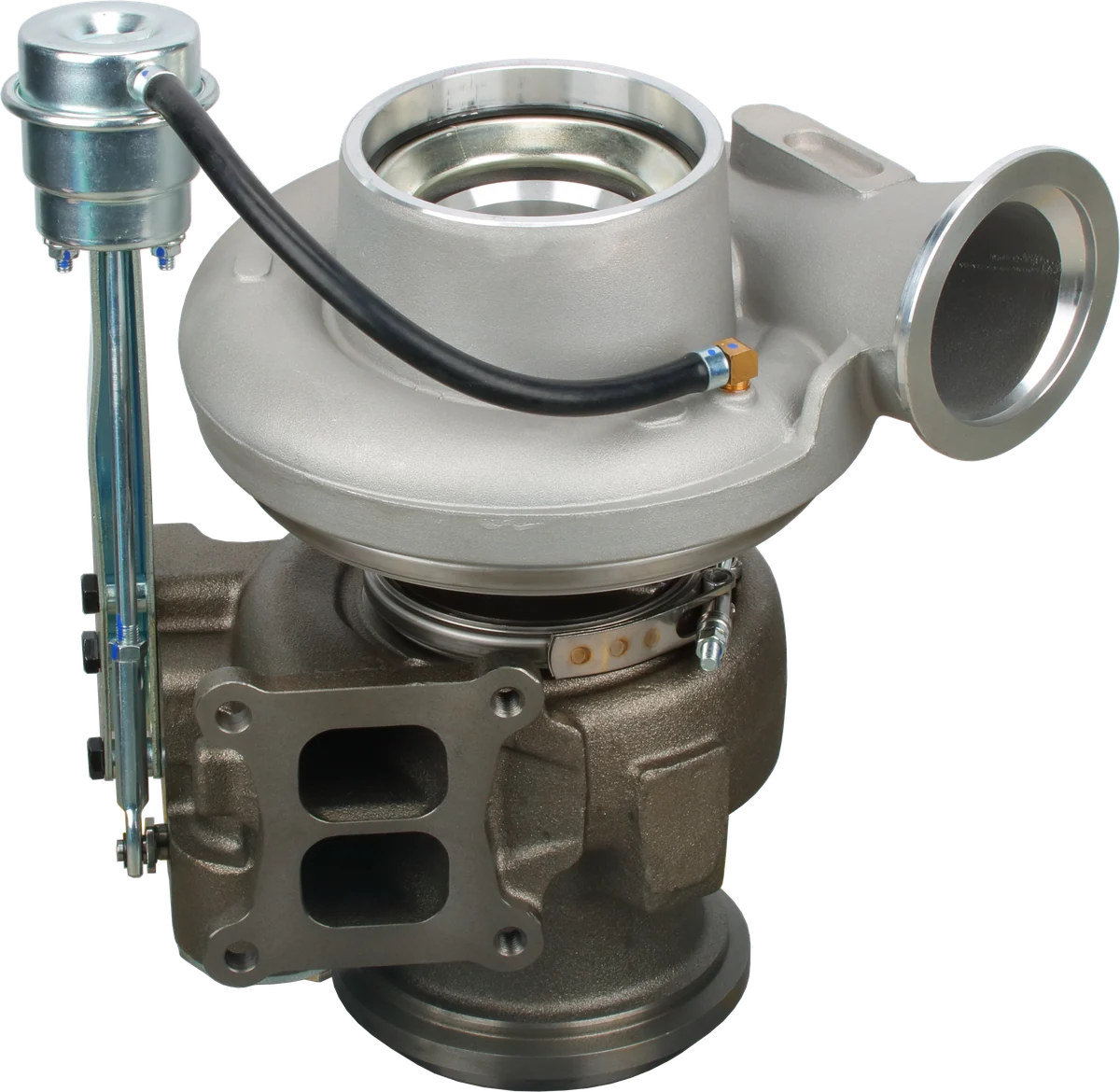
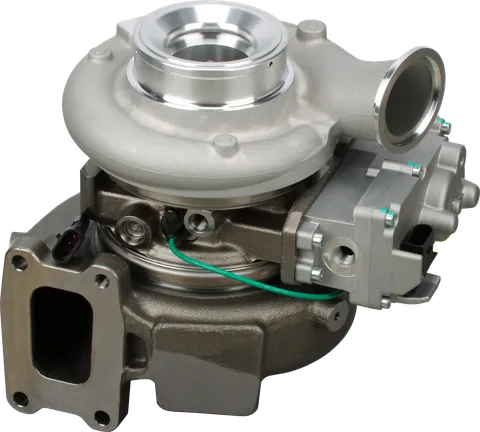
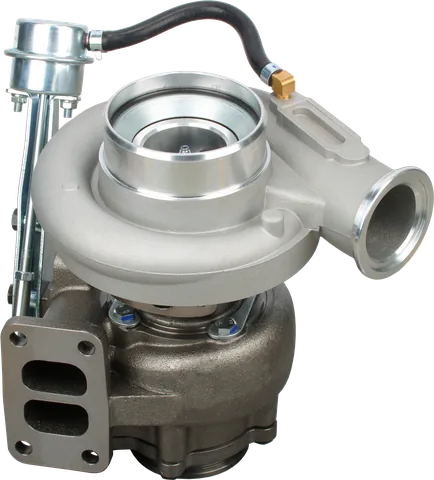
Compressor housing: guides the compressed air.
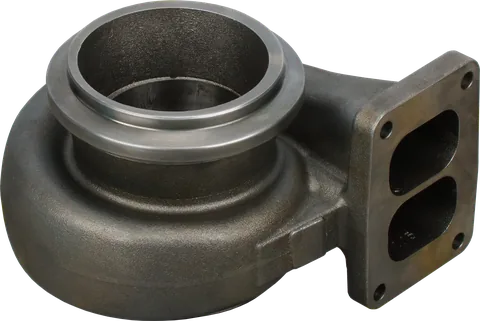
Turbine housing: guides exhaust gas to the turbine.
Actuator: check its type, linkage and calibration.
Product photograph from 2026. Numbers identify the features explained below.
Allow surge margin for the real working range
Surge margin is the operating allowance between normal compressor operation and unstable airflow. It needs to cover real conditions, including intake restriction, cooler fouling, temperature changes, and transitions between loads. A match that looks acceptable only with clean components at rated power is incomplete.
A generator's narrow speed range can make steady-state matching easier, but it still needs validated behavior during specified load pickup and rejection. Load acceptance means taking on electrical demand without unacceptable speed loss or poor combustion while boost catches up.
For propulsion, distinguish ordinary fixed-pitch cruising from duties that demand substantial torque at low rpm. Towing and controllable-pitch operation can require more operating flexibility. Vehicle applications similarly need margin across changing speed and torque.
There is no universal surge-margin percentage that buyers should apply to all three. Margin definitions differ, and the required allowance belongs to the approved engine-turbo match. Specify the actual service duty instead of requesting maximum boost.
Match the cooler and coolant circuit
Low-temperature water-cooled charge air coolers are common in marine and stationary diesel installations. Many use a separate cooling circuit, allowing charge air cooling without depending entirely on the hotter engine jacket-water circuit. The cooler belongs in the turbo match because charge temperature and pressure loss affect the air reaching the cylinders.
In marine service, seawater may remove heat from a closed freshwater circuit through a heat exchanger. Other installations pass raw water through a cooler designed for that service. Follow the actual circuit: seawater is not automatically intended to flow through a turbo housing.
A restricted water side can leave charge air too hot even when boost seems normal. Deposits on the air side can increase pressure loss as well as reduce heat transfer. An internal cooler leak can also admit water into the intake.
Colder is not always better. Excessive cooling can encourage condensation, so keep specified temperature controls and condensate arrangements functional. The cooler's cleanliness and coolant supply are part of the conditions under which the turbo must operate.
How do marine turbocharger bypasses work at low load?
Some highly boosted engines use factory-designed bypass controls to make a turbo optimized for heavy load behave properly at lighter operating points. An air-side bleed or bypass can allow more flow through the compressor than the cylinders consume, helping move compressor operation away from surge.
Engineered intake and exhaust bypass arrangements can also improve low-load air supply and reduce exhaust temperature and cylinder thermal loading. Those benefits depend on the passage routing, pressure differences, and control schedule. Opening an arbitrary valve does not guarantee more useful air in the cylinders.
Keep the factory arrangement and settings. A turbine wastegate changes turbine power by diverting exhaust around the turbine; it does not automatically reproduce a low-load air-bypass strategy.
If bypass equipment is fitted, verify valve movement, actuator supply, and control signals against the engine's service procedure. A stuck valve can undermine an otherwise correct replacement.
Account for salt exposure and hot surfaces
Salt-laden intake air and spray can leave deposits, promote corrosion, and compromise exposed connections. Intake location, mist separation, and enclosure ventilation therefore matter alongside the turbo itself. A protected engine room still needs inspection for salt tracks and signs of water entry.
Ship safety rules generally require surfaces above about 220 °C (428 °F) to be insulated where oil or fuel could reach them.
Some marine installations use water-cooled turbine housings to manage surface temperature; others use specified shields and insulation. Cooling connections may serve different parts of the assembly, so identify their function instead of treating all water-cooled units as equivalent.
Hot exhaust housings remain a burn and fire concern wherever fuel or lubricating oil could leak or spray onto them. Maintain the specified guards, shields, and insulation, including coverage around adjoining exhaust parts. Replace damaged protection and correct the leak that contaminated it.
Do not cover unfamiliar areas with generic wrap. The approved arrangement must preserve access, drainage, clearances, and any necessary heat dissipation. Also check exhaust supports: a rigid or poorly supported installation can transfer vibration and pipe loads into the turbo housing.
Marine vs truck turbocharger: why fit is not enough
For a marine diesel turbocharger, the propulsion rating and installed cooling arrangement matter as much as the engine family. A truck version may bolt into place while delivering the wrong airflow or lacking required heat protection.
On class-registered vessels, the turbocharger may need type approval from the classification society, and the replacement must match the approved assembly.
| Difference to verify | Why appearance is insufficient |
|---|---|
| Compressor and turbine specification | Similar covers can hide different flow capacity and operating limits. |
| Housing cooling and insulation | A truck assembly may lack the required marine thermal protection. |
| Power and duty rating | Intermittent output is not evidence of suitability for sustained load. |
| Controls and bypass hardware | Actuation and calibration must match the engine's intended behavior. |
| Connections and installed orientation | Oil drainage, coolant routing, and exhaust support must remain correct. |
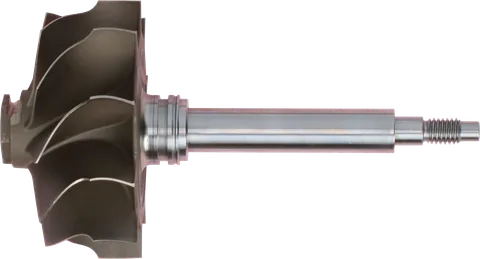
A complete assembly specification matters more than a family nickname. Even a shared basic engine can have different propulsion, auxiliary, and road ratings. The same caution applies to replacement cores: external fit does not establish that the rotating assembly matches.
Interchangeability needs a verified application-specific cross-reference. Resolve uncertain identity before installation; fueling or boost adjustments cannot establish whether an unsuitable turbo is safe for the application.
Maintain airflow, cooling, and protection
Build a marine turbocharger maintenance checklist around changes from a healthy baseline. Record boost, exhaust temperature, charge air temperature, rpm, and load under comparable conditions. A generator's electrical load and a boat's propulsion condition give those readings context.
| Check | What to inspect | Practical reason |
|---|---|---|
| Intake filter or separator | Restriction, salt deposits, damaged seals | Restricted or contaminated intake air changes compressor conditions. |
| Charge air cooler, air side | Deposits, leaks, damaged joints | Lost airflow or pressure can imitate poor turbo performance. |
| Cooler water circuit | Strainers, flow, corrosion, coolant condition | Poor heat removal raises charge temperature. |
| Heat protection and supports | Loose shields, wet insulation, stressed connections | Surface hazards and installation damage can develop unnoticed. |
Inspect coolers on the specified schedule, including the water side. Use the manufacturer's inspection and test limits; an improvised pressure test can damage a cooler. Investigate unexplained coolant loss or water in the intake promptly.
Large marine turbochargers often also have a turbine-side wash (water or dry granulate) to remove fuel-ash deposits from the nozzle ring and blades; use only the method the engine builder specifies. Only certain turbochargers are designed for compressor washing. An approved wash removes deposits that reduce compressor efficiency. Fluid type, quantity, injection method, and operating conditions are specific to the equipment. Improvised washing can damage blades or carry liquid into the engine.
Keep service records, especially after changes to cooling performance or intake restriction. They help distinguish deterioration from an unsuitable replacement specification.
Check performance under representative load
Assess a replacement under the manufacturer's commissioning procedure and representative working conditions. An unloaded run cannot establish full-load suitability for either a generator set turbocharger replacement or a propulsion unit.
- On a genset, check steady operation and approved load steps, including speed or frequency recovery.
- On a boat, confirm specified loaded rpm with the intended propeller and vessel condition.
- Compare temperatures and boost at equivalent loads, allowing for ambient air and cooling-water conditions.
- Investigate persistent surge, abnormal heat, or lost loaded speed before extending the run.
Common Questions
Can a standby generator use the same turbo as a prime-power set?
Sometimes, but the rating and approved parts list must agree. Identical engine displacement does not establish compatibility. Compare the engine build, power rating, turbo assembly number, and load-acceptance requirements.
Can propeller problems mimic turbocharger failure?
Yes. A damaged, fouled, or unsuitable propeller can alter engine loading. If full-throttle rpm falls while smoke or exhaust temperature rises, check the propulsion load and hull condition before blaming the turbo.
Does every marine turbo need a water-cooled housing?
No. Some installations use water-cooled housings; others manage surface heat with specified insulation and shields. Keep the arrangement approved for the engine and installation, including any required coolant connections.
Can I wash the compressor on any turbo?
No. Washing is appropriate only where the manufacturer provides a procedure for that turbo and installation. Use the specified fluid, equipment, and operating conditions; otherwise, arrange cleaning using the approved service method.
How do I identify the correct marine diesel turbocharger?
Provide the complete turbo assembly number, engine model and serial number, rated power and rpm, and service duty. Include photos showing coolant ports, housing orientation, and identification plates when available.
Contact LeadTurbo with the turbo part number, engine details, application, and rating for help checking the correct replacement.