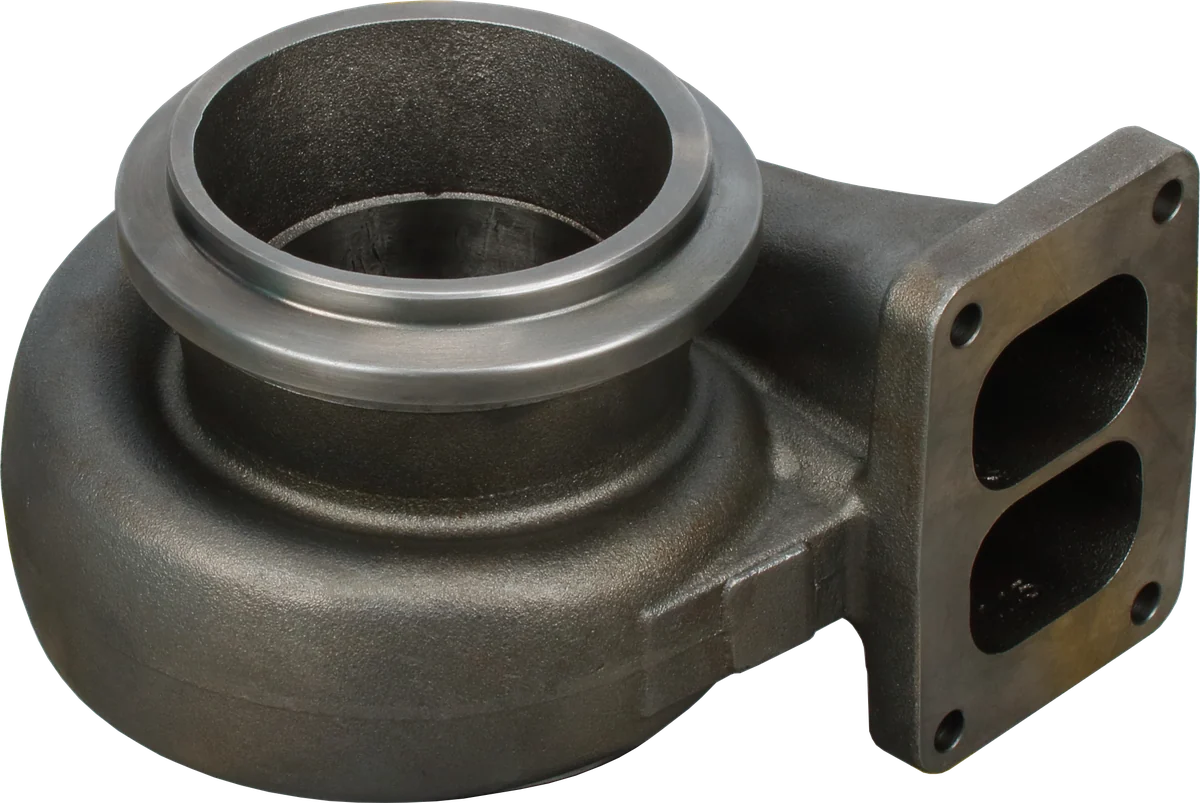
Melted wire insulation, hardened hoses, and repeated manifold cracks deserve a diagnosis before another layer goes on. Heat protection can reduce exposure around a healthy exhaust system. It cannot repair a leaking flange, restore missing pipe supports, or make an incorrectly routed harness safe. If a turbocharger was recently replaced, start by checking what was removed or moved during the job.
Find out where the heat is coming from
The manifold and turbine housing receive heat from exhaust gas. Their hot surfaces radiate energy toward nearby components without needing to touch them. A hose facing the housing can therefore overheat even when it has an air gap. A leaking exhaust joint creates a different problem: a concentrated stream of hot gas that shielding cannot reliably contain.
Heat also travels through brackets and flanges by conduction, while moving air carries it around the engine compartment. At road speed, airflow may clear some of that heat; a loaded machine working slowly can have a very different local environment. After shutdown, stored heat continues moving into cooler neighboring parts.
Protecting the intake duct can reduce external heating before air reaches the compressor. It does not remove the temperature rise caused by compression, and lower temperatures beside a shield do not guarantee the whole engine compartment becomes cooler.
| Finding | Check first | Useful next step |
|---|---|---|
| Brittle wiring near the turbine | Missing shield, wrong routing, lost clips | Restore routing and the specified barrier |
| Soot beside a flange | Failed joint, loose hardware, distorted mating faces | Repair the leak before insulating |
| Cracks that return | Restricted thermal movement, pipe weight, support condition | Correct the mechanical cause |
| Heat damage after turbocharger replacement | Shield fit, housing orientation, clearances | Compare the installation with service information |
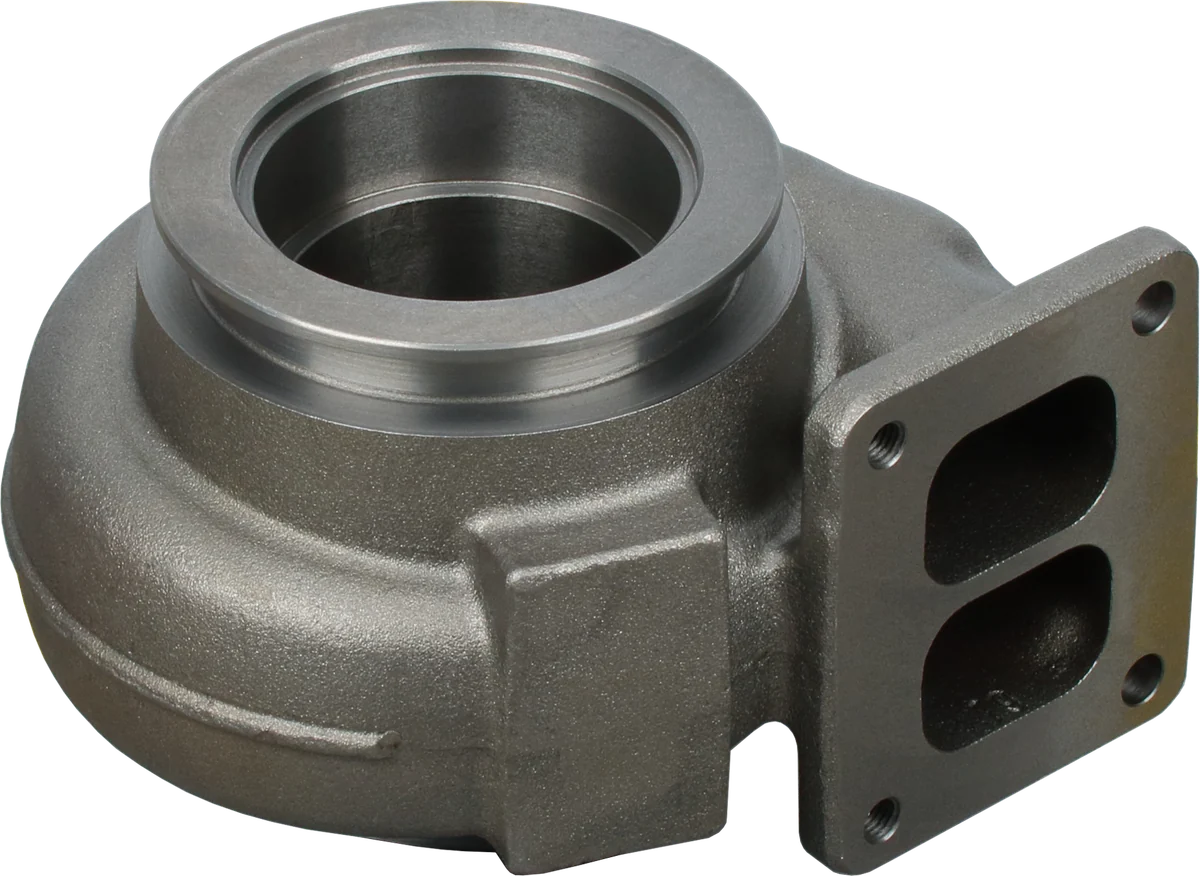
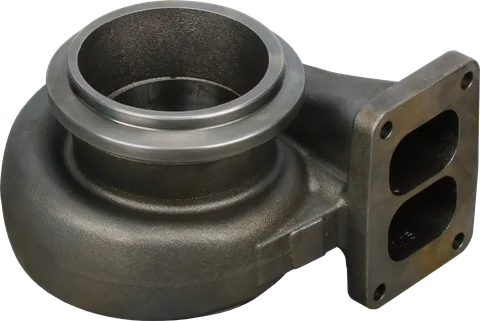
Exhaust inlet: verify the flange and passage geometry.
Turbine cavity: check clearance and contact damage.
Mounting face: the replacement must match the interfaces.
Product photograph from 2026. Numbers identify the features explained below.
Choosing a turbo heat shield, blanket, or coating
A turbo heat shield usually interrupts radiation with a formed barrier and a designed gap. A turbo blanket adds insulation close around the hot housing. An external thermal barrier coating changes heat transfer through a treated surface. These methods do different jobs, and their effectiveness depends on construction and fit.
| Option | Best use | Main limitation |
|---|---|---|
| Factory metal shield | Protects selected nearby parts while preserving designed clearances | Missing spacers, cracks, or poor alignment undermine protection |
| Removable turbine blanket | Reduces heat escaping from the covered housing surface | Holds more heat in the hot side and conceals inspection points |
| Specified thermal barrier coating | Adds protection where a bulky cover cannot fit | Performance depends on the coating system; preparation and adhesion matter |
| Wrap on manifold or exhaust piping | Provides insulation close to the surface where the installation specifically permits it | Can retain moisture and contamination and obscure pipe condition |
The clearest benefit is less radiant exposure for wiring, hoses, reservoirs, and nearby intake plumbing. Protection can also reduce local under-hood temperatures, depending on airflow and the installation. Turbine housing insulation may help the hot side reach operating temperature sooner by reducing heat loss. Neither benefit establishes a reliable improvement in fuel economy, power, or response. Coolant and engine oil warm-up depend on much more than the turbine cover.
The trade-off is that covered metal may run hotter. Whether that is acceptable depends on the casting, operating duty, and the turbocharger manufacturer’s limits. An accessory chosen for occasional pickup use is not automatically suitable for a generator running under sustained load. Ordinary paint rated for high temperatures should not be treated as an insulating coating.
Blankets and wrap also make cracks, soot trails, and fluid leaks harder to see. Oil or fuel contamination creates a fire hazard; absorbed water and road salt can encourage corrosion beneath a cover. Use only a product specified for the application, with access for inspection and removal.
How to choose turbocharger heat protection for the actual duty cycle
If the problem is one harness beside an otherwise sound installation, restoring its clips and the original barrier may solve it. A suitable protective sleeve or a small shield with proper spacing can provide targeted protection where the equipment maker allows it. Insulating the entire manifold may introduce more inspection work without addressing the routing problem.
For equipment that spends long periods under load, assess cooling airflow, nearby service lines, exhaust supports, and access around the cover. Include operation at low speeds and the period immediately after stopping, as appropriate for normal duty. A quick idle check may miss the conditions that damaged the original component.
Choose a removable solution matched to the application when regular access is needed. Check the turbocharger blanket’s temperature rating for the complete assembly. An outer cloth’s rating alone does not establish that the liner, stitching, and retainers suit the job.
Refit the original shields after a turbocharger swap
OEM shields are part of the installation’s heat protection system. Their shape, mounting position, and spacing protect particular components while allowing room for vibration and thermal movement. A replacement turbocharger that fits the exhaust connections can still leave a problem if its surrounding shields, clips, or brackets are omitted.
Before returning the vehicle or machine to service:
- Reinstall the correct shields, spacers, washers, and brackets in their specified positions.
- Replace shields with broken mounting tabs, severe corrosion, or distortion that prevents proper clearance.
- Check that wiring and hoses follow their intended routes and retain their supporting clips.
- Keep covers clear of the actuator, moving linkage, and connections that require access.
- Tighten hardware using the specified procedure; use locking parts where the manufacturer requires them.
A loose shield can rattle, rub through adjacent material, or fatigue at its mounting holes. Thermal cycling, damaged brackets, and incorrect fastening can let bolts loosen. Do not respond by tightening every fastener harder: use the specified torque and perform follow-up tightening only when the service procedure calls for it.
Treat additional insulation as an addition to the specified arrangement unless the equipment manufacturer approves a replacement configuration.
Give the exhaust room to grow
An exhaust manifold expansion joint accommodates movement as hot parts lengthen. Long manifolds, crossover pipes, and exhaust runs can develop substantial growth across their length. When supports or rigid connections restrain that movement, forces build at flanges, studs, and changes in section. Repeated cycles can contribute to cracks and leaks.
Depending on the engine, movement may be handled by segmented manifold joints, sliding connections, formed bellows, or a specified flexible pipe section. These components are not interchangeable.
| Location | Intended movement control | Service check |
|---|---|---|
| Long manifold assembly | Factory sliding or segmented joints, or an engineered expansion joint | Confirm joints are not seized, incorrectly assembled, or rigidly bridged |
| Crossover or turbine inlet piping | Joint rated for pressure and selected for the designed movement | Check alignment, supports, and the specified installed position |
| Exhaust piping after the turbo | Suitable bellows or flexible section with proper pipe support | Keep exhaust weight and forced misalignment off the turbocharger |
Bellows must suit temperature, pressure, expected travel, and repeated cycling. A flex connector intended for a tailpipe is not automatically suitable upstream of the turbine. Do not twist a bellows into place, use it to pull misaligned flanges together, or expect it to support heavy piping.
For a fabricated system, joint placement and supports need to be designed together. Insulation must leave the joint’s required movement intact. Adding a blanket does not provide expansion relief, and fitting a bellows does not cure a weak bracket or an unsuitable manifold.
How to inspect a diesel turbocharger blanket and the covered parts
Inspect with the engine stopped and cooled, following the equipment’s service procedure. Record the condition before fitting additional protection so later changes are easier to recognize. Removable insulation is only serviceable if someone can actually remove it without damaging surrounding parts.
- Look underneath. Remove a removable blanket as instructed and check the housing, flanges, and nearby pipework for cracks, corrosion, soot, or fresh fluid.
- Check the fabric and fasteners. Frayed layers, scorched seams, broken retainers, or shifted coverage call for assessment and replacement where needed.
- Treat wet insulation as a fault. Find the fluid source. Keep insulation soaked with oil or fuel out of service and follow the supplier’s replacement instructions.
- Check mounting points. Look for missing hardware, elongated holes, polished rub marks, or cracked brackets. Repair the cause of movement before refitting.
- Preserve access and clearance. Do not improvise wrapping around the center housing, oil connections, or actuator. Follow the approved cover’s installation boundaries.
- Inspect expansion joints. Soot, damaged corrugations, broken braid, or a joint sitting at the end of its travel requires investigation.
After reassembly, check for leaks and interference through an appropriate operating cycle, then inspect again once everything has cooled. Pay particular attention after a turbo replacement, exhaust repair, fluid leak, or unexplained increase in heat damage.
For a useful temperature comparison before and after installation, repeat similar load, ambient conditions, and fan operation. Measure the component being protected, not just the cover’s outer skin. Shiny metal can mislead an infrared thermometer, so use a suitable measurement method. A cooler cover surface does not prove that the casting underneath is cooler.
Common Questions
Turbo heat shield vs blanket: which is better?
For an otherwise standard diesel installation, restore the factory shield first. A correctly specified blanket can help where additional insulation is needed, but it must suit the housing, nearby controls, operating duty, and inspection requirements.
Will a blanket make the turbo spool faster?
Retaining exhaust heat may affect response, but a useful improvement is not guaranteed. Choose insulation to control exposure around the hot side, rather than expecting a dependable increase in boost or power.
Will insulation warm a diesel faster in winter?
It may help the turbine housing and nearby exhaust hardware warm faster. That does not establish a meaningful reduction in coolant or oil warm-up time, particularly during light-load operation.
Can I cover an exhaust leak or cracked manifold?
No. Repair the fault and find its cause before adding insulation. A cover can conceal soot tracks and damage while a leaking joint continues heating nearby components.
How often should a blanket be removed?
Follow the blanket supplier’s and engine manufacturer’s inspection requirements. Remove it for inspection whenever there is a new exhaust smell, soot, fluid leakage, loose hardware, or an unexplained change in nearby heat damage.
Why is my turbocharger melting wiring?
Missing shields, incorrect routing, lost clips, or exhaust leaks can expose nearby wiring to heat.
When should turbocharger heat shields be replaced?
Replace shields with broken mounting tabs, severe corrosion, or distortion that prevents proper clearance.
For help selecting a replacement turbocharger or parts, contact LeadTurbo with the turbo part number, engine model, and application details.