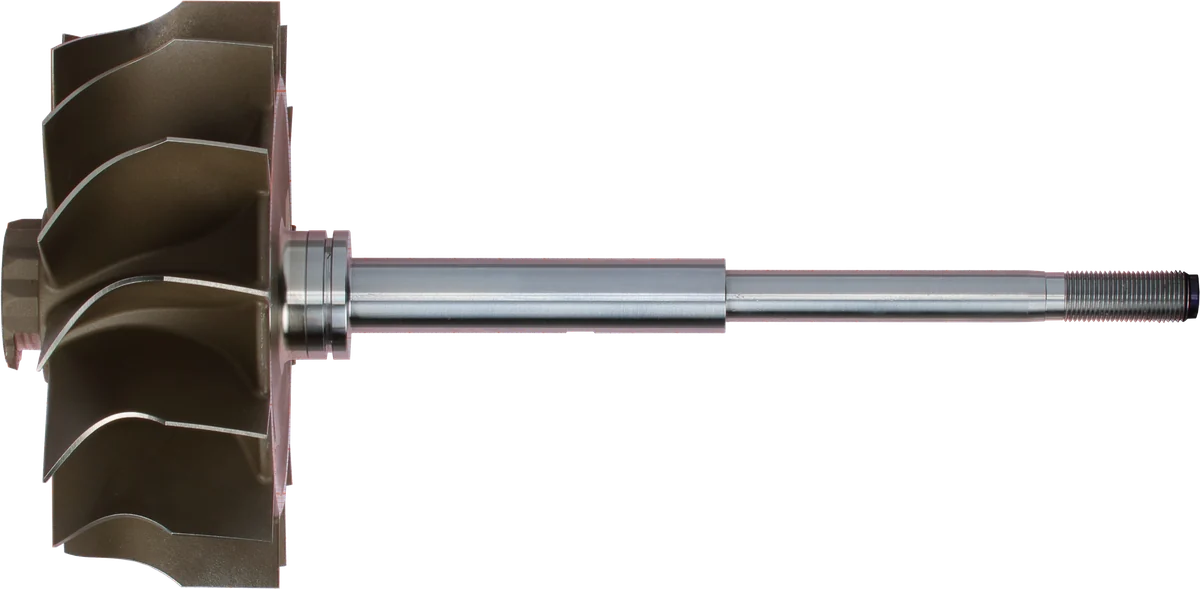
Why this small part costs so much
A turbine wheel spends its working life in exhaust gas while spinning under heavy load. In a highway tractor, excavator, or irrigation pump, sustained output can matter as much as brief acceleration. The material must retain strength through both.
Nickel alloy feedstock is costly, and the work does not end at the pour. Mold tooling, controlled processing, rejected castings, machining, inspection, and application validation all affect price. An inexpensive wheel may be serviceable, but matching dimensions and a familiar alloy name do not demonstrate equivalent durability.
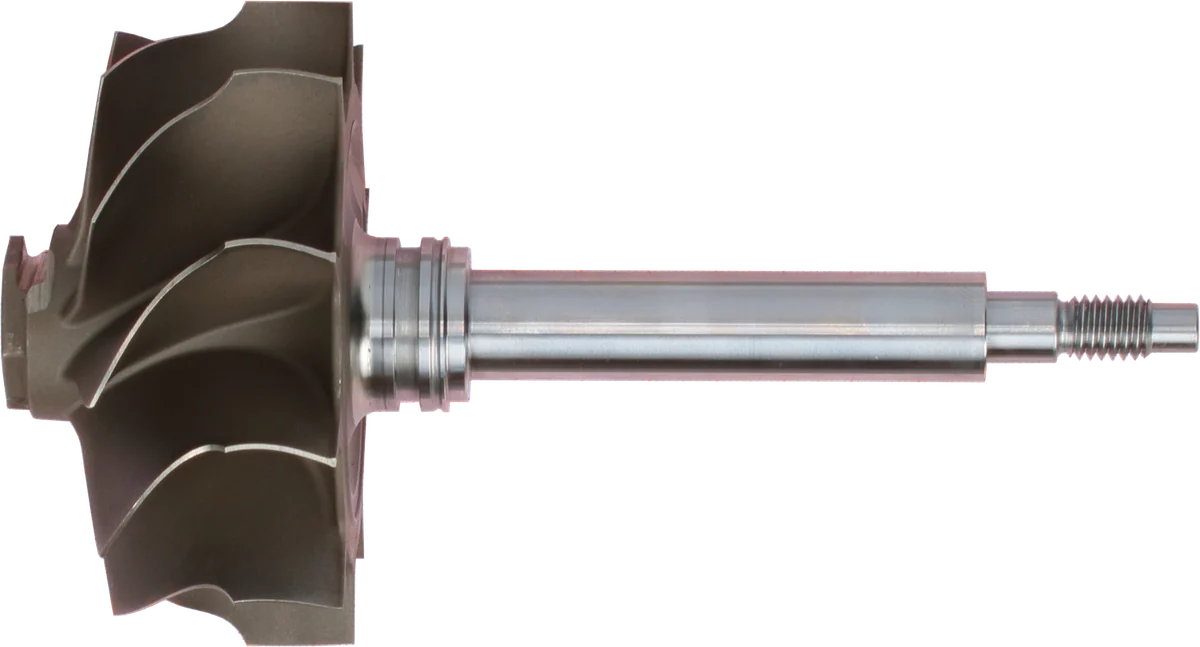
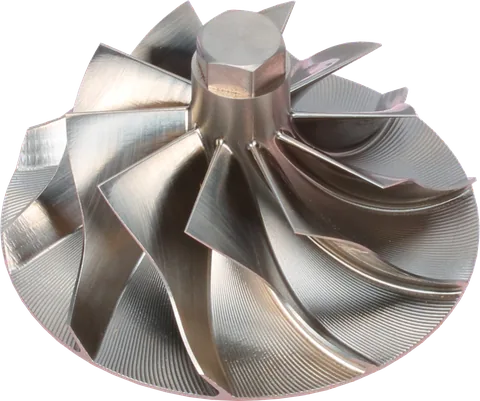
Turbine wheel: exhaust energy drives the shaft.
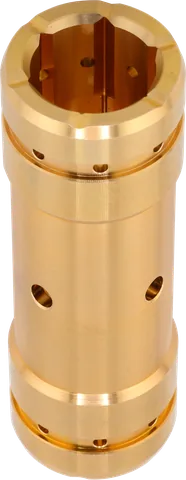
Shaft surface: inspect wear and scoring before reuse.
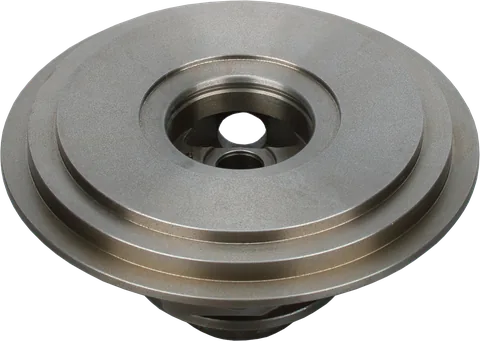
Shaft end: connects to the compressor-side rotating parts.
Product photograph from 2026. Numbers identify the features explained below.
What must turbine wheel material withstand?
These loads occur together, so a wheel cannot be selected using only a maximum temperature claim.
| Load | Effect on the wheel | Service implication |
|---|---|---|
| High temperature | Weakens the alloy and enables creep | Time at temperature matters, especially during sustained load |
| Centrifugal stress | Pulls rotating mass outward | Hub and blade roots must withstand the rated speed |
| Thermal cycling | Creates stress as hot and cooler regions expand differently | Repeated starts and load changes can accumulate damage |
| Blade vibration | Produces repeated bending stress | Small flaws can become fatigue crack initiation sites |
| Oxidation | Attacks the surface and consumes metal | Surface damage can reduce the remaining fatigue margin |
Exhaust gas temperature is not the same as wheel metal temperature. Heat transfer, operating time, and local flow all affect the metal. Likewise, using a stronger alloy does not authorize running the turbocharger beyond its approved speed.
Why does a diesel turbocharger use nickel?
Cast nickel superalloys offer a useful combination of hot strength, oxidation resistance, and manufacturability. Nickel forms the base; other elements strengthen the structure and help it develop protective oxide layers. The chemistry must work with the casting process, not just look impressive on a certificate.
Four properties deserve attention:
- Creep strength: resistance to slow, permanent deformation under sustained stress at elevated temperature.
- Fatigue resistance: ability to survive repeated mechanical loading and uneven heating without cracks growing.
- Oxidation resistance: ability to limit surface attack in hot exhaust over the intended service interval.
- Castability: ability to produce sound thin blades and a thick hub with consistent geometry and structure.
Hardness measured at room temperature alone says little about extended hot performance. An alloy can pass a simple hardness check yet have unsuitable chemistry, casting defects, or the wrong microstructure. Creep and fatigue behavior must be established for the relevant temperature and loading conditions.
An Inconel turbine wheel label is incomplete: Inconel names a family of nickel alloys, not one universal grade. Ask which grade and manufacturing specification apply. Neither a higher nickel percentage nor a higher advertised heat limit automatically makes a replacement suitable.
Why gasoline applications can need different alloys
Diesels generally operate with excess air and often have lower turbine inlet temperatures than performance gasoline engines. Their greater thermal efficiency also helps explain this difference. However, a heavily loaded diesel can impose long periods of thermal stress even without the highest peak temperature.
Hotter gasoline applications may require nickel grades with greater creep strength and oxidation resistance at their design temperature. That does not make every wheel intended for gasoline service an upgrade for a truck: geometry, speed capability, and engine duty still govern suitability.
For diesel service, use the OEM limits for the exact turbocharger and measurement location. Overfueling or restricted airflow can consume its thermal margin; an alloy change is not a repair for either condition.
How lighter materials compare
Lower density can reduce rotational inertia and the energy needed to accelerate a wheel of comparable geometry. That creates response potential, but changing the material also changes the design problem.
| Material | Heat and creep capability | Relative mass | Impact tolerance | Service cost and availability |
|---|---|---|---|---|
| Cast nickel superalloy for diesel duty | High within its rating | High | Relatively good | Established replacement supply |
| Nickel superalloy for hotter duty | Higher potential, grade dependent | High | Relatively good | Often higher cost |
| Titanium aluminide | Application and grade dependent | Low | Lower | Specialized, often expensive |
| Silicon nitride ceramic | High heat resistance; design dependent | Very low | Low | Specialized, limited replacement supply |
These qualitative comparisons assume comparable geometry and suitable grades; they do not establish temperature limits or interchangeability. All can fail from debris impact.
A titanium aluminide turbine wheel offers substantial mass reduction compared with nickel alloys. It is an intermetallic material, not ordinary titanium. Restricted ductility, impact sensitivity, difficult processing, and temperature limits that depend on the application complicate its use. Manufacturing cost can outweigh the response benefit for equipment that operates steadily for hours.
Ceramic wheels, historically including silicon nitride, also offered low mass and heat resistance. Their brittleness makes small defects and debris impacts especially consequential. Toughness and manufacturing consistency matter as much as temperature capability when comparing nickel vs ceramic turbocharger turbine wheels; neither ceramic nor titanium aluminide is a casual substitute during a diesel rebuild.
How an investment cast turbine wheel gets its strength
Thin blades and a thicker hub do not solidify at the same rate. A foundry must control metal feeding and cooling so shrinkage does not leave harmful cavities, especially in highly stressed regions.
The turbocharger investment casting process, also called lost-wax casting, uses a disposable wax pattern to create a ceramic mold cavity. The process reproduces complex blade passages that would be expensive to machine from solid metal. Tooling, mold quality, and dimensional control all influence the finished geometry.
Vacuum melting helps control contamination and unwanted reactions during alloy preparation; controlled pouring remains essential. Vacuum processing alone does not certify the chemistry or eliminate porosity.
The solidified metal contains grains whose size, distribution, and boundaries affect creep and fatigue. Finer grains are not automatically better for every duty. Cooling practice and any specified heat treatment must produce the intended structure, with checks for segregation and undesirable phases.
Welding a wheel to its shaft also requires a qualified process and inspection.
How to spot turbocharger wheel casting defects
A good supplier combines checks because no single test establishes alloy identity, internal soundness, and finished geometry.
| Check | Useful evidence | Important limitation |
|---|---|---|
| Visual and dimensional inspection | Blade shape, surface condition, damage, and fit | Hidden defects and alloy chemistry remain unknown |
| X-ray inspection or industrial CT | Internal porosity, shrinkage cavities, and some inclusions | Detection depends on defect size, orientation, and setup |
| Dye penetrant inspection | Cracks or other flaws open to a clean surface | Does not reveal sealed internal defects |
| Chemistry and metallurgical checks | Alloy composition and sampled grain structure | Sampling does not prove every wheel is defect free |
| Balance verification | Mass distribution and residual imbalance | Does not establish strength or casting integrity |
Inspection frequency and acceptance criteria depend on the qualified production plan; do not assume every wheel is individually X-rayed. Ask what is checked on each part and what is verified by batch.
At the bench, quarantine a replacement with cracklike lines at blade roots, open cavities, bent blades, missing edges, or irregular grinding that changes the blade profile. These are reasons for supplier review, not an invitation to blend away the evidence.
An even, slightly textured cast surface can be normal. A shiny finish does not prove a sound interior, and a visible flaw on a used wheel does not establish whether manufacturing or service caused it.
Buying an OEM or aftermarket replacement
A turbine wheel material claim becomes useful when it is tied to a traceable part and the intended engine application.
- Confirm the turbo part number, revision, engine rating, and service duty; matching wheel diameter alone is insufficient.
- Ask for an alloy designation and evidence of suitability, rather than accepting “premium alloy” or “racing specification.”
- Check traceability, manufacturing controls, and the supplier's inspection policy, including handling of rejected parts.
- Confirm blade geometry and housing compatibility; similar wheels can have different flow and stress characteristics.
- For rebuilds, use the applicable acceptance criteria and required rotor and assembly balance procedures.
- Compare the complete repair cost, warranty terms, and supplier support, especially where equipment downtime is expensive.
OEM identification offers a defined route to the original specification. A documented aftermarket equivalent can also be appropriate, but the seller should establish the match. A material upgrade cannot correct an unsuitable wheel design, and a balance report cannot replace evidence of sound metallurgy.
Parts for this guide
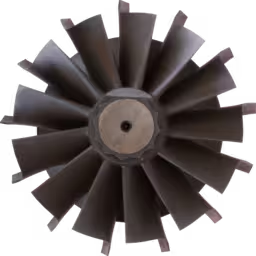 3819093 TW HX82 Turbine Wheel Replacement for Komatsu 930E QSK78
FOR 3819093 TW
Turbine wheel
In Stock
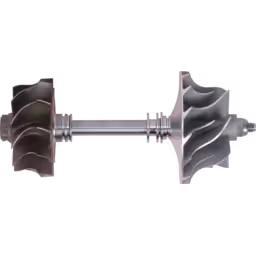 S300W049 Turbocharger Rotor Assembly for CAT 3116
BJMXRA0046527
Rotor Assy
In Stock
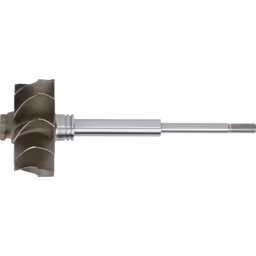 166196 S4DSL029 Turbine Wheel Replacement for CAT 3412E & D8N
166196
Turbine wheel
In Stock
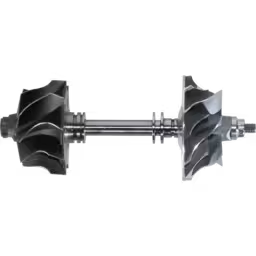 465153-5004S RA Turbocharger Rotor Assembly for Ford & New Holland
FOR 465153-5004S RA
Rotor Assy
On backorder — orders accepted
Common Questions
What turbine wheel material is best for a working diesel?
Usually, the specified cast nickel superalloy. Match the original application and duty rating; a more exotic material is not automatically a better replacement.
Is an Inconel label enough to identify the alloy?
No. Inconel covers multiple alloys. Ask for the grade, application suitability, and traceability rather than treating the name as a complete specification.
Will a lighter turbine wheel improve response?
Lower rotational inertia can help, but the result also depends on wheel geometry, turbo matching, and control calibration. A material substitution alone cannot promise a particular improvement.
Can appearance identify a turbocharger wheel alloy?
No. Similar-looking castings can have different chemistry and internal quality. Alloy verification and manufacturing records provide evidence that color, shine, and surface texture cannot.
Does X-ray inspection find every defect?
No. X-ray inspection can reveal internal cavities, but detection depends on defect size, orientation, and inspection setup. Surface penetrant testing addresses different flaws.
Are aftermarket wheels always inferior?
No. A properly engineered, traceable aftermarket wheel can be suitable. Evaluate the application specification, production controls, and inspection evidence instead of relying on branding or price.
Which turbocharger turbine wheel should I buy?
Match the original application and duty rating. Confirm the alloy designation, blade geometry, housing compatibility, and traceability; matching wheel diameter alone is insufficient.
Contact us with your turbocharger part number, engine details, and operating duty for help identifying a suitable replacement.