How Fast Does a Turbo Spin in Normal Use?
Small automotive turbochargers commonly run well above 100,000 rpm under load, and some small units can exceed 200,000 rpm. Those figures describe the general scale of turbo rpm. They are not an acceptable speed range for every replacement turbo.
Small automotive turbocharger rpm depends on wheel size, airflow, pressure ratio, exhaust energy, and the control system. A small passenger-car turbo and a larger pickup turbo can have different speed limits while both operate correctly.
The turbine and compressor in a conventional turbocharger share a shaft, so they rotate at the same rpm. Neither follows engine rpm at a fixed ratio. An engine pulling hard uphill can supply much more turbine-driving exhaust energy than the same engine turning at similar rpm under light load.
For a specific unit, determine the maximum turbocharger shaft speed from its manufacturer’s operating data and the vehicle application—not a general internet rpm figure.
How Does Wheel Size Affect Turbocharger RPM?
A compressor adds energy to air through its rotating blades. How quickly those blades move through space matters, particularly near the wheel’s outer edge. This is tip speed.
A small wheel travels a shorter distance around its circumference each revolution. To reach the same tip speed as a larger wheel, it must complete more revolutions in the same time.
That helps explain why compact turbochargers spin so quickly. Their small size supports useful airflow and pressure rise through high rotational speed.
Wheel diameter also explains why rpm alone cannot establish safety. At the same rpm, a larger wheel has a higher tip speed. Installing a different compressor wheel therefore changes more than potential airflow: it can change stress, balance, aerodynamic loading, and compatibility with the housing.
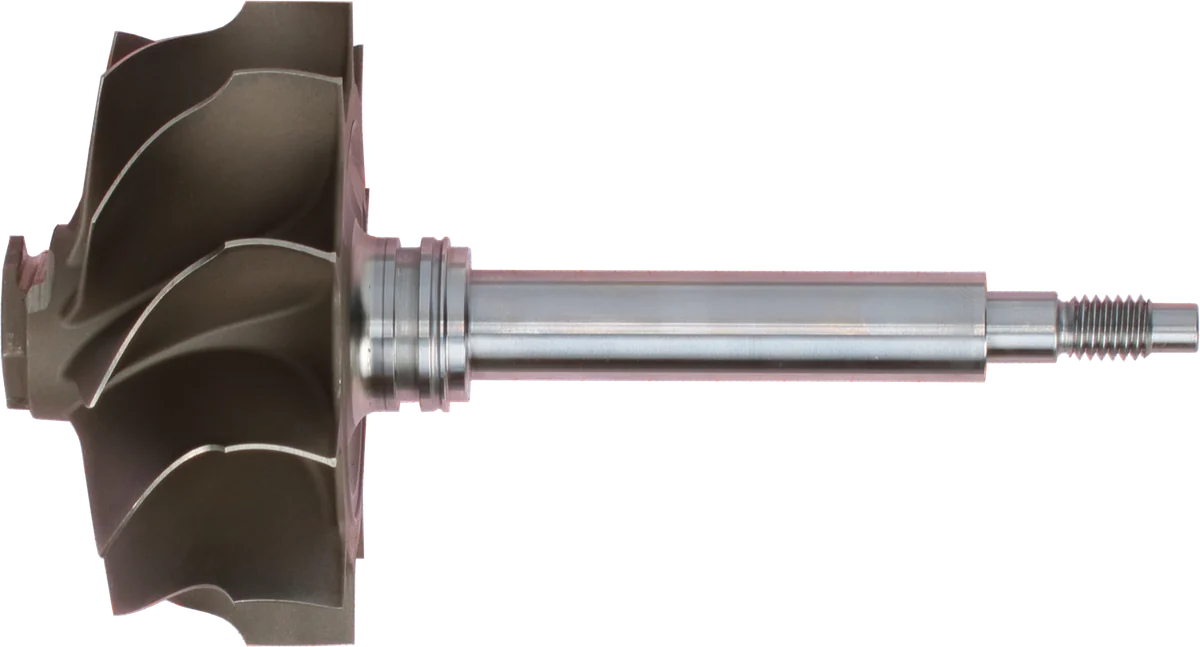
Turbine wheel: exhaust energy drives the shaft.
Shaft surface: inspect wear and scoring before reuse.
Shaft end: connects to the compressor-side rotating parts.
Product photograph from 2026. Numbers identify the features explained below.
What High Turbocharger Shaft Speed Demands from the Parts
Several different limits operate together inside a turbo:
| Factor | What speed changes | Practical implication |
|---|---|---|
| Wheel tip speed | The outer edge moves faster as rpm rises | Use the speed limit for the exact wheel and turbo design |
| Wheel stress | Rotational loading increases strongly with speed | Correct alloy, manufacturing quality, and wheel condition matter |
| Residual imbalance | The same imbalance generates much greater force at higher rpm | A rotor that feels smooth by hand may still need balancing |
| Bearing behavior | Oil-film forces change with speed, temperature, and shaft motion | Correct lubrication and bearing clearances are essential |
| Rotor vibration | Excitation can approach a natural vibration frequency | The assembled rotor and bearings must work as a matched system |
There is no universal tip-speed limit covering every compressor and turbine wheel. Geometry, material, temperature, manufacturing process, and intended service life all affect the allowable operating conditions.
Wheel Materials Must Handle Speed and Heat
Rotation loads the wheel as its mass is continuously accelerated around the shaft. As speed rises, rotational stress increases rapidly. Temperature adds another challenge, particularly on the exhaust side.
Many automotive compressor wheels use aluminum alloys. Turbine wheels commonly use heat-resistant nickel-based alloys because they must retain useful strength in hot exhaust gas. The appropriate material depends on the design; no single alloy is automatically correct for every turbo.
Material identity alone is also insufficient. Casting quality, heat treatment, machining, and inspection affect whether a finished wheel performs as intended. A wheel’s appearance cannot verify its alloy or internal soundness.
Our guide to compressor wheel materials explains the distinctions buyers should understand. Where a turbine design specifies IN713C, why genuine IN713C material matters addresses the importance of meeting that specification.
“Genuine material” should mean the stated alloy and required processing are actually supplied. A marketing label cannot establish either.
Why Tiny Imbalance Becomes a Large Problem
A rotating assembly has imbalance when its mass distribution does not align properly with its rotation axis. Small manufacturing differences, damaged blades, deposits, or assembly changes can contribute.
For an unchanged imbalance, doubling shaft speed produces four times the imbalance force. That is why hand-spinning a turbo tells you little about its behavior under load.
The resulting vibration does not necessarily increase in the same simple proportion. Shaft flexibility, bearing support, damping, and proximity to resonance influence the response.
Balancing individual components is useful, but assembly introduces additional variables. The completed rotor or CHRA needs the balancing and verification process appropriate to its design, often including high-speed CHRA vibration testing.
Read turbocharger balancing explained before treating a wheel swap as a simple parts replacement. Balancing cannot repair cracked material, incorrect geometry, or damaged bearing surfaces.
Oil Films Support and Dampen the Rotor
In a journal-bearing turbo, the operating shaft rides on a hydrodynamic oil film. Shaft movement draws oil into a narrowing gap, developing pressure that supports the rotating assembly. The oil also removes heat and helps damp vibration.
Many designs use floating-ring bearings, with oil films between the shaft and ring and between the ring and housing. Those films form part of the rotor’s support system.
Their behavior changes with oil viscosity, temperature, clearances, and shaft motion. Inadequate supply, contamination, or incorrect assembly can compromise that support. See how floating-ring bearings work for a closer explanation.
Oil films can also produce self-excited vibration under certain conditions. Oil whirl involves shaft-center motion below rotational frequency, often roughly half shaft speed or less. Oil whip occurs when an instability becomes associated with a rotor natural mode and its frequency no longer rises proportionally with shaft speed.
These mechanisms differ from simple imbalance. A sound recording alone cannot identify them reliably.
Turbo Critical Speed: Resonance, Not a Redline
A rotor can move sideways, rock on its supports, and bend. These different movement patterns are called vibration modes. Their natural frequencies depend on the shaft, wheels, bearings, and operating conditions.
A turbo critical speed occurs when a rotating excitation can strongly excite one of those natural modes. Imbalance, for example, applies a force that repeats once per shaft revolution. When that repeating force aligns with a suitable natural frequency, vibration can increase.
Engineers use a Campbell diagram to examine these relationships. Imagine a chart with shaft speed running across the bottom and vibration frequency up the side. Lines show how the rotor’s natural frequencies change with speed. Another line shows the once-per-revolution excitation. Relevant crossings flag potential resonance conditions for further evaluation.
A crossing does not automatically mean failure. Damping and the strength of the excitation determine how large the response becomes.
A properly engineered turbo may pass through critical speeds while accelerating or slowing down. Its rotor and bearing system must keep movement acceptable during those passages. This is different from exceeding its maximum approved shaft speed.
What Causes Turbo Overspeed?
Turbo overspeed means the rotor exceeds its allowable speed. Boost pressure alone does not reveal whether that has happened.
Common causes or contributing conditions include:
- Higher altitude: Lower inlet absolute pressure increases the compressor pressure ratio needed to maintain a given absolute outlet pressure. This can require greater shaft speed. Correct controls may reduce output to protect the turbo.
- A charge-air leak: Escaping compressed air can make the control system demand more turbine effort to recover manifold pressure. Depending on the leak and control strategy, the turbo may accelerate beyond its intended range.
- An unsuitable tune: Increased boost targets, fueling changes, or altered control limits can demand operation beyond the turbo’s approved capability.
- Stuck VGT vanes: Vanes stuck in a position that excessively restricts the turbine nozzle area for the operating condition can create excessive turbine drive. A VGT fault does not always cause overspeed; the position and load matter.
- Wastegate or actuator faults: A wastegate that fails to bypass enough exhaust can allow excessive turbine power.
The guide to wastegate and VGT boost control explains how these systems regulate turbine drive.
Consequences can include wheel deformation, housing contact, accelerated fatigue, and wheel burst. Damage may develop through repeated excessive loading rather than one obvious event. A failed wheel still needs investigation: foreign-object damage and other faults can produce overlapping evidence.
What to Check Before Buying a Replacement
Replacing the turbo without correcting its operating conditions can expose the new assembly to the same failure.
Before ordering or installation:
- Confirm the turbo part number and application. Wheel size or housing appearance alone cannot establish compatibility.
- Check the intake and charge-air system. Follow the vehicle’s test procedure for leaks and inspect restrictions.
- Verify boost control. Check actuator operation, wastegate or VGT movement, relevant wiring or hoses, and required calibration.
- Review modifications. Confirm that tuning and hardware match the turbo’s operating capability.
- Inspect lubrication and contamination. Check the oil supply, drain, and evidence of debris or wheel contact.
- Ask about replacement quality. Look for application-specific material specifications, balancing procedures, and traceability.
Use what to check before installing a replacement turbocharger to organize the work. If deciding how much to replace, CHRA versus complete turbocharger explains the practical differences.
Common Questions
How fast does a turbo spin?
Small automotive turbochargers commonly operate well above 100,000 rpm under load, and some small units can exceed 200,000 rpm. Actual speed depends on the turbo design and operating conditions. These are general operating figures, not safe limits for a particular turbo.
Turbocharger rpm vs engine rpm: Are they the same?
No. Exhaust gas drives the turbine, so turbo speed is not mechanically tied to crankshaft speed. Two operating conditions at the same engine rpm can produce very different turbocharger shaft speeds.
Can a turbo overspeed without excessive boost?
Yes. A charge-air leak can let compressed air escape while the control system tries to restore boost. Higher altitude can also increase the compressor pressure ratio needed for a given absolute outlet pressure. Neither situation requires an unusually high dashboard boost reading.
Is turbo critical speed the maximum safe rpm?
No. Critical speed describes a resonance condition involving the rotor and its supports. Maximum allowable shaft speed is an operating limit. A properly designed turbo may pass through a critical speed within its approved operating range.
Can you tell turbocharger rpm by sound?
Not reliably. Turbo noise can come from airflow, blade passing, leaks, imbalance, or bearing behavior. A phone recording cannot reliably separate these effects or establish safe shaft speed. Accurate measurement requires suitable equipment and a validated method.
Does replacing a compressor wheel require balancing?
Replacing a compressor wheel changes the rotating assembly and requires the appropriate balancing process. A prebalanced wheel alone does not establish that the assembled rotor or CHRA meets its requirements. Follow the turbo manufacturer's or qualified rebuilder's procedure.
What rpm can a replacement turbocharger handle?
The safe rpm limit is the one specified by the manufacturer for the exact turbo and vehicle application. Check the manufacturer’s operating data; general turbo rpm figures cannot establish that limit. Before buying, confirm the part number and application, and check that the vehicle’s tuning and hardware match the turbo’s operating capability.
For help choosing a replacement, contact LeadTurbo with your turbo part number, vehicle details, and symptoms.