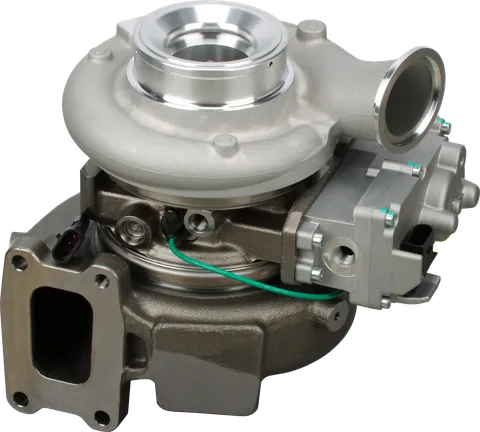
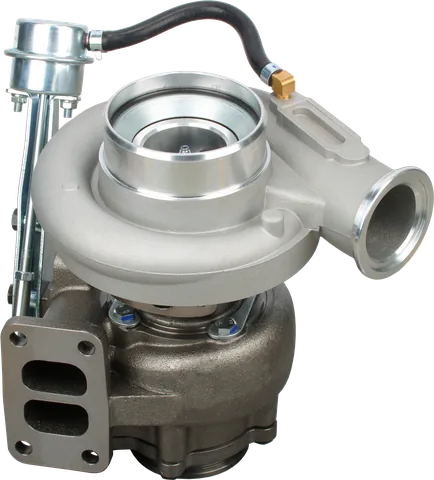
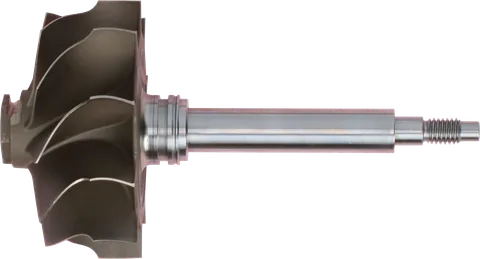
A boost gauge shows what pressure reached the intake manifold; it does not show how hard the engine worked to get it. For a diesel that loses pulling power or develops high exhaust gas temperature (EGT), the useful question is where pressure builds, where it drops, and what the controls are doing.
Start with the measurement location
“Backpressure” can mean pressure before the turbine, pressure after it, or pressure drop across an aftertreatment component. Those readings answer different questions. A diesel particulate filter (DPF) differential pressure reading is not a substitute for exhaust manifold pressure.
| Measurement | Location | What it helps establish |
|---|---|---|
| Boost or manifold pressure | Intake manifold, usually after the charge air cooler | Pressure delivered to the engine; check whether the display uses gauge or absolute pressure. |
| Turbine inlet pressure | Exhaust manifold before the turbine | Pressure opposing exhaust discharge and available to drive the turbine. |
| Turbine outlet pressure | After the turbine, ahead of downstream exhaust components | The pressure into which the turbine discharges. |
| DPF differential pressure | Difference between the specified DPF sensing ports | Pressure drop across that measured section, interpreted with exhaust flow. |
Some aftertreatment pressure sensors span more than the filter itself. Verify the plumbing diagram and scan tool parameter definition before calling a reading “DPF restriction.”
Exhaust back pressure vs turbocharger boost: the shaft power balance
At steady operation, turbine power must cover compressor power and mechanical losses. During acceleration, some power also accelerates the rotating assembly. Exhaust flow, turbine inlet temperature, expansion from inlet to outlet, and turbine efficiency determine how much shaft power is available.
The compressor's demand depends on airflow, inlet temperature, pressure ratio, and efficiency. Raising pressure or moving more air generally requires more power. The boost pressure ratio used for compressor work requires absolute pressures at the compressor outlet and inlet; dividing two gauge readings does not produce a valid compressor pressure ratio.
Under load, manifold pressure is lower than compressor outlet pressure because the cooler and piping cause pressure loss. Intake restriction also lowers compressor inlet pressure. Use the appropriate ports when assessing compressor work.
Hotter exhaust can supply more turbine power, but high EGT does not guarantee useful boost. Exhaust energy can be poorly converted, airflow can be restricted, or the engine controller can limit fueling. A hotter engine is not automatically getting more air.
Boost is also not an airflow measurement. At the same manifold pressure, hotter intake gas is less dense. Engine speed, cylinder filling, exhaust gas recirculation (EGR), and retained exhaust change the fresh air available for combustion. A normal boost reading can therefore coexist with inadequate oxygen for the requested fuel.
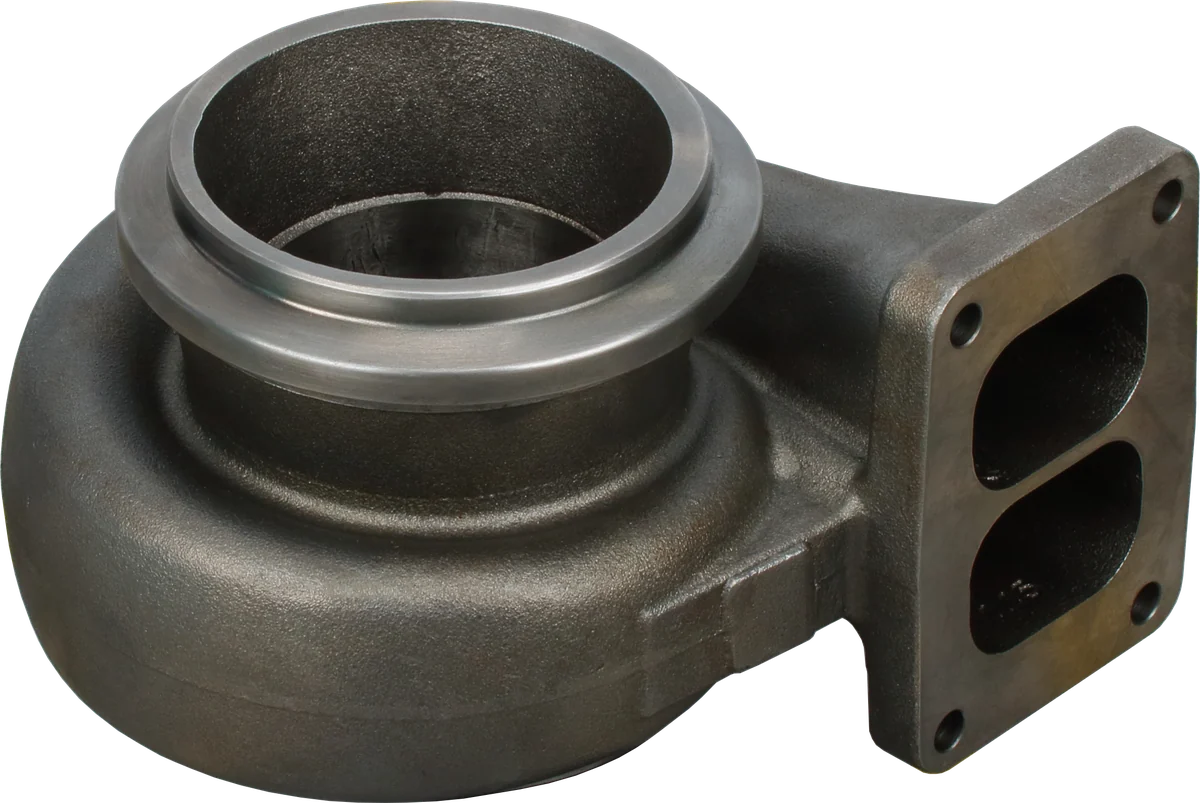
Exhaust inlet: verify the flange and passage geometry.
Turbine cavity: check clearance and contact damage.
Mounting face: the replacement must match the interfaces.
Product photograph from 2026. Numbers identify the features explained below.
Pressure across the engine changes cylinder filling
The pressure difference between the intake and exhaust manifolds influences gas exchange. During valve overlap, both intake and exhaust valves are open. If local intake pressure exceeds exhaust pressure at the right moment, fresh air can help push remaining exhaust out of the cylinder. This is positive scavenging.
If the pressure difference reverses, exhaust can resist fresh air entry or flow back toward the intake. More hot residual gas can remain in the cylinder, reducing the oxygen available for the next combustion event. Engines with meaningful valve overlap are particularly sensitive to this relationship.
Average manifold readings are only a guide: exhaust pulses, valve timing, and port pressures determine instantaneous flow. Limited overlap reduces the opportunity for scavenging. More airflow through an overlapping cylinder also does not necessarily mean more air retained for combustion.
Turbine inlet pressure above boost is not automatically a fault. Some engines deliberately create that pressure difference for high-pressure EGR or other control functions. Use the specified operating condition, not a universal intake-to-exhaust ratio.
What causes high turbocharger drive pressure?
Pressure rises when the turbine cannot pass the required flow easily or when pressure downstream increases. The operating condition determines whether that rise is expected.
| Possible cause | How it raises pressure | Useful confirmation |
|---|---|---|
| Small effective turbine area | A small housing, nozzle opening, or mismatched turbine needs more inlet pressure to pass high exhaust flow. | Verify the installed turbocharger and calibration against the engine application. |
| Variable geometry turbine (VGT) stuck too far closed | Restricted nozzle area raises drive pressure; boost may rise or airflow may become limited. | Compare commanded and actual operation using the manufacturer's actuator procedure. |
| Restricted DPF or other aftertreatment | Higher turbine outlet pressure reduces expansion at the same inlet pressure. | Validate pressure sensors and locate the pressure drop under the prescribed conditions. |
| Collapsed pipe or blocked muffler | Downstream resistance backs pressure up toward the turbine. | Measure across the suspected section and inspect for damage. |
For the same turbine work, raised outlet pressure can demand higher inlet pressure. The controls may close the VGT or change fueling to compensate, until a limit is reached. Consequently, downstream restriction can produce high drive pressure with low or apparently normal boost, depending on the system's response.
How excess pressure hurts performance
Pressure becomes a problem when the engine spends excessive work moving exhaust or cannot exchange gases effectively.
- Pumping loss: The piston must push exhaust out against greater resistance. More of the engine's work is consumed by gas exchange.
- Higher EGT: Reduced fresh oxygen and altered combustion can raise exhaust temperature at a given demand. Fuel limiting may instead reduce power without a large temperature rise.
- More residual gas: Retained exhaust reduces fresh charge and can increase the starting temperature of the next cycle.
- Possible overspeed: Compensating control responses or an overly closed VGT can increase shaft speed under some conditions. High exhaust pressure alone does not prove overspeed; severe restriction can instead reduce turbine power and speed.
How should an exhaust back pressure test be set up on a turbo diesel?
Use the engine manufacturer's pressure test procedure, port locations, load condition, and limits. An unloaded rev test rarely represents the exhaust flow of a working truck, loader, or generator.
Measure pre-turbine pressure through an approved manifold port with pressure-rated, heat-compatible fittings. Use the specified metal stand-off or cooling line so the transducer stays within its temperature rating. Do not drill an assembled manifold where chips could reach the turbine. Route and secure the assembly away from moving parts, and keep exhaust gas out of the cab.
During a diesel turbo exhaust back pressure test, record boost from the intake manifold at the same time. Check whether scan data are absolute or gauge pressure; both channels must use the same reference for a direct pressure difference. Inspect sensing lines for leaks, soot plugging, and damage. Follow the instrument's guidance on damping pulsations.
- Log engine speed, actual load, boost request and actual boost, exhaust pressure, and EGT.
- Include VGT command and available feedback, EGR state, regeneration state, and aftertreatment pressure.
- Record EGT sensor location; pre-turbine and post-turbine readings are not interchangeable.
- Verify units, sensor zero or atmospheric reference, and data timing before interpreting a mismatch.
Exhaust braking, warm-up, and regeneration can intentionally alter these readings. Compare the same operating mode, with the engine fully warmed when the service procedure requires it.
A practical diagnostic sequence
Work from confirmed measurements toward the component causing the pressure rise:
- Verify the complaint. Record codes and freeze-frame data. Establish the speed, load, and operating mode where power falls or EGT rises.
- Validate the signals. Check pressure ports, tubing, sensor references, and scan tool definitions. An implausible sensor signal can also provoke an incorrect control response.
- Capture a repeatable loaded run. Use an approved road or dynamometer procedure and stop at the manufacturer's limits. Have a separate operator or data logger capture readings.
- Separate turbine restriction from downstream restriction. Check turbine outlet pressure and pressure drop across suspect exhaust sections. Evaluate DPF readings at the prescribed flow condition.
- Check control behavior. Compare VGT request with verified movement or feedback. Check exhaust brake and EGR operation before judging the turbine's flow capacity.
- Address the confirmed cause and repeat the same test. Check air delivery and fueling if the pressure pattern does not explain the complaint. Verify power, pressure, and temperature together.
A filter pressure drop must be compared at the specified flow, not against an idle reading from another engine. Temperature, load, and regeneration state all influence the result.
| Observed pattern | What it suggests | Next confirmation |
|---|---|---|
| High inlet and outlet pressure | Downstream resistance may be raising drive pressure. | Localize the restriction with component pressure-drop tests. |
| High inlet pressure, acceptable outlet pressure | Turbine flow area or control state deserves attention. | Check VGT operation and the installed turbo specification. |
| Low boost with unremarkable exhaust pressure | Exhaust restriction may not explain the complaint. | Check charge air delivery, exhaust leaks, and fueling controls. |
| Normal boost, unexpectedly high inlet pressure | Boost control may be masking extra pumping work. | Compare temperature, airflow data, and turbine outlet pressure. |
These patterns, including normal turbocharger boost with high exhaust pressure, narrow the search; they do not establish a failed part. A forced regeneration is not a generic response to high pressure. Confirm the aftertreatment fault and follow the service procedure; regeneration burns soot but does not remove accumulated ash.
Common Questions
What is a normal exhaust back pressure reading on a turbo diesel?
There is no universal limit or ideal ratio to boost. Use the engine manufacturer's specification for the stated measurement location, speed, load, and operating mode.
Can exhaust pressure exceed boost on a healthy engine?
Yes. Turbocharger matching, EGR demand, and control strategy can require turbine inlet pressure above intake pressure. Compare readings with the expected behavior at that operating point.
Can a clogged DPF cause low boost?
Yes. Increased turbine outlet pressure can reduce available turbine expansion. The controller may compensate or derate the engine. Confirm the restriction with valid pressure measurements.
Does normal boost rule out an exhaust restriction?
No. The turbocharger may maintain boost while exhaust pressure and pumping work rise. Charge temperature, EGR, and residual exhaust can also reduce oxygen supply despite normal boost.
Will replacing my turbocharger fix high backpressure?
Only if a confirmed turbocharger fault or incorrect match is responsible. A restricted DPF, blocked muffler, or unresolved control fault can remain after replacement. Before replacing parts, verify the pressure readings, check for downstream restrictions, and compare VGT commands with actual movement or feedback.
How does backpressure affect turbocharger boost?
Higher turbine outlet pressure can reduce available turbine expansion. Controls may compensate or derate the engine, so downstream restriction can cause low or apparently normal boost.
Contact LeadTurbo with your turbocharger part number, engine details, and pressure test results for help identifying the appropriate replacement turbocharger or parts.