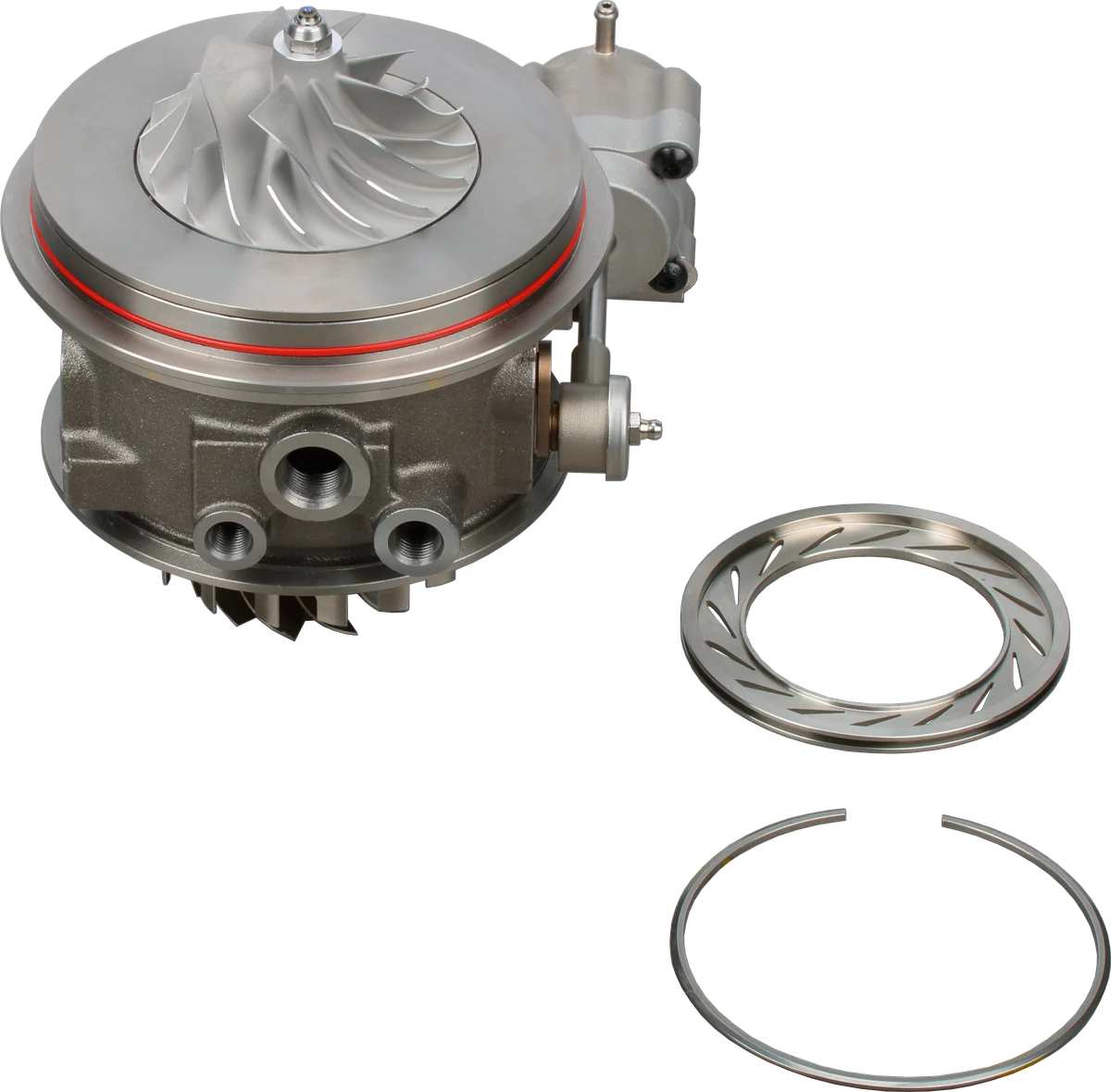
The purpose of turbocharger testing is to check how a turbocharger moves air, controls shaft motion, survives heat, and operates as an assembly before facing real engine conditions.
For someone buying a replacement turbo or center housing rotating assembly (CHRA), “tested” sounds reassuring. But it can describe anything from a basic leak check to an extensive development program.
The useful question is what was tested, under which conditions, and against which acceptance limits. Different tests answer different questions, and no single machine proves everything about a turbocharger.
Turbocharger Bench Testing vs Engine Testing
An engine introduces many changing variables: exhaust flow, fueling, intake restriction, cooling, and control commands. If a turbo vibrates or misses its airflow target, those interactions can make the cause difficult to isolate.
A dedicated turbo test bench lets engineers control selected conditions and repeat them. They can change oil temperature while holding speed steady, compare compressor configurations, or investigate bearing behavior without running an entire vehicle.
Separate testing also provides access for instrumentation and allows hazardous development tests inside purpose-built protective equipment.
It does not replace engine testing. Exhaust pulses, underhood heat, intake plumbing, and rapid load changes affect the installed turbocharger. Bench work establishes component behavior; engine and vehicle work checks how that component performs in its intended system.
How Does a Turbocharger Gas Stand Work?
A turbo gas stand supplies the turbine with a controlled stream of hot gas. In a combustor-based stand, burning fuel heats the gas that drives the turbine. The turbine turns the shaft, and the compressor draws in and compresses air.
The stand manages turbine inlet conditions and compressor discharge restriction to establish operating points. Oil supply—and coolant where applicable—is provided through controlled circuits.
Typical measurements include:
- Shaft speed and airflow.
- Pressures and temperatures at the compressor and turbine connections.
- Oil inlet pressure, temperature, and flow.
- Coolant conditions where the turbo uses water cooling.
- Vibration and selected housing temperatures.
Instrumentation and operating limits depend on the purpose of the test. A development stand may have substantially more measurement capability than a production checking station.
How Compressor Map Testing Works
During compressor map testing, engineers collect operating points along approximately constant corrected-speed lines. They adjust airflow and loading, recording pressure ratio and the measurements needed to determine efficiency.
“Corrected” speed and flow account for inlet conditions so results can be compared meaningfully.
A compressor map shows how pressure ratio changes with airflow. Efficiency contours indicate where compression requires less energy for the same useful pressure rise. Temperature measurements require care because heat transferred through the turbo can influence the results.
The low-flow boundary involves surge, an unstable operating condition. At the high-flow end, choking limits further flow. Mapping identifies these boundaries through controlled procedures with appropriate safeguards.
A map characterizes a particular compressor configuration. It does not guarantee that an engine installation will stay in an efficient region or avoid surge during every transient.
What can each type of turbocharger testing tell you?
Testing claims are easier to evaluate when their scope is clear.
| Test | Main question it answers | Important limitation |
|---|---|---|
| Hot gas stand and mapping | Does the turbo meet defined aerodynamic targets? | Does not reproduce every engine transient or installation |
| Rotordynamic rig | How does the shaft and bearing system behave across operating conditions? | Results depend on how closely the rig represents the intended assembly |
| Durability and thermal cycling | Can the design withstand a specified loading and temperature sequence? | Passing applies to that test program, not unlimited service life |
| Containment test | Does the housing contain specified rotor-failure debris under defined conditions? | Destructive qualification, not a check on every saleable unit |
| Production checks | Does an individual assembly meet selected manufacturing limits? | Cannot establish the full durability of that individual turbo |
A supplier should be able to explain whether a claim concerns design validation, periodic sampling, or inspection of every unit.
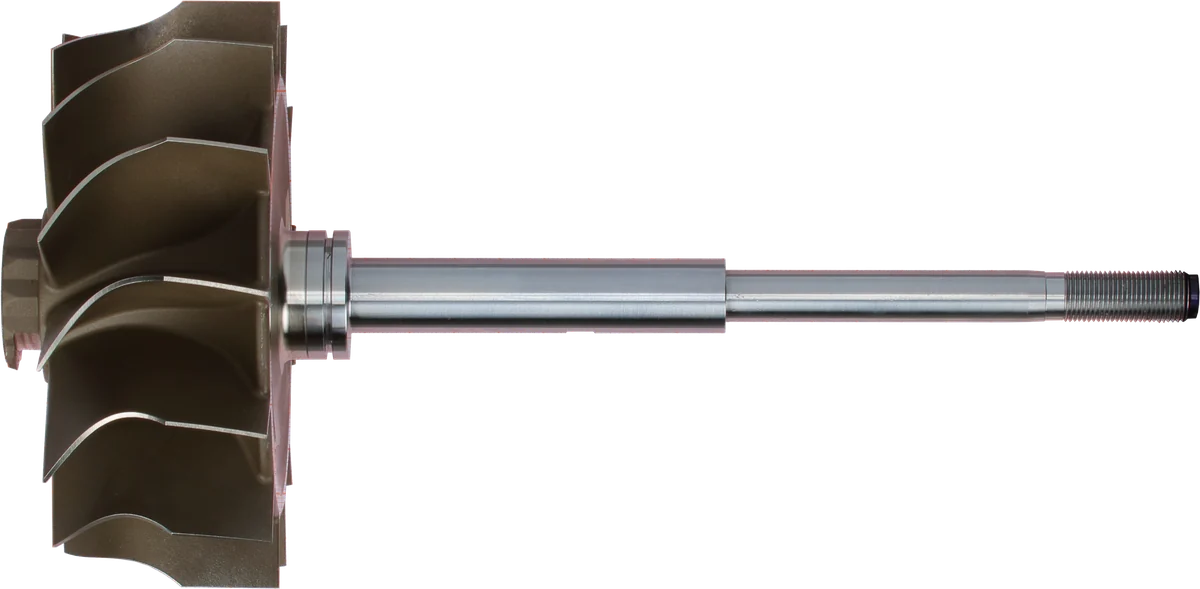
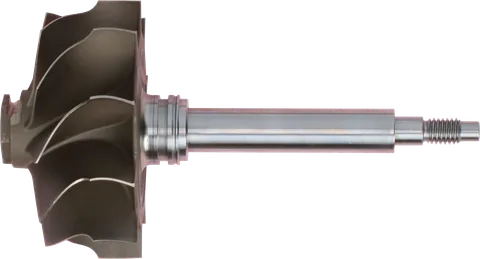
Turbine wheel: exhaust energy drives the shaft.
Shaft surface: inspect wear and scoring before reuse.
Shaft end: connects to the compressor-side rotating parts.
Product photograph from 2026. Numbers identify the features explained below.
Rotordynamic Rigs: Looking Beyond Balance
A rotor can be well balanced and still have unfavorable bearing behavior. Rotordynamics examines how the shaft moves as speed, loading, and lubrication conditions change.
Specialized rigs may use noncontact shaft motion probes to track radial movement. Measurements in two directions can reveal the path the shaft follows within its bearing clearance. Housing vibration sensors provide complementary information, but housing vibration and shaft displacement are not interchangeable measurements.
Engineers may also monitor:
- Bearing or nearby metal temperatures.
- Oil supply pressure, inlet temperature, and flow.
- Oil drain behavior.
- Axial movement or thrust loading where the setup permits.
- Vibration frequency content during acceleration and deceleration.
Why the Frequency of Motion Matters
Residual unbalance commonly produces vibration at shaft rotational frequency. Oil-film effects can produce motion below shaft frequency, called subsynchronous vibration.
In some journal-bearing systems, oil whirl occurs at somewhat less than half shaft speed. Under certain conditions, the motion can couple with a rotor natural mode and develop into oil whip. These behaviors depend on the bearing arrangement, lubricant properties, geometry, and loading.
A frequency trace helps distinguish mechanisms that may look similar in a single overall vibration reading. Balancing alone cannot necessarily correct an oil-film instability.
Noise is another clue, but it is not a diagnosis. A whistle that changes with speed and a persistent tone can have different causes. Air leaks and aerodynamic effects can also produce prominent sounds.
Why Test Rotor and Housing Design Matter
A useful rig must represent the features that govern the behavior being studied. Wheel mass, shaft stiffness, bearing spacing, and wheel overhang all influence rotor motion. A substitute rotor with different mass distribution may produce misleading results.
The bearing housing matters too. Its stiffness, bearing alignment, oil passages, drainage, and thermal expansion affect the shaft’s operating environment. Probe access must be designed without materially weakening the structure or disrupting lubrication.
Engineers therefore define which features must match the production assembly and which can differ for measurement purposes. A convenient laboratory arrangement is not automatically a faithful model of a working turbo.
Durability, Thermal Cycling, and Containment
A durability test follows a defined operating sequence. It may include sustained running, repeated speed changes, and combinations of temperature and loading intended to expose particular weaknesses.
Results need context. Test duration alone says little without the operating conditions, failure criteria, and inspection findings.
Thermal cycling repeatedly heats and cools the assembly. Components expand and contract at different rates, potentially changing clearances or stressing housings and joints. Relevant test programs may also examine shutdown heat soak, when heat continues moving from the turbine into nearby components after operation stops.
Post-test inspection can reveal problems that were not obvious during running:
- Cracks, distortion, or rubbing.
- Bearing and thrust surface wear.
- Oil deposits or restricted passages.
- Loosened joints or degraded sealing performance.
- Changes in vibration or aerodynamic performance.
Containment, sometimes called burst testing, addresses a different question. A rotor failure is deliberately produced under controlled conditions to assess the housing’s ability to contain specified debris.
This is destructive work conducted in specialized facilities. Passing a defined containment test does not establish that every possible failure will be contained, and it does not make operation beyond rated limits acceptable.
Turbocharger Production Testing: End-of-Line Checks
Development tests qualify a design. End-of-line checks look for manufacturing and assembly defects in finished products. The exact sequence varies by manufacturer, product, and whether the turbo is new or remanufactured.
Component Balance and VSR Testing
Individual rotating components can be balanced before assembly. An assembled CHRA may then undergo high-speed vibration testing on a vibration sorting rig, commonly called a VSR.
The rig spins the lubricated core and measures its vibration response through a specified speed range. Where required, balance correction reduces residual vibration associated with the assembled rotating group.
This matters because acceptable individual components can still produce an assembly that needs correction.
A meaningful report identifies the assembly, test conditions, and applicable limits. A generic graph or unexplained “high-speed balanced” statement provides less evidence. VSR testing does not create a compressor map or reproduce full engine thermal loading.
Leak Checks
Leak checks may examine oil passages, coolant circuits, or other specified boundaries. Ask which circuit was tested and how acceptance was determined.
Turbo shaft sealing also depends on operating pressures, drainage, and the surrounding system. Passing a static leak check does not guarantee freedom from oil leakage when the engine has excessive crankcase pressure or a restricted oil drain.
VGT Actuator Calibration
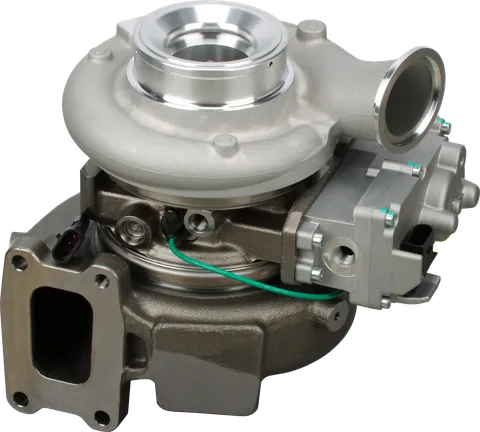
A variable geometry turbocharger uses movable vanes to regulate turbine behavior. Checks may include mechanism travel, position feedback, end stops, and actuator calibration.
Calibration must suit the particular actuator and turbo assembly. Some setups also use flow-based checks to verify vane behavior. Simply watching the actuator move does not prove correct calibration.
Depending on the application, vehicle-side initialization may still be required after installation.
What Engine Testing Adds
In diesel turbocharger testing, an engine dynamometer checks the turbo alongside the engine’s exhaust flow, intake system, and control strategy. It can reveal boost response, exhaust restriction, temperature behavior, and control problems that a steady bench test may miss.
Vehicle validation adds installation effects and real operating sequences, such as towing, acceleration, and hot shutdowns. The relevant program depends on the application.
A replacement supplier may rely on an established design and documented compatibility rather than repeating the original engine development program. The supplier should describe that basis accurately.
Questions Buyers Can Ask a Supplier
The depth of aftermarket turbocharger testing varies. A clear explanation is more useful than a long list of unexplained machine names.
Before ordering, ask:
- Which checks are performed on every turbo or CHRA?
- Which durability or performance claims come from design tests or sampled units?
- Is the assembled core tested at high speed, and what determines acceptance?
- Can test records be connected to a serial number or production batch?
- Which circuits receive leak checks?
- For VGT units, how are vane operation and actuator calibration verified?
- What application details and installation procedures must be confirmed?
Limited public documentation does not automatically prove poor quality. However, a supplier should distinguish what it verifies directly from what it relies on its manufacturing partners to verify.
Common Questions
Does every replacement turbo go through a hot gas stand?
No. Hot gas stands are commonly used for development and validation, while individual production units may receive balance, leak, and actuator checks. Suppliers should distinguish testing performed on a design or sample from checks performed on the unit you buy.
Is VSR balancing the same as performance testing?
No. Vibration sorting rig testing evaluates vibration from a rotating assembled core and supports balance correction. It does not establish compressor efficiency, turbine performance, thermal durability, or correct operation on a particular engine.
Can a balance report prove that a turbo will last?
No. A balance report addresses one part of quality. Service life also depends on materials, clearances, lubrication, assembly, operating temperatures, and installation conditions. The report is more useful when it identifies the tested assembly and the acceptance criteria.
Why does VGT actuator calibration matter?
The actuator and vane mechanism must agree on commanded position and actual movement. Incorrect setup can produce boost control problems even when the rotating assembly is sound. Some applications also require a vehicle-side initialization or learn procedure after installation.
Can turbo noise reveal whether testing was adequate?
Not reliably. Noise can come from airflow, leaks, blade interaction, imbalance, or bearing behavior. A recording alone cannot establish the cause or the quality of factory turbocharger testing. Diagnosis needs operating conditions and supporting mechanical or sensor checks.
What should I request when buying a replacement CHRA?
Ask about application compatibility, component and assembled-core balancing, traceability, and installation requirements. Confirm which existing housings and controls must be reused and inspected. A tested CHRA cannot correct damaged housings, a sticking vane mechanism, or an engine oil supply problem.
Can turbocharger testing detect leaks?
Yes. Leak checks can detect leaks in oil passages or coolant circuits. Ask which circuit was tested and how the supplier determined whether it passed. A static check cannot rule out oil leakage caused by excessive crankcase pressure or a restricted oil drain.
What testing should a replacement turbocharger have?
Look for balance and leak checks on the unit you buy, plus vane operation and actuator calibration checks for VGT units. Ask how results are judged and whether records identify the unit or batch. The supplier should distinguish these checks from performance or durability testing done on a design or sample.
Contact LeadTurbo with your turbo part number, vehicle details, and symptoms for help identifying a suitable replacement.