On a diesel truck, excavator, or generator set, a burst can threaten nearby equipment and people as well as the engine. Buyers therefore need more than a statement that a turbo is balanced. They need to understand which assembly was tested, how it failed, and what the housing actually retained during diesel turbocharger containment testing.
Why do turbocharger wheels burst?
Turbocharger wheels carry substantial loads while rotating. Their ability to survive depends on operating speed, temperature, wheel geometry, material condition, and accumulated damage. Failure becomes possible when the stress exceeds what the remaining wheel structure can withstand.
Several mechanisms can lead toward that point:
| Failure trigger | How it can contribute to a burst |
|---|---|
| Overspeed | Excessive rotational speed raises centrifugal stress beyond the wheel's intended operating limits. |
| Fatigue | Repeated loading can grow a crack until the remaining section can no longer carry the load. |
| Foreign object damage | An impact can remove material, create a crack, or leave a notch where local stress becomes concentrated. |
| Material or manufacturing flaws | Internal defects or unsuitable processing can reduce strength and create locations where cracks begin. |
A damaged blade does not automatically mean the entire wheel will burst. However, damage can create a path to more severe failure. Both compressor and turbine wheels require consideration; a compressor wheel burst is not the only event relevant to housing safety.
For an unchanged rotor, stored rotational energy increases with the square of speed. When the wheel breaks apart, fragments carry some of that energy into the surrounding structure. Their size, direction, and impact location affect how severely they load the housing.
The housing becomes a physical barrier between those fragments and the surrounding equipment. Its walls, backplate, and connections must work together to resist penetration or separation.
What happens in a turbocharger containment test?
In an overspeed-to-burst test, a laboratory deliberately accelerates a wheel until it breaks apart inside its production housing. The assembly is then examined for fragment escape and structural damage. A useful turbo burst test challenges a defined configuration under documented conditions.
Some rigs use hot gas to drive the turbine and accelerate the assembled rotor. Others use specialized electric or air-driven spin equipment, with a fixture suited to the component being assessed. The report should describe the drive method and whether a complete rotor or modified test arrangement was used.
The work takes place remotely inside an engineered safety enclosure. That external enclosure protects personnel and equipment if the turbocharger fails to contain the event. It serves a different purpose from the production housing: a fragment caught by the test-cell barrier has already escaped the turbocharger.
Useful records include:
- Actual rotational speed immediately before the burst and how it was measured.
- Wheel, housing, backplate, and retaining-hardware identification.
- Relevant temperatures and operating conditions.
- Any wheel modifications used to initiate a particular failure pattern.
- Photographs, fragment recovery records, and inspection findings.
After the equipment is made safe, investigators examine the housing and joints, collect fragments, and look for evidence of their paths. To assess turbocharger housing damage after a burst, investigators must explain missing pieces, holes, opened connections, and witness marks outside the housing. Recovering fragments also helps establish how the wheel broke apart.
If a wheel was deliberately modified to control its breakup, that matters when interpreting the result. Fragment size and impact direction can change the challenge presented to the housing.
What the housing and its connections must withstand
Containment is an assembly function. A strong outer wall cannot compensate for a connection that releases under impact, and correct hardware cannot rescue a casting with inadequate strength in a critical section.
| Part or feature | What the test challenges | What supports confidence in production parts |
|---|---|---|
| Housing wall and local geometry | Resistance to fragment penetration and severe deformation | Controlled wall sections, casting dimensions, and inspection of critical areas |
| Housing material | Strength and fracture behavior under the test conditions | Material specification, traceability, and any required processing or heat treatment |
| Backplate and housing interfaces | Resistance to opening or displacement during the burst | Correct geometry, seating, and compatible components |
| Fixing bolts, clamps, and V-bands | Ability to keep connected parts together under sudden loading | Specified hardware, correct engagement, and controlled assembly procedures |
The test challenges these features together. It does not independently prove that every bolt, casting batch, or substitute clamp will behave the same way.
This is why thin walls or the wrong material can create a safety risk. Reducing a critical wall section can reduce its ability to absorb impact without penetration. An unsuitable alloy or uncontrolled casting defects can change how the housing fractures, even when its external appearance looks correct.
A low selling price alone does not establish poor containment. The concern is an unverified substitution presented as equivalent to the tested design. Appearance, surface finish, and casting weight provide limited evidence.
Simply making a housing heavier is also insufficient. Local shape, material behavior, temperature, and the strength of its connections all affect the result. There is no single wall-thickness measurement that proves every turbo housing safe.
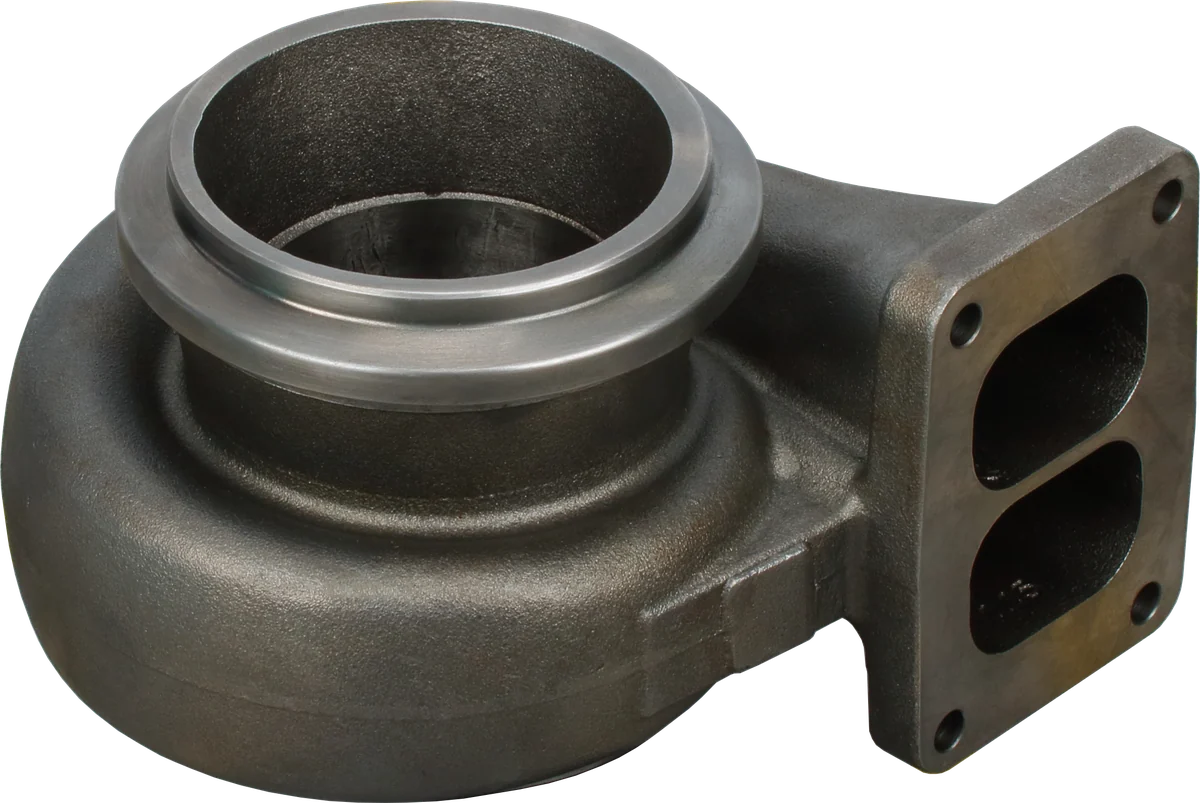
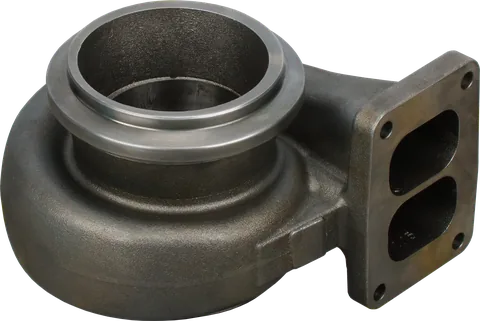
Exhaust inlet: verify the flange and passage geometry.
Turbine cavity: check clearance and contact damage.
Mounting face: the replacement must match the interfaces.
Product photograph from 2026. Numbers identify the features explained below.
Why a passing result needs context
A turbocharger containment test supports a specific assembly and defined failure event. Applying that result to other configurations requires an engineering basis.
Start with the test conditions. A wheel bursting below the intended challenge speed may produce a less demanding event than the claimed validation requires. Temperature also matters, particularly when interpreting turbine-side results. A report should explain how the tested conditions represent the intended application.
The acceptance criteria must identify the containment boundary and what constitutes unacceptable fragment release. A test-cell video showing no obvious external damage is incomplete evidence. The inspection findings and fragment accounting help explain what actually happened.
A balance certificate answers a different question about rotor behavior. Likewise, the statement “overspeed tested” may describe a test that ends with the wheel intact. Neither phrase, by itself, demonstrates that the housing retained fragments after a burst.
Design changes also deserve attention. Different wheel dimensions, housing geometry, material, backplate, or retaining hardware can change the failure event or the structure resisting it. Those changes need a documented engineering review to determine whether earlier evidence still applies.
What buyers should ask suppliers
Buyers do not need confidential design drawings to ask useful questions. A report summary or documented explanation can establish whether a containment claim has meaningful support.
| Ask the supplier | What a useful answer should establish |
|---|---|
| Which part number and design revision does the evidence cover? | A clear connection between the tested assembly and the product being supplied |
| Was the compressor side, turbine side, or both evaluated? | The actual scope of the claim and any limits on its application |
| What burst conditions and acceptance criteria were used? | Measured speed, relevant temperatures, failure method, and the definition of successful containment |
| Were production housings and specified retaining components used? | Whether the tested walls, material, backplate, bolts, and V-bands represent the supplied assembly |
| What records and manufacturing controls support the claim? | An identifiable test report or summary, plus traceability and controls for production consistency |
“Tested to our standard” needs an explanation of that standard. If a supplier names a customer requirement or published specification, ask which revision applies and what the reported result covers. A test claim does not automatically establish independent certification.
For fleet purchasing, retain the supplier's response with the part number, revision, and purchase record. That makes the evidence usable when another shipment arrives or the supplier changes a component. A generic brochure is harder to connect to the replacement actually installed.
CHRA and repair-kit purchases require particular care because existing housings may remain in service. A new rotating assembly does not establish the condition of an old casting or its retaining hardware. Cracks, corrosion, previous wheel contact, machining, and mismatched components can change the assembly from the configuration originally evaluated.
For a complete replacement turbocharger, the same principle applies: confirm that the claimed evidence follows the assembled product, including its housings and connections.
Containment does not replace overspeed prevention
Containment addresses the consequences of wheel failure. Preventing the conditions that cause failure remains essential. Even a contained burst can destroy the turbocharger, interrupt equipment operation, and send debris into connected air or exhaust passages.
Keep the prevention checks focused:
- Verify that the turbocharger matches the engine application and approved operating requirements.
- Check wastegate or variable-geometry control operation, including relevant sensors and commands.
- Address intake restrictions, charge-air leaks, or other faults that can drive excessive turbo speed under some operating conditions.
- Avoid unverified fueling or boost-control changes that push the rotor outside its intended operating range.
- Investigate evidence of overspeed or foreign object damage before returning the equipment to service.
Boost pressure alone does not establish rotor speed. Different airflow, pressure, and control conditions can produce different shaft speeds at similar boost readings. A containment claim therefore provides no permission to increase operating limits.
After a wheel failure, preserve the damaged parts and relevant operating information. Understanding the initiating problem helps prevent the replacement from encountering the same conditions.
Common Questions
Is every replacement turbocharger containment tested?
No. Bursting a wheel is destructive. Containment testing generally evaluates a design using representative assemblies, while production units receive other checks. Ask how the supplier connects its test evidence to the part, revision, and manufacturing controls behind your replacement.
Turbocharger overspeed test vs burst test: what's the difference?
Not necessarily. An overspeed test may take an intact rotor to a specified speed without breaking it. A burst test intentionally produces wheel failure. The test report must explain the objective, conditions, and acceptance criteria before the terms mean much.
Can a housing be damaged and still pass?
Possibly. A sacrificial housing may deform or crack while meeting the test's containment criteria. The report must show whether fragments escaped and whether joints remained effective. A passed burst test does not mean the tested housing is reusable.
Does a stronger housing prevent wheel failure?
No. The housing limits the consequences of a burst; it does not eliminate overspeed, fatigue, impact damage, or wheel defects. Correct turbo selection, functioning controls, and sound maintenance remain necessary even when containment has been validated.
Does a tested CHRA prove my reused housings will contain a burst?
No. Containment depends on the assembled wheel, housings, backplate, and retaining hardware. A CHRA test alone cannot establish the condition or capability of your reused castings. Ask whether the exact assembly and any allowed housing reuse are covered by the supplier's evidence.
How does turbocharger containment work?
Turbocharger containment uses the housing as a barrier to fragments from a burst wheel. Its walls, backplate, and retaining hardware work together to resist penetration or separation. Check that the supplier's test evidence covers the complete assembly, because a strong outer wall cannot compensate for a connection that opens under impact.
Contact LeadTurbo with your turbocharger part number, engine details, and any housing reuse plans for help identifying a suitable replacement and available product documentation.