An OM366 turbo replacement should begin with identification and diagnosis. An engine designation narrows the search, but it does not identify the complete turbocharger specification. The same applies when deciding which turbocharger fits an OM352 engine in an older working vehicle.
For mechanics maintaining Mercedes-Benz trucks, buses, and Unimogs, the practical questions are straightforward: What is fitted now? Why did it fail? Which components remain serviceable? Answering those questions helps prevent repeat failures and installation problems.
LeadTurbo supplies aftermarket replacement parts. The catalog examples below are identification aids, not a declaration that every listed unit fits every vehicle using that engine family.
The engine family and why turbo condition matters
The OM352 and OM366 are inline-six diesel engine families associated with heavy-duty service. This guide focuses on the turbocharged applications identified in the catalog, including OM352A, OM366A, and OM366LA.
The turbocharger uses exhaust energy to drive a compressor, increasing the air available for combustion. Lost airflow can reduce pulling performance and contribute to black smoke when fuel delivery exceeds the available air. Bearing damage or oil leakage can create more serious problems.
Sustained loads make clean intake air, reliable lubrication, and sound exhaust plumbing especially important. Replacing a damaged turbocharger without correcting an engine-side fault can damage its replacement.
How to identify an OM366 turbo or OM352 unit before ordering
Locate the turbo identification plate or stamped identification area. Start around the compressor housing, where tags are commonly found, but inspect the whole assembly because location varies. Use gentle cleaning and a mirror or camera when access is restricted. Avoid abrasive cleaning that could erase shallow markings.
Record every readable character, including suffixes. Photograph the plate and the complete assembly before removal.
A turbo model, such as TO4B81 or TO4E66, identifies a design family or designation. It does not necessarily identify the exact complete assembly. An OE part number identifies an original-equipment service reference, while a turbo manufacturer's assembly number identifies a particular turbo specification. A casting number on a housing may identify only that component.
A catalog part number should not automatically be interpreted as an OE number. Establish what each number represents and confirm the cross-reference.
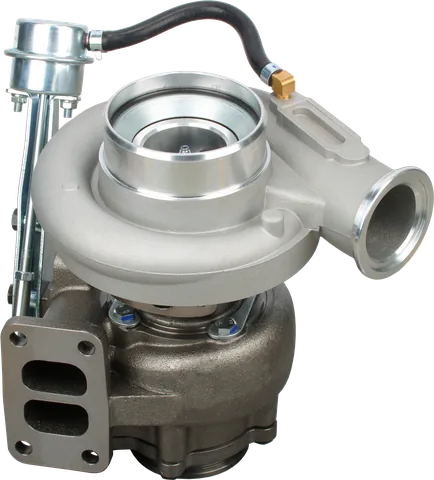
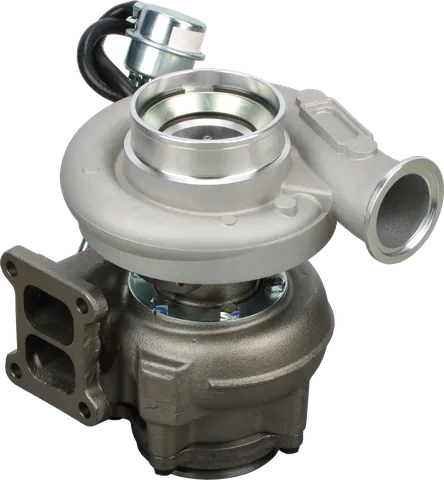
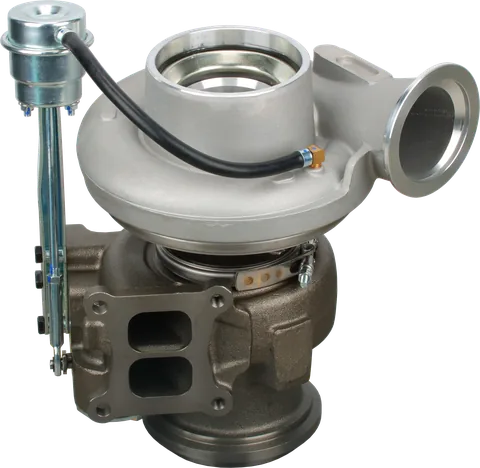
If the plate is missing, provide the engine identification, any documented OE reference, and clear photographs of the inlet, outlet, mounting flange, oil connections, and control hardware. Appearance alone is insufficient.
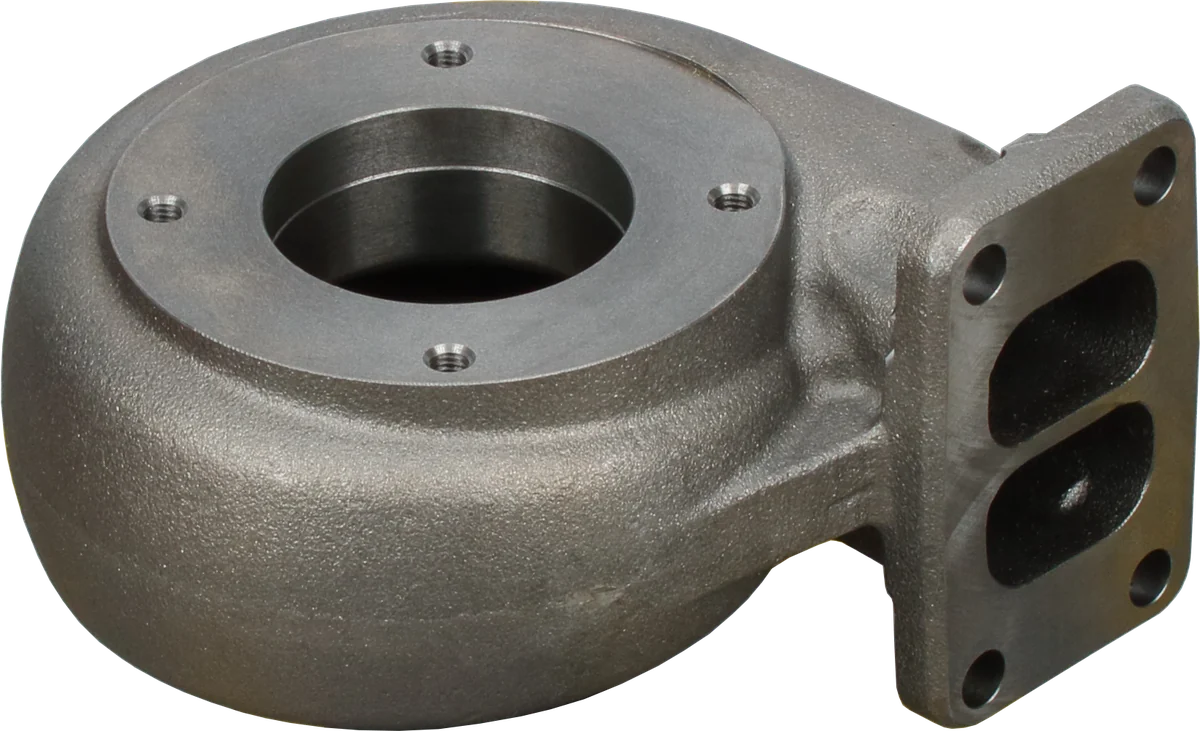
Exhaust inlet: verify the flange and passage geometry.
Turbine cavity: check clearance and contact damage.
Mounting face: the replacement must match the interfaces.
Product photograph from 2026. Numbers identify the features explained below.
Representative catalog examples: verify against the data plate
These examples reproduce catalog part numbers, models, product types, and applications.
| Part number | Turbo model | Product type | Application |
|---|---|---|---|
| 3520964299 | TO4B81 | Complete turbocharger | Mercedes Benz OM352A |
| 3520964599 | TO4B27 | Complete turbocharger | Mercedes Benz OM352A |
| 366 096 4199 | TO4E66 | Complete turbocharger | Mercedes Benz OM366LA |
| 3660960199KZ | TO4B81 | Complete turbocharger | Mercedes Benz OM366LA |
| 466646 0004 | TO4E66 | Complete turbocharger | Mercedes Benz OM366A Trucks |
| 3900960199 | — | Complete turbocharger | Mercedes Benz OM366LA |
| 3640960899 | TA3164 | Complete turbocharger | Mercedes Benz OM364 LA |
| 408105 0079 | TO4B27 | CHRA/cartridge | Mercedes Benz OM352A |
| 447450 0055 | — | CHRA/cartridge | Mercedes Benz OM366LA |
| 435066 0017 | — | Turbine housing | Mercedes Benz OM366LA |
| 446618 0029 | — | Compressor wheel | Mercedes Benz OM366LA |
| 446249 0004 | — | Turbine wheel/shaft | Mercedes Benz OM366LA 6L Trucks |
A search for OM366LA turbocharger replacement options therefore returns more than one model or assembly reference. Likewise, a TO4B designation is useful for searching, but it is not enough information to place an order.
Why apparently similar variants differ
Check these details alongside the identification numbers:
- Housing A/R: This describes housing passage area relative to radius. A different turbine housing can change response and exhaust restriction even when mounting dimensions look similar.
- Compressor and turbine trim: Wheel dimensions and proportions affect flow capacity and operating behavior. A wheel must match its housing and rotating assembly.
- Boost control: A wastegate bypasses exhaust around the turbine; a free-floating turbo has no wastegate; variable geometry changes the turbine flow passage. The catalog listing alone does not establish which control arrangement each listing uses.
- Connections and orientation: Verify oil inlet fittings, drain position, coolant connections where fitted, and housing orientation. Do not assume that every variant is water-cooled.
- Flanges and outlets: Match the manifold flange, exhaust outlet, compressor connections, and clearances around nearby components.
Similar mounting hardware does not establish equivalent performance. Do not infer VGT or electronic actuation from an engine designation or a generic listing image.
Diagnose symptoms before condemning the turbo
Boost loss and black smoke
Check the air filter, intake ducting, charge-air hoses, clamps, and intercooler where fitted. A split hose or leaking cooler lets compressed air escape before it reaches the cylinders. A restricted filter limits compressor inlet flow.
Look for soot around exhaust manifold joints and the turbine inlet: an upstream exhaust leak reduces the energy available to drive the turbine. Also investigate exhaust restrictions and fuel-system faults. Low power without smoke may reflect insufficient fuel delivery rather than turbo failure.
Compare boost readings under an appropriate operating load with the applicable service specification. Free-revving in the workshop is not a reliable substitute.
Blue smoke and oil leakage
Turbo oil control depends on drainage and pressure conditions as well as internal component condition. A restricted drain or excessive crankcase pressure can obstruct oil return and encourage oil leakage into the compressor or turbine housing.
Check oil level, oil consumption, breather condition, drain routing, and engine blow-by. Intake oil may also originate from crankcase ventilation. A light film alone does not prove a failed turbo; pooled oil or rapidly increasing consumption requires prompt investigation.
Do not continue operating an engine with substantial oil accumulation in the intake. Ingested oil can become an uncontrolled fuel source.
Whine, whistle, and changing noise
Some turbo sound is normal. A new whistle can come from a pressurized-air leak or exhaust leak rather than damaged bearings.
A rising siren-like noise, scraping, or vibration warrants inspection for wheel damage, housing contact, bearing wear, and rotor imbalance. Dirt ingestion or foreign-object impact can damage blades and disturb balance. Noise alone cannot reliably distinguish these faults.
Inspect with the engine stopped and cool. Never place fingers or tools near a running compressor.
Shaft play and bearing damage
Journal bearings operate on an oil film. Some radial movement can be detectable when that film is not established, so a dry finger check is not a complete assessment.
Measure radial and axial clearances using the applicable procedure. Investigate binding, wheel contact, excessive clearance, and damaged blades.
Restricted oil supply can collapse the protective oil film. Contaminated oil can score bearing surfaces and the shaft. Check the oil feed, engine oil pressure, filter condition, oil condition, and evidence of contamination before installing another turbo.
Cracked turbine housings
Thermal cycling and mechanical stress can contribute to turbine housing cracks. Inspect the location and extent, including whether a crack reaches a flange, allows an external exhaust leak, or affects wheel clearance.
Not every visible line has the same significance. Use the housing's inspection criteria or obtain specialist assessment. Check exhaust supports and alignment: forcing heavy pipework into position can load the housing.
Actuator faults where applicable
Where a wastegate is fitted, inspect its linkage, pressure or vacuum supply as applicable, and actuator operation. A gate stuck open can reduce boost; one that fails to open can allow excessive boost under load.
If electronic control is actually fitted, investigate wiring, diagnostic faults, and required calibration. Do not adjust a rod or stop screw to compensate for an unidentified boost problem.
Choose the replacement level: OM366 CHRA vs complete turbocharger
A complete turbocharger is often the practical choice when several components are damaged, housing condition is uncertain, or control hardware also needs attention. Confirm exactly what the supplied assembly includes.
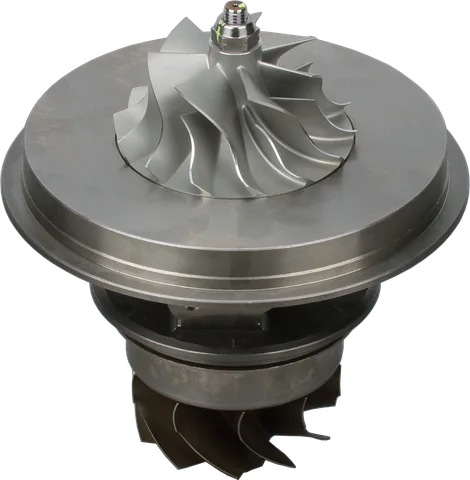
A CHRA/cartridge replaces the central rotating assembly while retaining suitable outer housings. Choose this route only when the exact cartridge is confirmed and the housings pass inspection for cracks, erosion, contact damage, and locating-surface condition. Confirm the cartridge's balancing specification.
A turbine housing can address an isolated housing fault if the rotating assembly remains serviceable. Match its geometry, flange, wheel clearance, and control provisions.
The family summary also includes journal bearings, compressor wheels, and turbine wheel/shaft components. These support specialist rebuilding, which requires dimensional inspection, correct component matching, and appropriate balancing after rotating components are replaced. Installing a bearing alone will not correct a scored shaft or damaged bearing bore.
Select the repair scope from inspection results, then verify the turbo data-plate number and applicable OE reference before ordering.
OM352 and OM366 diesel turbocharger installation priorities
- Remove the original cause. Correct lubrication faults, intake leaks, contamination, excessive crankcase pressure, and exhaust problems before fitting replacement parts.
- Clean the air path. Inspect intake plumbing and the intercooler where fitted for oil and fragments. Replace components that cannot be reliably cleaned. Account for missing blade material and assess possible engine ingestion.
- Inspect oil feed and drain lines. Check for deposits, restrictions, damage, and poor routing. Follow replacement guidance for suspect feed lines. Ensure the drain permits unobstructed return without kinks.
- Use new specified gaskets and seals. Keep debris and excess sealant out of oil passages. Support the turbo and exhaust pipework independently during assembly; do not pull misaligned flanges together with bolts.
- Prime before starting. Follow the turbo supplier's procedure using clean, specified engine oil. Where instructed, establish oil pressure with starting disabled according to the engine service procedure.
- Verify controls and operation. Complete electronic actuator calibration if applicable. After starting, inspect for oil, air, and exhaust leaks, then check operation under a controlled load using the relevant specifications.
Use the engine's specified warm-up and shutdown procedures, particularly after sustained heavy work.
Common Questions
Will any OM366 turbo fit an OM366 engine?
No. The catalog includes multiple turbo models and part numbers for this family. Match the turbo data-plate number and applicable OE part number, then verify housings, flanges, connections, and control hardware before ordering.
Are TO4B27 and TO4B81 turbos interchangeable?
Do not assume so. Both appear in our catalog, but a shared TO4B designation does not establish interchangeability. The complete assembly number and physical specification must match the installation.
Does oil in the intake mean the turbo has failed?
Not necessarily. Oil can come from crankcase ventilation, restricted turbo drainage, excessive crankcase pressure, or internal turbo damage. Check the amount, oil consumption, breather system, drain, and rotating assembly before deciding.
Can I replace only the CHRA?
Yes, when the exact cartridge is confirmed and the reusable housings meet inspection requirements. Cracks, wheel contact, damaged locating surfaces, or faulty control hardware can make a complete turbo the better choice.
Is some turbo shaft play normal?
An unpressurized journal-bearing turbo can have perceptible radial movement. Acceptability depends on measured clearances and the manufacturer's limits. Wheel contact, binding, or excessive axial movement requires investigation; a finger check alone cannot establish serviceability.
Can this guide identify an OM904 turbo replacement?
No. The LeadTurbo catalog contains no OM904 application entries. An OM904 turbo requires its own data-plate and OE part-number verification; these examples do not establish compatibility.
Why is my OM366 turbocharger whistling?
A new whistle can come from a pressurized-air leak or an exhaust leak, so it does not automatically mean damaged bearings. With the engine stopped and cool, check charge-air hoses, clamps, and the intercooler where fitted, and look for soot around exhaust manifold joints and the turbine inlet. Noise alone cannot reliably identify the fault.
Send the turbo data-plate number, OE part number, engine identification, and clear photos to LeadTurbo to confirm OM352 or OM366 turbo fitment.