For a pickup towing a trailer or an engine running a pump all day, boost pressure alone tells little about fuel use or durability. The compressor drive and the complete air system matter.
Two ways to power the compressor
A mechanical supercharger is an air compressor driven by the engine's crankshaft through a belt, gears, or another mechanical transmission. Roots, screw, and centrifugal units all fit this definition.
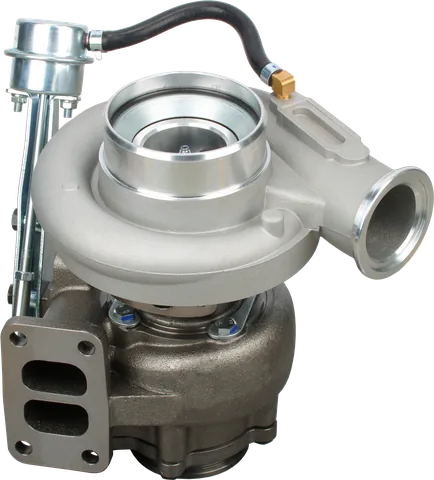
A turbocharger uses an exhaust turbine to drive its compressor on a shared shaft. Its speed responds to exhaust conditions and control settings rather than following a fixed ratio to crankshaft speed.
Both can increase the air mass available to the cylinders. Additional usable torque still depends on appropriate fueling, charge-air temperature, and the engine's limits.
| Feature | Mechanical supercharger | Turbocharger |
|---|---|---|
| Power source | Crankshaft | Exhaust turbine |
| Low-speed response | Prompt airflow from Roots or screw designs | Depends on exhaust energy and turbo matching |
| Main engine-side cost | Direct compressor drive load | Exhaust backpressure and associated pumping work |
| Control hardware | Drive ratio, bypass, and sometimes a clutch | Wastegate, variable geometry, or other system controls |
| Common diesel role | Scavenging or specialized boost assistance | Primary boost on modern four-stroke engines |
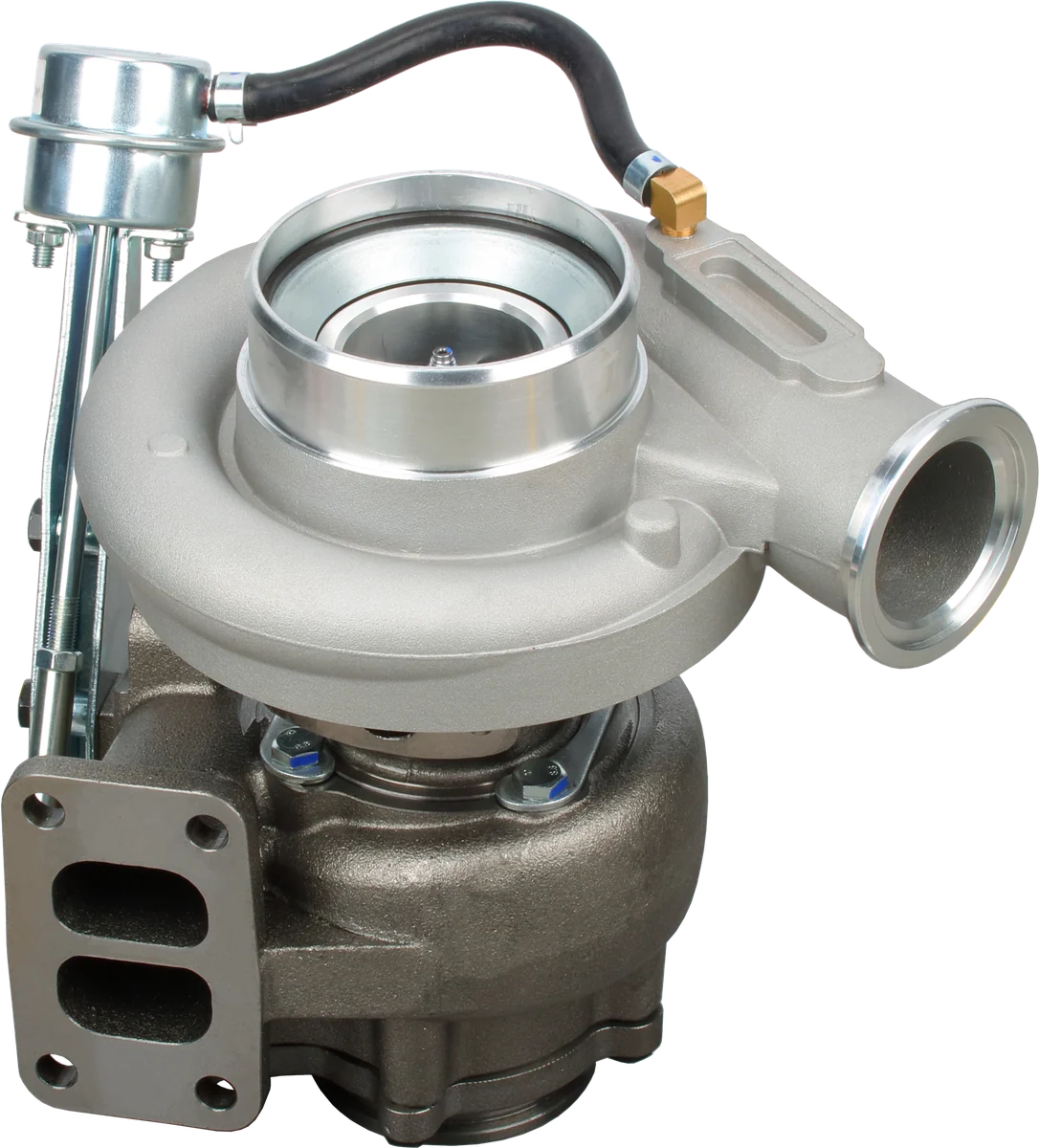
Compressor housing: guides the compressed air.
Turbine housing: guides exhaust gas to the turbine.
Actuator: check its type, linkage and calibration.
Product photograph from 2026. Numbers identify the features explained below.
Mechanical superchargers do not all behave the same
The compressor type matters as much as its power source. A crank-driven centrifugal unit does not deliver the same low-speed behavior as a positive-displacement blower.
| Type | How it moves or compresses air | Practical implication |
|---|---|---|
| Roots | A conventional design carries pockets of air to the outlet without significant internal compression | Strong low-speed delivery; discharge heating becomes a major constraint at higher pressure ratios |
| Screw | Compresses trapped air internally as spaces between the rotors shrink | Broad low-speed delivery; efficiency depends on matching the design to its operating pressure ratio |
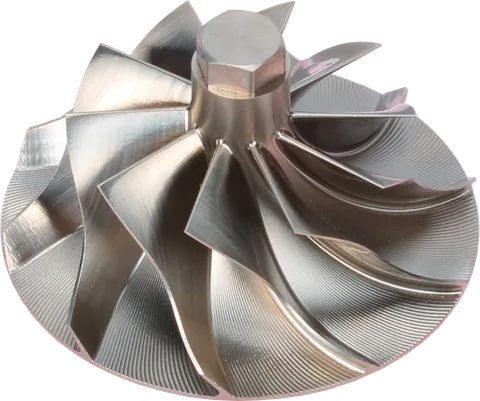
| Centrifugal | Uses a high-speed impeller and diffuser | Pressure generally builds more strongly with speed, so low-speed assistance may be limited |
For positive-displacement blowers, delivered volume broadly follows drive speed, but leakage and the engine's airflow demand affect actual boost. A fixed pulley ratio does not guarantee a fixed manifold pressure.
Supercharger vs turbocharger fuel efficiency
Compressing air takes power in either system. A mechanical supercharger draws that power directly from the crankshaft, leaving less shaft output available for propulsion or equipment. Higher airflow and pressure ratio generally increase the required drive power.
A turbo recovers part of the energy in exhaust that would otherwise leave the engine. However, its turbine needs a pressure drop to work. Higher pressure upstream can increase the work the engine does pushing exhaust out.
Mechanical drive does not itself add a turbine restriction to the exhaust, but its crankshaft demand remains. Neither arrangement should be judged from boost pressure alone.
At comparable useful output under sustained diesel loads, a well-matched turbo usually offers the better efficiency balance. Actual fuel consumption still depends on compressor efficiency, exhaust restriction, charge cooling, engine calibration, and the operating point.
Response and low-speed boost
A Roots or screw blower moves air as soon as the engine turns it. This can support prompt torque response when exhaust energy is limited. It still needs adequate drive speed, and pressure buildup depends on the bypass position and the volume of the intake system.
A centrifugal supercharger generally develops pressure more strongly as its speed rises. Calling every mechanically driven compressor an instant low-rpm boost solution therefore misses an important distinction.
Turbo response depends on turbine sizing, rotor inertia, exhaust conditions, and controls. Appropriate variable geometry or staged hardware can improve low-speed behavior, although acceleration from light load still requires the air system to respond.
For a machine working near governed speed, transient response may matter less than efficiency over hours of operation. A pickup repeatedly accelerating from low rpm places more emphasis on how boost builds during each load change.
What limits boost from a crank-driven blower?
There is no universal boost ceiling for mechanical superchargers. A claimed maximum pressure means little without the blower model, speed, airflow, inlet conditions, and cooling arrangement.
Raising the drive ratio can increase airflow, but it also increases demands on the compressor and drive. Check these limits together:
- Rated rotor or impeller speed across the full engine speed range.
- Belt capacity, gear loads, bearing loads, and required drive torque.
- Compressor discharge temperature and available charge-air cooling.
- Engine cylinder-pressure limits and the approved fuel calibration.
A blower may be capable of making more pressure while using too much power or producing excessively hot air. The useful limit is the complete system's operating envelope.
Use absolute inlet and outlet pressures when checking a compressor's rated pressure ratio, especially at altitude. Gauge boost by itself does not describe how hard the compressor is working.
Why two-stroke diesels use blowers
On many smaller high-speed two-stroke diesels, such as classic truck, bus and marine engines, a crank-driven Roots blower performs essential scavenging work. Large low-speed marine two-strokes are different: the turbocharger supplies the scavenge air in normal running, and electrically driven auxiliary blowers cut in only for starting and low load. There is no separate intake stroke; fresh air must flow through the cylinder while the intake ports and exhaust outlets are open, clearing exhaust and leaving air for combustion.
A Roots blower can provide that pressure difference during starting and low-speed operation. Its presence does not automatically mean the engine is configured for unusually high boost.
Some engines combine a blower with a turbocharger. The turbo contributes compressed air under load, while the blower supports the airflow required elsewhere in the operating range. Bypass arrangements vary, so replacement decisions must follow the engine's designed scavenging system.
Twincharging: combining mechanical and exhaust drive
Twincharging uses a mechanical supercharger and turbocharger together. The purpose is often to cover low-speed air demand while retaining exhaust-driven compression at higher load.
In series, the same air passes through both compressors. The second stage receives already compressed air, so stage pressure ratios multiply (for example, 2.0 × 1.5 = 3.0 overall); the two gauge-boost readings cannot simply be added. Stage order, cooling, and bypass routing determine the actual result.
In parallel, separate compressor branches feed a common intake. Their discharge pressures and controls must be compatible, with valves or other provisions preventing unwanted reverse flow through a branch. This arrangement combines airflow at a common delivery pressure.
A bypass and, where fitted, a clutch can reduce unnecessary blower work once turbo airflow is sufficient. The benefit comes with added valves, plumbing, drive hardware, and calibration. Two turbochargers alone form a different arrangement; they do not constitute mechanical twincharging.
Where an electric supercharger fits
An electric supercharger uses a motor to drive a separate compressor. An electrically assisted turbo instead applies motor assistance to the turbo shaft. Both can help supply air when exhaust energy is insufficient.
The electrical power still has to come from somewhere: stored battery energy, a charging system, or recovered energy. Motor cooling, wiring, power electronics, and duty-cycle limits matter as much as the compressor itself. Charging and conversion losses belong in the fuel-use comparison.
Many such systems are intended to assist during transitions. Sustained boost requires a sustained electrical supply. Treat electric boosting as an integrated engine system when comparing options.
Why modern diesels overwhelmingly use turbochargers
For loaded trucks, equipment, marine engines, and generator sets, exhaust energy is a useful compressor power source. Turbocharging supports high torque and power density without requiring the entire compressor load to pass through a crank-driven belt or gearbox.
Charge-air cooling, suitable turbine sizing, and boost controls help make the arrangement practical across the required operating range. Factory systems also coordinate airflow with fueling, emissions controls, and engine protection.
For fleet and shop buyers, established replacement parts and service procedures strengthen the case for keeping the original turbo arrangement. A custom supercharger conversion must justify its additional engineering and service requirements.
Buying and maintaining the system
A supercharger vs turbocharger decision starts with the engine's existing air system and its duty cycle. Replacing failed hardware and developing a new induction package involve very different work.
Compare the service burden before choosing:
| System | Maintenance focus |
|---|---|
| Mechanical blower | Drive condition, alignment, specified lubrication, and bypass or clutch operation |
| Turbocharger | Oil supply and drainage, intake integrity, exhaust joints, and boost-control operation |
| Twincharged system | Both compressors plus interstage plumbing, control valves, sensors, and coordinated transitions |
| Electric boosting | Electrical connections, required cooling, fault diagnosis, and manufacturer service procedures |
All systems need effective air filtration and sound charge-air plumbing. Some blowers have dedicated lubricant; others use the engine's lubrication system. Check the unit's requirements rather than assuming its service matches a turbocharger's.
A bypass fault can change boost delivery without any damage inside either compressor. On combined systems, a control or transition problem can therefore look like a failed turbo. Diagnosis should identify which component is responsible before replacement.
For a working engine, identify the installed components and confirm the original configuration before ordering. Adding a blower can introduce mounting, drive, cooling, and control requirements that a replacement turbo purchase does not address.
Common Questions
Can a diesel run with a mechanical supercharger?
Yes, if its air system, drive, cooling, and fueling are engineered for it. Installing one on an existing turbo diesel requires substantial integration work.
How does a turbocharger get power?
Its compressor takes power from the exhaust turbine. Creating that turbine pressure drop can increase exhaust backpressure and pumping work, so turbocharging still has an energy cost.
Is there a maximum boost for a crank-driven blower?
There is no universal pressure limit. The usable range depends on blower speed, airflow, efficiency, outlet temperature, drive capacity, and the engine's approved operating limits.
Does a two-stroke diesel blower only add power?
On many designs, its primary job is scavenging: supplying air that clears exhaust and refills the cylinders. That essential airflow function can coexist with turbocharging.
Can an electric supercharger replace a turbo?
Only if it is sized and powered for the full required airflow and duty cycle. Many electric boosters are designed for temporary assistance during low-speed operation.
Who wins the supercharger vs turbocharger comparison for work diesels?
For most four-stroke work diesels, the factory turbo arrangement is the practical choice. Mechanical blowers remain relevant where the engine design or a specialized response requirement calls for them.
Can a bypass fault mimic turbocharger failure?
Yes. On systems that combine a supercharger and turbocharger, a bypass fault can change boost delivery without damage inside either compressor. Check bypass operation and system controls, and identify the component causing the problem before replacing the turbocharger.
Can a supercharger replace a turbocharger?
Yes, but a mechanical supercharger conversion requires substantial integration work. The air system, drive, cooling, and fueling must be engineered for it, with mounting and control requirements also addressed. Confirm the original engine configuration before choosing parts. For most four-stroke work diesels, the factory turbo remains the practical choice.
For help sourcing a replacement turbocharger or turbo parts, contact LeadTurbo with the turbo part number, engine details, and application.