Start with the cooling circuit
A replacement must suit the engine’s cooling arrangement, not just fit between two hoses. “Water-to-air” covers two very different systems: one uses hot engine coolant; the other uses a separate, cooler liquid supply. That distinction often matters more than the air-versus-water label.
An air-to-air charge air cooler sends compressed air through a core exposed to outside air. Vehicle motion supplies ram air, while the fan provides airflow when road speed is low. This arrangement is typical on on-highway diesel trucks. Performance depends on the grille, ducting, fan operation, and cleanliness of the cooling stack.
A jacket water aftercooler uses the engine’s own cooling circuit. Sharing the pump, coolant, and heat rejection system simplifies installation, but warm jacket water limits how cool the intake air can become. At light load, coolant can even warm charge air that enters below coolant temperature. This can be intentional in the engine design.
A separate low-temperature circuit keeps charge-air cooling apart from hot jacket water. It offers the strongest cooling potential of the two liquid-cooled arrangements when properly sized for sustained load. These systems are common in marine and stationary applications, typically with a dedicated pump and a separate means of rejecting heat.
On marine engines, the low-temperature loop may reject heat through a seawater heat exchanger. Other designs pass raw water through the charge cooler itself. Confirm the actual plumbing and water exposure before selecting parts.
| Cooling method | Typical application | Main advantages | Main limitations |
|---|---|---|---|
| Air-to-air | Highway trucks | No liquid circuit at the charge cooler; straightforward plumbing | Depends on ambient air and fan airflow; needs exposed core area |
| Jacket-water-cooled | Engines designed around shared coolant | Fewer separate cooling components | Hot engine coolant limits charge-air cooling |
| Separate low-temperature water circuit | Marine, stationary, and selected equipment installations | Strong cooling potential; flexible cooler location | Additional pumps, plumbing, heat exchangers, and liquid-leak risks |
A dedicated water circuit is not automatically colder than an air-to-air system. Its advantage depends on coolant inlet temperature and the capacity to carry heat away continuously.
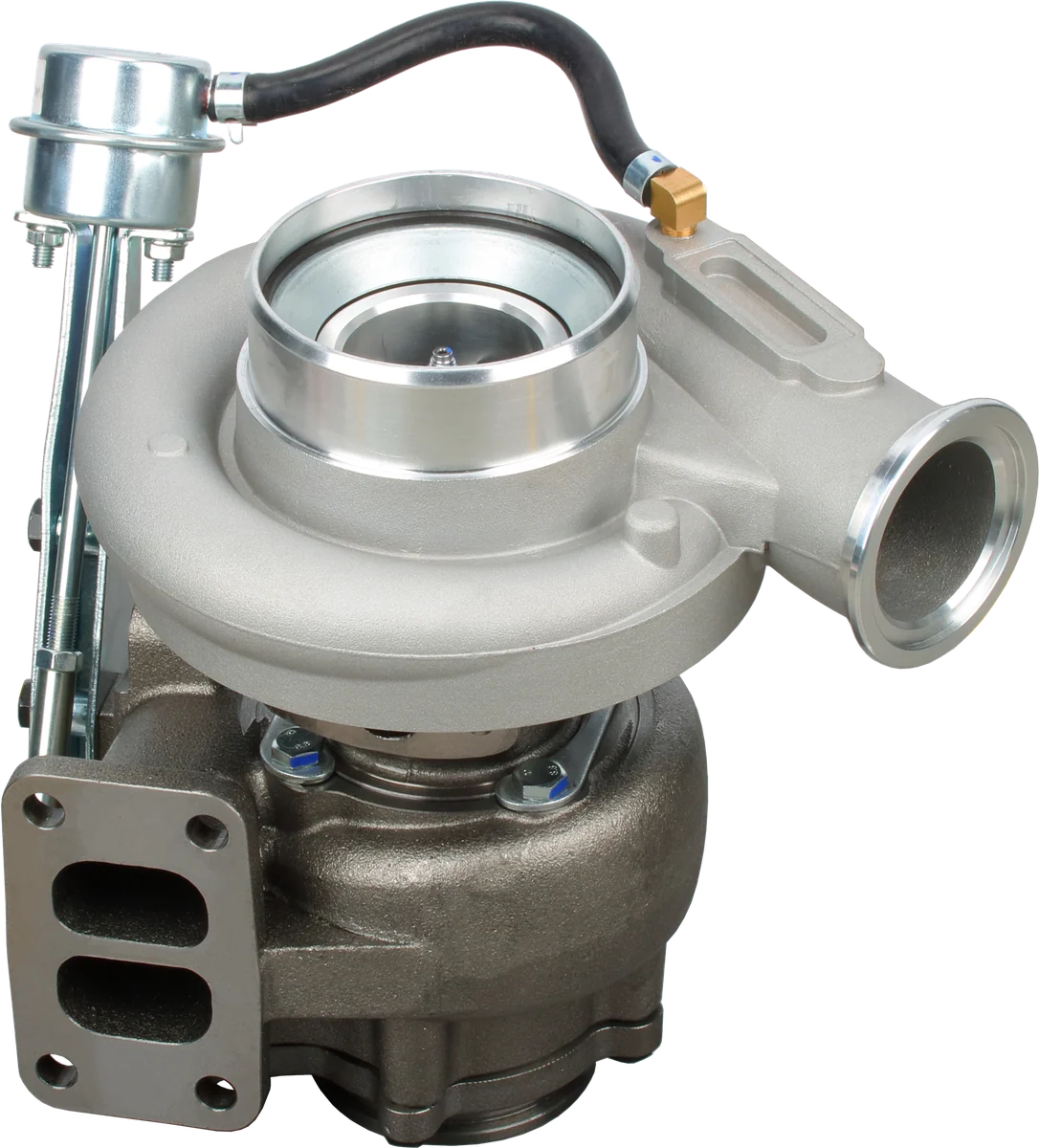
Compressor housing: guides the compressed air.
Turbine housing: guides exhaust gas to the turbine.
Actuator: check its type, linkage and calibration.
Product photograph from 2026. Numbers identify the features explained below.
Core construction: compare more than the label
Cooling medium and intercooler core design are separate choices. Tube-and-fin and plate-based constructions can appear in different applications, and catalog names alone do not establish strength, cooling performance, or restriction.
| Core construction | Basic arrangement | Practical considerations |
|---|---|---|
| Tube-and-fin air core | Charge air flows through tubes connected to external fins | Often relatively light; tube, header, and fin design determine durability and airflow |
| Plate-fin / bar-and-plate core | Stacked plates and fins form enclosed passages | Large heat-transfer area in a compact package; weight and airflow resistance vary with passage and fin design |
| Finned-tube liquid core | Charge air passes over finned tubes carrying water or coolant | Tube materials, end seals, corrosion resistance, and cleaning access matter |
Fins add surface area, but the spaces between them still need to pass air. Tighter passages and more aggressive internal fins can improve heat transfer while increasing resistance. Dense external fins can also trap chaff, dust, or road debris.
For a loader or tractor, cleaning access and debris tolerance may matter more than fitting the densest core into the available space. For a liquid-cooled unit, confirm that its materials and seals suit the specified coolant or raw-water exposure. A heavier bar-and-plate unit is not automatically a better replacement.
Balance cooling effectiveness against pressure drop
Cooling effectiveness describes how much of the available temperature difference a cooler can use. A large temperature drop alone does not prove a better design: hotter incoming charge air creates more opportunity for cooling.
A useful air-to-air vs water-to-air turbocharger intercooler comparison holds engine load and operating conditions constant. Ask for charge-air inlet and outlet temperatures, cooling-air or coolant inlet temperature, and the relevant air and liquid flow rates.
Turbocharger intercooler pressure drop is the pressure lost as charge air crosses the cooler. A restrictive core leaves less pressure available at the intake manifold for a given compressor outlet pressure. If the control system compensates, the turbocharger may have to work harder to deliver the requested manifold pressure.
Neither the coldest outlet temperature nor the smallest pressure drop wins by itself. The replacement must satisfy both requirements at the engine’s actual airflow. Compare supplier results at equivalent flow and inlet conditions, and distinguish core-only measurements from readings that include hoses and piping.
For continuous operation, the whole cooling system matters. A water reservoir can absorb heat briefly, but it cannot replace sufficient radiator or heat-exchanger capacity. A short demonstration does not establish performance during a long climb or a fully loaded generator run.
Failures that change the replacement decision
A leaking core and a restricted core can both hurt engine performance, but they require different decisions. Inspect the entire cooler assembly and its operating environment before ordering another unit.
| Failure | Practical clues | What to address |
|---|---|---|
| Cracked tubes, headers, or end tanks | Boost leakage, oily tracks, or movement at joints | Check mounts, vibration, hose loading, and thermal stress |
| Leaking boots, clamps, or seals | Leakage around connections | Confirm whether the core itself is sound before replacing it |
| Internal oil fouling | Oily deposits, reduced heat transfer, possible restriction | Investigate oil entry; use only approved cleaning procedures |
| External clogging or bent fins | Packed debris, damaged airflow passages | Restore airflow and check cleaning access |
| Internal water-side leak | Unexplained coolant loss or liquid on the air side | Prevent restart until water entry and the leak are resolved |
Water leaking into the intake is dangerous. Enough liquid reaching a cylinder can cause hydrolock and major engine damage. Leakage direction depends on the pressure difference and may change between running and shutdown. Boost pressure does not make a leaking water-cooled core safe.
If liquid ingestion is suspected, stop the engine and do not crank or restart it until the intake and cylinders have been assessed. Coolant loss alone is not proof of a failed cooler; confirm the leak location using the manufacturer’s test procedure.
After compressor-wheel damage, trapped metal is another concern. Follow the engine manufacturer’s cooler replacement or cleaning guidance; do not reuse a core whose internal cleanliness cannot be verified.
How to choose a replacement turbocharger intercooler
Use the original cooler specification as the starting point. Similar dimensions or a matching hose diameter do not establish equivalence.
- Correct identification: Match the cooler part number, engine rating, and equipment configuration. An engine family may use several cooling arrangements, and the turbocharger part number alone does not identify the cooler.
- Physical fit: Check mounting points, core dimensions, tank clearance, connection orientation, sensor bosses, drains, and sealing surfaces. Hoses should fit without pulling the tanks or preloading the mounts.
- Thermal performance: Request suitability for the actual duty cycle and cooling-medium inlet temperature. Peak-power advertising does not establish sustained cooling capacity.
- Air-side restriction and ratings: Verify pressure drop at the required airflow, plus allowable pressure, temperature, and leakage limits. Use the manufacturer’s acceptance criteria instead of a universal test value.
- Liquid-side compatibility: Confirm water-side pressure rating, port sizes, flow direction, required coolant flow, and compatibility with the existing pump and temperature controls.
- Materials and service parts: Verify coolant or seawater compatibility, corrosion provisions, gasket specifications, and access for inspection or cleaning. A similar-looking marine core may use unsuitable materials.
- Installation condition: Address damaged mounts, blocked airflow, coolant contamination, and remaining intake debris before installation. Replace seals and other service items as specified.
A thicker replacement can also reduce airflow through the radiator behind it. Check clearance and cooling-stack compatibility, not just whether the new cooler fits the brackets.
Which system should you choose?
For diesel truck intercooler replacement in highway service, a correctly specified air-to-air unit usually preserves the simplest service arrangement. Check that the fan and cooling stack can support the engine under slow, heavy pulling as well as highway operation.
For marine or stationary equipment, identify whether the cooler uses jacket water, a dedicated low-temperature loop, or raw water. Retain the engine’s intended coolant temperatures and flow control. Switching systems changes the heat-rejection package and requires engineering validation, even when the new cooler fits.
Common Questions
Is water-to-air always better than air-to-air?
No. Performance depends on cooling air or water temperature, flow, and heat-rejection capacity. A properly sized air-to-air system can outperform a liquid system supplied with hot water or inadequate cooling.
Can engine coolant run through any water-to-air intercooler?
No. Confirm compatibility with the coolant chemistry, temperature, pressure, and flow. A cooler designed for a low-temperature loop may provide inadequate cooling when supplied with hot jacket water.
Can I replace air-to-air with water-to-air?
A conversion needs an engineered liquid circuit, pump, heat exchanger, controls, and performance validation. Use a package approved for the engine and its duty cycle instead of selecting components by size alone.
Does bar-and-plate always mean lower pressure drop?
No. Passage dimensions, fins, flow distribution, and core size determine restriction. Compare measured pressure drop at equivalent charge-air flow and inlet conditions, not construction labels alone.
Does intercooler oil mean turbocharger failure?
No. A light oil film can come from crankcase ventilation. Pooling oil needs investigation before reuse. Establish the cause separately instead of replacing the turbocharger based only on an oily connection.
What decides the choice for a replacement cooler?
Start with the original engine specification, then verify sustained cooling capacity, pressure drop, fit, fluid compatibility, and service access. Matching the old cooler's outside dimensions is insufficient.
Can a turbocharger intercooler leak coolant?
Yes. A water-cooled core can leak coolant into the charge-air side. If liquid ingestion is suspected, stop the engine and do not crank or restart it until the intake and cylinders have been assessed.
Contact LeadTurbo with your part number, engine details, and cooling-system type to discuss your replacement needs.