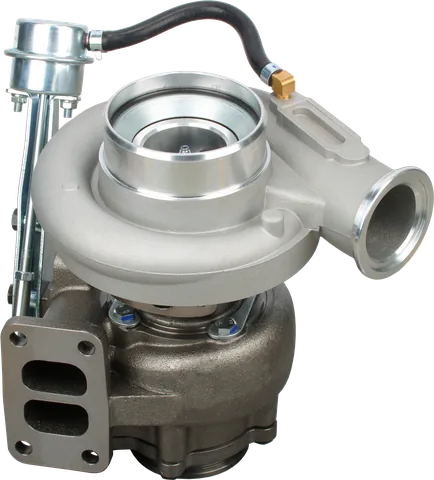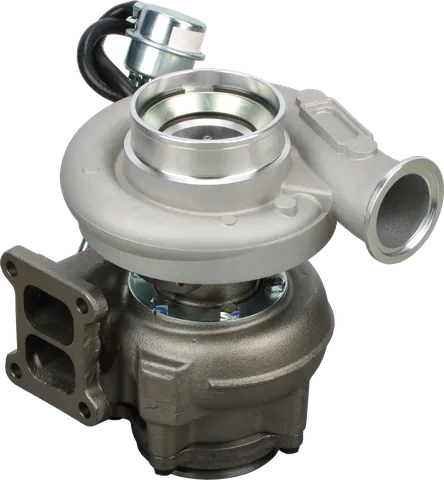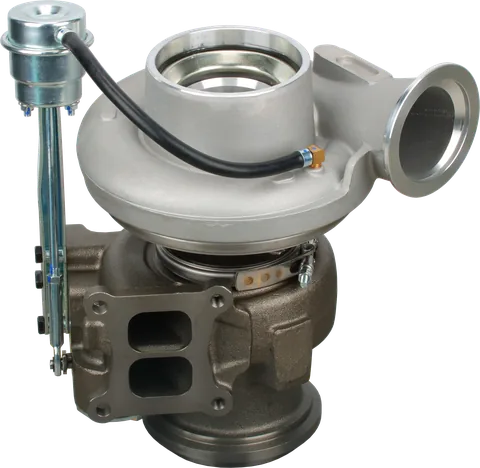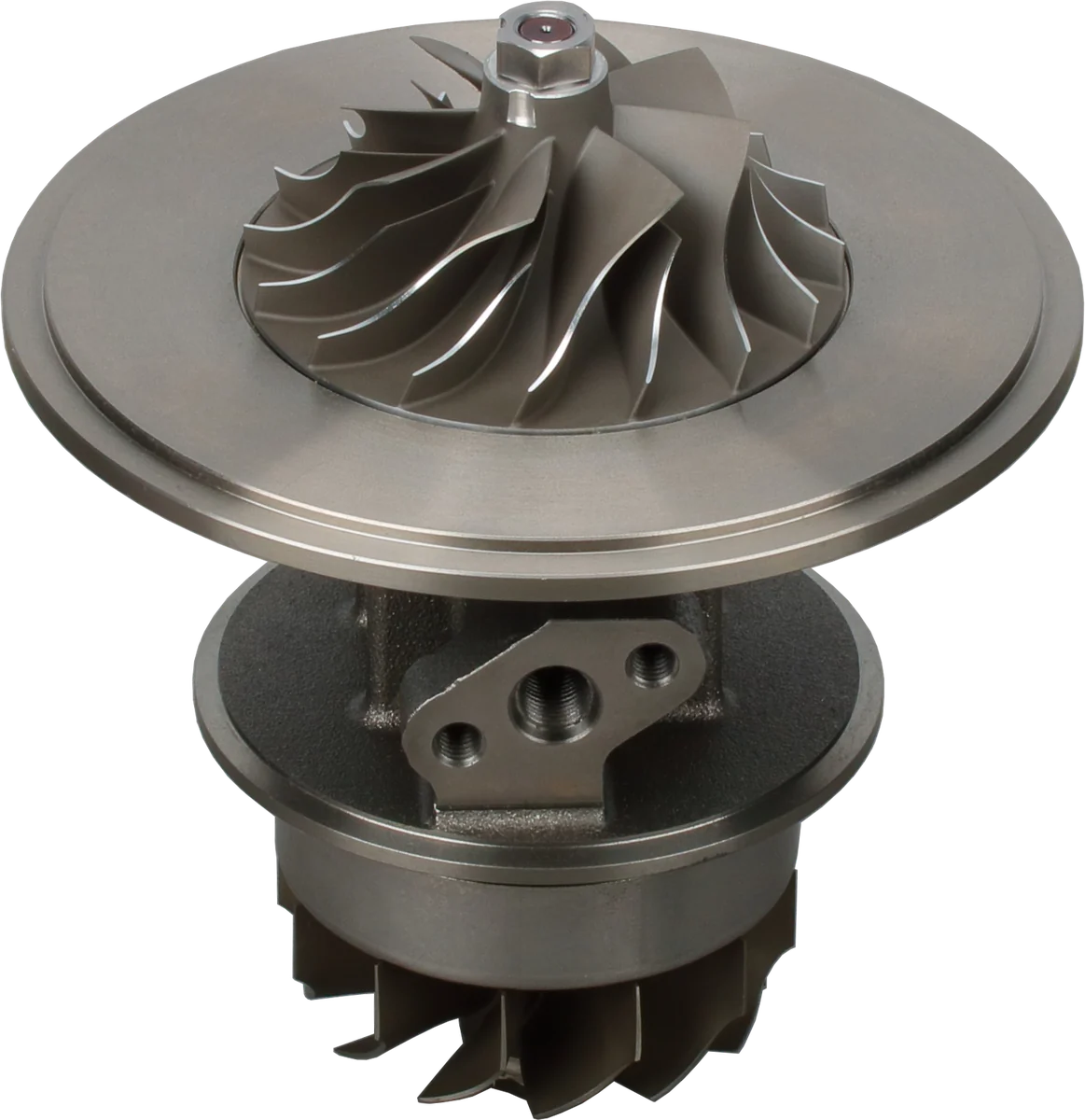
A DT466 turbo problem can show up as weak pulling power, increased smoke, rising oil consumption, or an unfamiliar whistle. Those symptoms deserve attention, but they do not automatically mean the turbocharger itself has failed. Split charge-air plumbing, restricted lubrication, and engine problems can produce similar complaints—or damage a replacement turbo.
For an International DT466, turbocharger diagnosis and identification belong together. Confirm the cause of the complaint, then match the installed turbo’s data-plate number and OE part number before ordering.
The engine family and why turbo condition matters
The DT466 is a roughly 7.6-liter inline-six diesel associated with medium-duty trucks, school buses, and agricultural equipment. Related engines and application designations appear throughout our catalog, but shared naming does not establish turbo interchangeability.
The turbocharger uses exhaust energy to drive a compressor, increasing the air available for combustion. On a hard-working diesel, inadequate airflow can reduce pulling power and contribute to black smoke when fuel delivery exceeds the available air.
Turbocharger bearings also depend on clean oil and dependable lubrication. A replacement installed without correcting an oil supply problem, contaminated intake, or restricted drain can suffer the same damage as the original.
Identify the DT466 turbo before choosing a replacement
Look for an identification plate or stamped identification area, commonly on the compressor housing. Location varies, and installed plumbing can obscure it. Clean gently and photograph the complete markings before removal. Casting numbers may identify a housing rather than the complete assembly.
Record the turbo assembly number, model designation, serial number if present, and any OE reference. Include engine identification and photographs of the inlet, outlet, mounting flange, oil connections, and actuator if fitted.
The turbo model describes a design family; the assembly or OE part number helps identify a particular configuration. A model name alone is not enough to determine which turbocharger fits a DT466.
For example, someone searching for a “T04B turbo” should preserve the exact characters on the tag: this catalog uses TO4B25 and TO4B18. Do not silently substitute the letter O and the numeral 0 when requesting fitment confirmation.
Likewise, “DT466E turbo” is useful search language, but it does not establish a specific assembly or control system. Confirm fitment individually when comparing DT466E turbocharger replacement options.
Why apparently similar turbos can differ
Matching requires more than checking whether the mounting bolts line up:
- Housing A/R: The housing’s area-to-radius ratio affects flow behavior and response. Similar castings can have different specifications.
- Control arrangement: A wastegate bypasses exhaust around the turbine. A free-floating turbo has no wastegate or variable-geometry mechanism. VGT changes the turbine’s effective flow geometry. These are different configurations, not interchangeable features.
- Compressor and turbine trim: Wheel dimensions and profiles affect airflow and must match their housings.
- Connections: Confirm oil inlet and drain details, plus coolant connections if fitted. Do not assume every unit is water-cooled.
- Flanges and orientation: Verify the exhaust mounting pattern, outlet connection, compressor connections, and housing orientation.
The catalog titles do not establish the control arrangement, A/R, or cooling configuration of every entry. Verify those details against the installed unit.
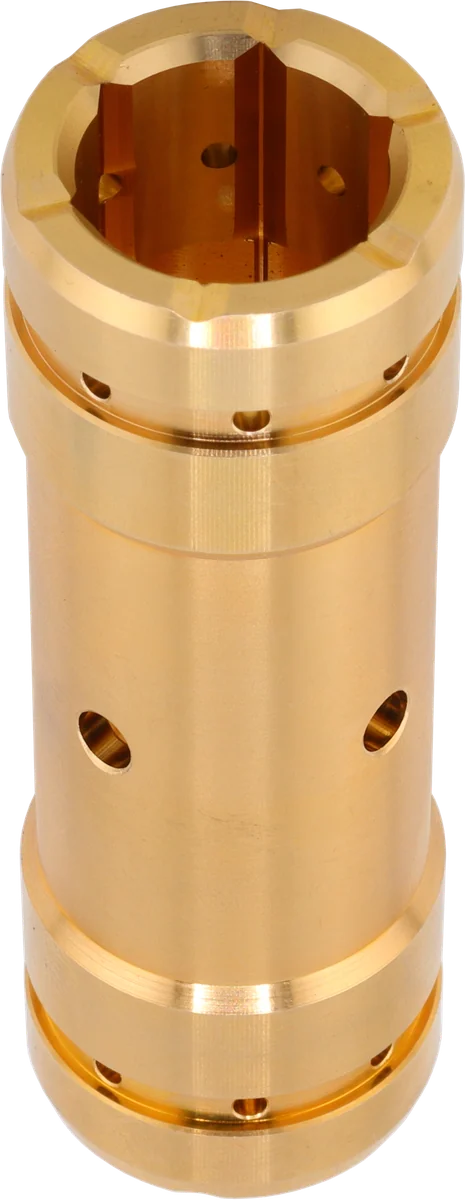
Bearing bore: the inner oil film supports the shaft.
Oil passages: keep the lubrication path clear.
Outer bearing surface: inspect the fit and condition.
Product photograph from 2026. Numbers identify the features explained below.
Representative catalog examples: verify against the data plate
These are examples from LeadTurbo’s catalog, not a universal interchange list. Related DTA466 and DTA360 entries do not establish DT466 fitment. The listed products are aftermarket replacements; these descriptions do not imply OEM affiliation.
| Part number | Turbo model | Product type | Application |
|---|---|---|---|
| 179079 | GT37 | Complete turbocharger | Navistar DT466 |
| 1806078C91 | TO4B25 | Complete turbocharger | Navistar DT466 |
| 1808749C91 | TO4E13 | Complete turbocharger | Navistar DTA466 Replacement |
| 1819904C91 | T04E17 | Complete turbocharger | Navistar DTA360 |
| 466741 0048 T | GT4082 | Complete turbocharger | Navistar DT466P |
| 1830735C92 | GT37 | Complete turbocharger | Navistar DT466 |
| 409570 5016 | TO4B18 | Complete turbocharger | Navistar DT436 DT466 |
| 409770 0020 | TO4B25 | Complete turbocharger | Navistar DT466 |
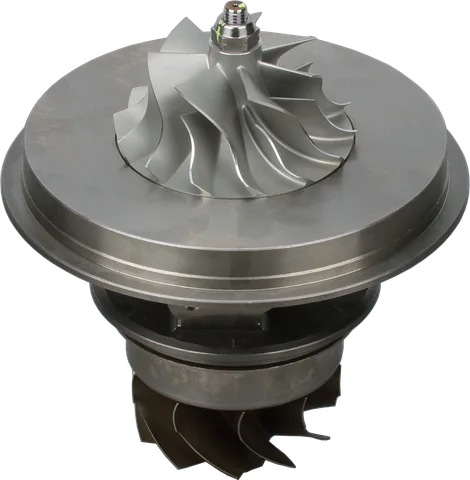
| 408105 0278 | TO4E13 | CHRA/cartridge | Navistar DTA466 |
| 408105 0215 | TO4B25 | CHRA/cartridge | Navistar DT466 |
| 449998 0003 | GT37 | Turbine housing | Navistar DT466 |
| 432183 0002 | TO4B18 | Turbine housing | Navistar DT466 |
| 446905 0005 | TO4B25 | Turbine wheel/shaft | Navistar DT466 |
| 408274 0224 | TO4B25 | Compressor housing | Navistar DT466 TO4B25 Turbocharger |
Is my DT466 turbocharger failing? Symptoms and causes
Boost loss and weak pulling power
Start with the air filter, intake ducting, charge-air boots, clamps, and intercooler if equipped. A leak downstream of the compressor releases air before it reaches the engine. An exhaust leak upstream of the turbine reduces the energy available to drive it.
Also check exhaust restriction and engine fueling or control faults. Where fitted, a wastegate stuck open or a malfunctioning variable-geometry mechanism can reduce boost. Test the system using the applicable service procedure before condemning the rotating assembly.
Black, blue, or white smoke
Black smoke can indicate insufficient air for the injected fuel. Intake restriction, charge-air leaks, turbo damage, and fueling faults are possible causes.
Blue smoke suggests oil burning, but the oil may come from the engine, crankcase ventilation, or turbocharger. White smoke can involve unburned fuel or coolant and is not a reliable turbo diagnosis by itself.
Compare smoke with oil consumption, operating conditions, and other symptoms. Color alone cannot identify the failed component.
Oil leaks and oil in charge-air plumbing
Distinguish external leakage at fittings from oil entering the compressor or turbine housing. Turbo oil control depends partly on pressure balance and unrestricted drainage; oil leakage does not always mean a damaged sealing component.
A restricted drain or excessive crankcase pressure can prevent oil from leaving the bearing housing properly. Breather carryover can also introduce oil into the intake, depending on the ventilation arrangement.
A light film does not prove failure. Pooled oil, increasing consumption, or heavy smoke requires investigation. Do not restart an engine with substantial accumulated intake oil until the cause and ingestion risk are addressed.
Whine, whistle, and scraping
Airflow and rotating blades naturally generate sound. A newly loud whistle may come from a loose boot or leaking exhaust joint.
A siren-like whine can accompany rotor imbalance or bearing damage, while scraping suggests possible wheel contact. Foreign-object damage can change wheel balance and rapidly worsen vibration. Noise alone cannot distinguish these conditions; inspect the plumbing and rotating assembly.
Shaft play and wheel damage
With the engine stopped and cool, inspect accessible blades for chips, bent edges, and housing rub marks. Some radial movement can exist in an unpressurized journal-bearing turbo because its supporting oil film is absent.
Use the correct measurement procedure and limits. Wheel contact, binding, or excessive axial clearance is concerning. Do not spin the rotor with compressed air.
Cracked turbine housing or actuator faults
Repeated thermal cycling and excessive heat can contribute to housing cracking. Crack location and extent matter: leakage, loose material, distortion, and affected mounting surfaces require professional evaluation.
Where an actuator is fitted, inspect its hoses, wiring, connectors, linkage, and movement as applicable. A control fault does not automatically require replacement of the entire turbo. The catalog does not identify actuator equipment for every listed assembly.
Find the root cause before replacing parts
Oil starvation weakens the film separating the shaft and bearings. Contaminated oil introduces abrasive particles, while degraded oil and deposits can restrict lubrication or drainage.
Before a DT466 turbo replacement, check oil condition, service history, engine oil pressure, the turbo feed line, and the return path. Investigate fuel or coolant contamination rather than relying on an oil change alone.
Inspect the crankcase ventilation system and measure crankcase pressure when symptoms justify it. Excessive blow-by can impair turbo oil drainage. Check air filtration and intake integrity for the source of any compressor damage, and investigate upstream engine debris if the turbine is damaged.
Correct these faults before installing replacement parts.
DT466 turbocharger vs CHRA replacement: choosing the right scope
Complete turbocharger: Often the practical choice when several components are damaged, housing condition is uncertain, or rebuilding would require extensive specialist work. Verify what the assembly includes and match all identification and connection details.
CHRA/cartridge: Replaces the central bearing and rotating assembly while retaining serviceable external housings. It can suit internal damage when the housings are clean, dimensionally sound, and correctly matched. Confirm balancing and assembly specifications with the supplier.
Individual housings: A replacement compressor or turbine housing may be appropriate for isolated housing damage. Wheel clearance, profile, A/R, flanges, and orientation must match. Inspect for hidden rotor damage before reusing the center assembly.
Turbine wheel/shaft: This is a specialist rebuilding option. Replacing a rotating component requires inspection, correct assembly, and appropriate balancing; transferring marks from the old parts does not establish acceptable balance.
Choose by the condition of the complete assembly and the available repair expertise, not simply by which component appears damaged.
DT466 turbocharger installation checklist for heavy-duty diesel service
Follow the engine and turbo supplier’s procedures for torque values, lubrication, and setup.
- Remove contamination. Clean the intake and charge-air system. After wheel failure, account for debris throughout the airflow path. Replace an intercooler or other component if trapped fragments cannot be reliably removed. Remove accumulated oil before startup.
- Use new specified gaskets and seals. Clean mating surfaces and inspect mounting hardware. Avoid excess sealant that could enter an oil passage.
- Inspect the oil feed and drain. Replace damaged or restricted lines. Ensure the return follows its intended route without kinks or obstruction.
- Check crankcase pressure. Correct ventilation restrictions or excessive blow-by that could interfere with oil drainage.
- Prime before starting. Introduce the specified clean oil into the turbo as directed. Use the approved engine procedure to establish lubrication before firing; do not improvise fuel-disable methods.
- Verify controls and alignment. Confirm actuator setup where fitted. Electronic systems may require calibration or a relearn procedure. Do not adjust rods or stops by guesswork.
- Inspect during commissioning. Check for leaks and abnormal noise at startup, then verify operation under controlled load. Support connected piping so it does not strain the housings.
Common Questions
Does every DT466 use the same turbocharger?
No. The catalog includes several turbo models and part numbers across DT466 and related applications. Match the installed turbo data-plate number and OE part number, then verify the housings, connections, and control arrangement.
Can I identify a DT466E turbo by the engine name alone?
No. DT466E identifies an engine application, not a complete turbo specification. Use the turbo identification numbers, engine information, and clear photos to confirm the correct replacement.
Does a whistling turbo always need replacement?
No. A charge-air leak or exhaust leak can whistle. A new siren-like sound, scraping, or noise accompanied by smoke and power loss warrants prompt inspection for wheel contact, bearing damage, and leaks.
Is some turbo shaft play normal?
Some radial movement can be normal in an unpressurized journal-bearing turbo. Acceptable clearance depends on the exact unit. Measure against its service specifications; wheel contact, binding, or excessive axial movement requires further evaluation.
When is a CHRA a reasonable replacement?
A correctly matched CHRA can be appropriate when the rotating assembly is damaged but both housings remain serviceable. Confirm wheel profiles, housing clearances, mounting details, and control compatibility before reusing the housings.
Will a new turbo fix oil in the intake?
Only if turbo damage is the actual cause. Restricted oil drainage, excessive crankcase pressure, and breather carryover can also contribute. Diagnose the source and remove accumulated oil before operating the engine.
How do I identify a DT466 turbocharger?
Find the identification plate or stamped area, commonly on the compressor housing, and record the assembly number, model designation, and any OE reference. Gently clean and photograph the complete markings. A model name alone does not confirm fitment, and casting numbers may identify only a housing, so verify the numbers before ordering.
Send the DT466 turbo data-plate number, OE part number, engine details, and photos to LeadTurbo to confirm fitment before ordering.